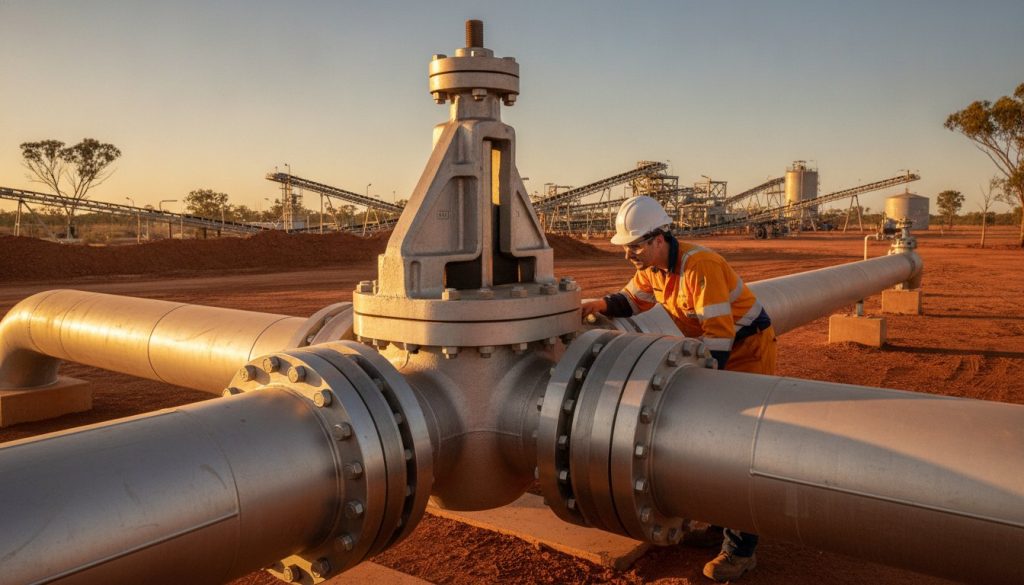
A single installation error, such as fitting a uni-directional valve backwards, often results in catastrophic bypass and immediate system failure during high-pressure backflush operations. In the demanding context of Australian mineral processing and tailings management, the margin for mechanical oversight is non-existent. You likely recognise that frequent valve failure from abrasive slurry erosion and the subsequent unplanned downtime in remote sites represent the most persistent challenges to operational integrity.
The implementation of bi-directional knife gate valves offers a definitive solution to these risks, providing zero-leakage isolation that remains effective regardless of flow orientation. This article details how these engineered components enhance reliability and eliminate the hazards associated with traditional uni-directional designs. We will examine the technical essentials of push-through elastomer sleeves, the impact of the AS 6401:2022 standard on procurement, and why SKG Insamcor technology is the preferred choice for achieving bubble-tight shutoff in severe service environments. By prioritising technical validation and precise design standards, operators can secure long-term stability in their fluid handling processes.
Key Takeaways
- Understand the mechanical design of bi-directional knife gate valves and how they facilitate secure isolation regardless of flow direction.
- Evaluate the engineering principles required to achieve bubble-tight shutoff and maintain gate alignment under high-velocity slurry conditions.
- Compare the maintenance requirements and total cost of ownership between bi-directional and uni-directional models to optimise plant uptime.
- Determine the critical selection criteria for Australian mining and water applications, focusing on slurry density and corrosion resistance.
- Explore the technical advantages of SKG Insamcor solutions for managing pressure spikes and abrasive media in severe service environments.
Understanding the Fundamental Design of Bi-Directional Knife Gate Valves
The engineering of bi-directional knife gate valves centres on the requirement for reliable isolation within systems where flow direction may fluctuate or reverse. Unlike standard valves that rely on line pressure to assist the seal on a single side, these components maintain integrity from both directions. The gate itself features a sharpened, bevelled edge designed to shear through thick slurries and suspended solids, ensuring the valve reaches its seat without obstruction. This capability is vital for modern process automation, where sensors and remote actuators require a valve that functions predictably regardless of transient pressure spikes or backflow.
Engineers must select the appropriate body configuration based on the specific installation requirements of the pipeline. The fundamental differences between wafer style and lugged body configurations include:
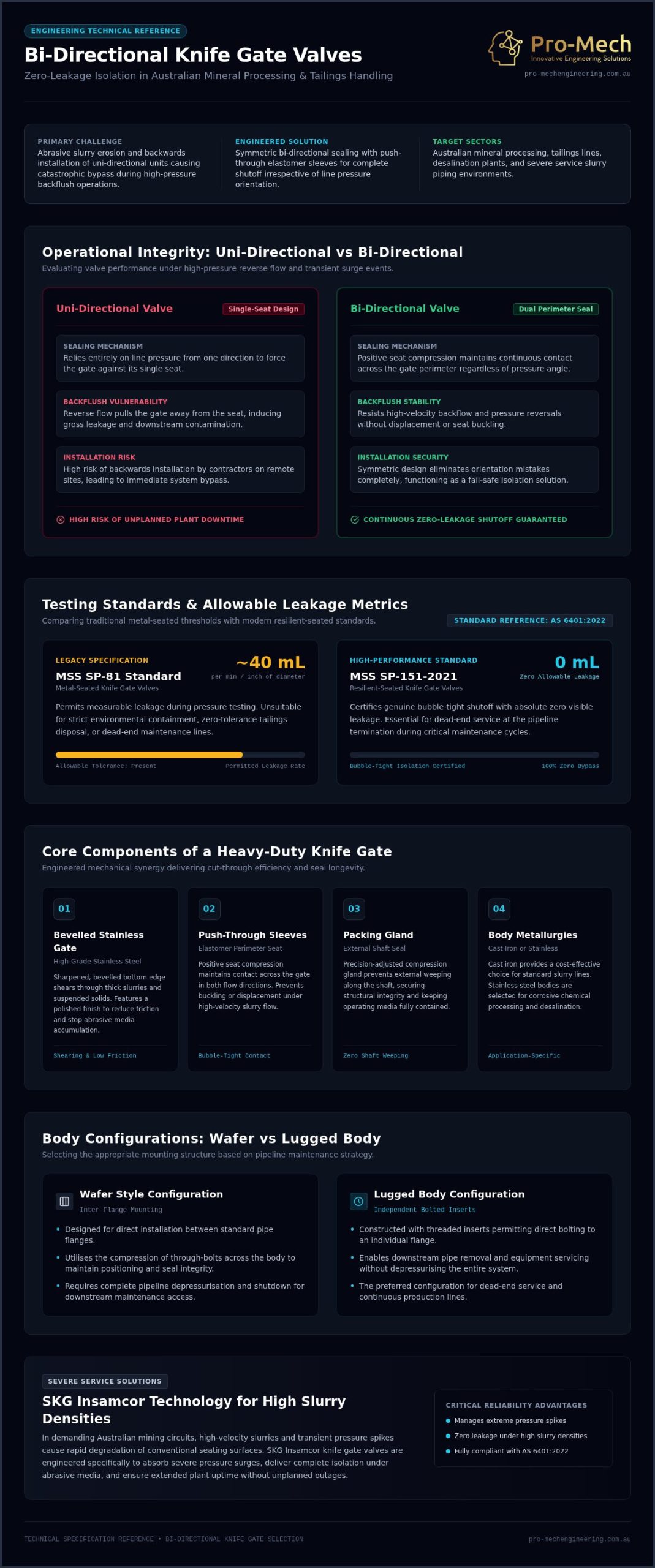
- Wafer style: These are designed for installation between pipe flanges, utilising the compression of the bolts to maintain position and seal integrity.
- Lugged body: These feature threaded inserts that allow the valve to be bolted directly to a single flange. This configuration facilitates downstream maintenance and pipe removal without the need to depressurise the entire system.
The Evolution from Uni-Directional to Bi-Directional Systems
Traditional uni-directional valves often fail when subjected to back-pressure, as the reverse force pulls the gate away from its single seat. This design flaw leads to gross leakage and potential downstream contamination. In large-scale Australian mining and water projects, contractors frequently face the risk of fitting valves in the wrong orientation. This is a mistake that usually goes unnoticed until a system failure occurs during a backflush or surge event. Bi-directional designs eliminate this installation risk entirely by providing a symmetric sealing capability. A bi-directional valve is a fail-safe isolation solution for complex piping.
Core Components of a Heavy-Duty Knife Gate
The structural integrity of bi-directional knife gate valves depends on several core mechanical elements. The gate is typically constructed from high-grade stainless steel with a polished finish to reduce friction against the internal sleeves. This smooth surface prevents the accumulation of abrasive media, which would otherwise degrade the seal over time. External seal integrity is managed by the packing gland, a component that requires precise adjustment to prevent external weeping along the shaft. For body materials, engineers choose based on the chemical profile of the media. Cast iron offers a cost-effective solution for standard slurries, while stainless steel bodies are essential for corrosive environments found in desalination or chemical processing.
The Engineering Behind Bubble-Tight Shutoff in Both Directions
Achieving a bubble-tight shutoff in both flow directions requires a precise mechanical synergy between the gate and the seat. In bi-directional knife gate valves, this is typically achieved through positive seat compression. Unlike uni-directional models that rely on line pressure to force the gate against a single seat, bi-directional designs use a perimeter seat that maintains contact under all conditions. This configuration prevents the seat from buckling or displacing when subjected to high-velocity flow or sudden pressure reversals. For Australian plants, ensuring zero leakage is often a regulatory and environmental necessity.
The term “bubble-tight” refers to the absence of visible leakage during pressure testing. While the traditional MSS SP-81 standard allows for specific leakage rates in metal-seated valves (approximately 40 mL per minute per inch of diameter), high-performance resilient-seated valves are tested against MSS SP-151-2021 standards. This standard certifies zero allowable leakage, providing a higher level of isolation security. This level of performance is essential for dead-end service, where a valve must provide reliable isolation at the end of a pipeline during maintenance cycles. Specialist partners like Pro-Mech provide installation and commissioning plans to ensure these engineering principles translate into field reliability.
Elastomer Seat Selection and Material Science
The service life of a valve in abrasive mining environments is largely dictated by elastomer selection. EPDM is frequently specified for its excellent resistance to weather and ageing, while Nitrile (NBR) is preferred for hydrocarbon-based media. In high-temperature or chemically aggressive applications, Viton (FKM) provides the necessary thermal stability. Beyond the base polymer, reinforced liners play a critical role in protecting the valve body from the high-energy erosion typical of Australian slurry lines. These materials must be selected based on the specific particle size and chemical profile of the process fluid to prevent premature degradation. For a deeper understanding of how material selection and geometry optimisation extend component longevity, the technical principles behind engineering mining slurry handling valves for maximum service life provide essential guidance for severe service specifications.
Internal Sealing Mechanisms and Gate Guidance
Gate alignment is maintained through integrated guides that prevent the blade from shifting under lateral pressure. These guides ensure that the gate remains centred within the seat throughout high-cycle operations. The use of rounded gate edges is another technical detail that extends the life of the packing gland by reducing mechanical wear on the seals. The internal seat geometry is specifically engineered to prevent media build-up in the valve chest, ensuring that solids don’t interfere with the closing stroke. This self-cleaning action is vital for maintaining bi-directional knife gate valves in systems with high solids concentrations, such as thickened tailings or mineral concentrates.
Bi-Directional vs Uni-Directional: Evaluating the Performance Gap
Selecting between uni-directional and bi-directional configurations involves a critical assessment of long-term operational stability. While uni-directional valves are suitable for simple, gravity-fed lines, they lack the mechanical resilience to manage reverse pressure spikes. In contrast, bi-directional knife gate valves maintain a positive seal regardless of the pressure source. This capability is essential for systems where back-pressure is a variable. The symmetric design also reduces engineering oversight during on-site installation, as contractors don’t need to verify flow orientation. This flexibility simplifies the layout of restricted plant spaces, where piping geometry often limits valve placement options.
Weight and footprint considerations also favour the bi-directional design in modern plant upgrades. Although the internal architecture is more complex, the overall dimensions remain comparable to standard wafer-style units. This allows for a direct replacement of failing uni-directional valves without requiring extensive modifications to existing pipework. The ability to handle full pressure from both sides ensures that the valve remains functional even during pump failures or downstream blockages that create significant back-pressure.
Risk Mitigation in High-Stakes Environments
In chemical processing and wastewater treatment, the prevention of catastrophic back-flow is a primary safety objective. Uni-directional valves are prone to jamming when flow reverses, as solids can accumulate behind the gate and prevent a full stroke. Bi-directional designs eliminate this failure mode by providing a clear, self-cleaning path for the gate. This technical assurance provides significant safety benefits for maintenance teams. During line isolation, technicians can rely on the valve to hold pressure from either side, ensuring a secure working environment for downstream repairs.
Cost-Benefit Analysis for Procurement
The initial capital expenditure for a bi-directional unit is often higher than a standard model. However, the total cost of ownership is significantly lower when accounting for reduced maintenance frequency and extended service life. Standardising on bi-directional knife gate valves across a facility allows procurement teams to reduce spare parts inventory. Instead of stocking multiple seat types and gate configurations, a single high-specification model can serve various roles. This standardisation directly impacts plant uptime metrics by ensuring that the correct replacement parts are always available, thereby minimising the duration of unplanned maintenance cycles.
Critical Selection Criteria for Australian Mining and Water Sectors
Specifying bi-directional knife gate valves for Australian industrial applications requires a detailed analysis of environmental and process variables. Remote Outback operations present unique challenges, including extreme temperature fluctuations and high-pressure requirements that test the limits of standard valve designs. In these environments, mechanical failure isn’t just a maintenance issue; it’s a significant threat to project timelines and safety. Engineers must prioritise components that offer high-specification isolation and comply with rigorous national standards to ensure long-term operational stability.
Compliance with Australian engineering standards is mandatory for infrastructure integrity. For waterworks, the AS 6401:2022 standard defines the criteria for design and testing, while flange compatibility often follows AS 4087:2011 or AS 2129:2000. Selecting a technical partner who understands these regulatory frameworks is essential for successful procurement. Pro-Mech specialises in quality inspections and installation planning to ensure every valve meets the specific requirements of the site.
Mining Slurry and Abrasive Media Handling
In mineral processing circuits and tailings lines, slurry density and particle size dictate the rate of mechanical wear. High-density slurries with large, abrasive particles can quickly erode valve internals if turbulence isn’t managed correctly. A full-port design is critical in these applications, as it provides an unobstructed flow path that minimises the energy of the media against the valve body. This reduces the risk of localised thinning and premature body failure. Operators seeking to maximise component longevity in these conditions should review the strategies for selecting mining slurry handling valves engineered to resist particle impingement and abrasive wear over extended service cycles.
SKG Insamcor valves are preferred for abrasive slurry isolation because their twin-sleeve design creates a 100% full-port bore that completely shields the valve body from the abrasive media. This mechanical arrangement ensures that wetted metallic parts don’t come into contact with the slurry, significantly extending the service life of the valve compared to traditional metal-seated designs.
Water and Wastewater Infrastructure Requirements
Wastewater treatment plants face distinct challenges, particularly regarding the management of suspended solids and fibrous materials that can snag on valve gates. Bi-directional valves are indispensable for pump station isolation, where they must manage flow from both the wet well and the discharge line during maintenance. In desalination plants, the high salinity levels necessitate body materials and coatings that resist chloride-induced corrosion. Longevity in these chemically treated environments depends on selecting the correct elastomer and alloy combination to prevent pitting and stress corrosion cracking.
Optimising Plant Integrity with SKG Insamcor Valve Solutions
SKG Insamcor represents the pinnacle of heavy-duty valve engineering, specifically designed to meet the rigorous demands of global mining and mineral processing. As an industry leader, the brand specialises in bi-directional knife gate valves that provide reliable isolation in the most challenging conditions. These solutions are not merely components; they’re engineered safeguards that protect plant integrity by preventing the erosion and mechanical failure common in lesser designs. Pro-Mech Engineering Solutions serves as the critical link in the Australian supply chain, ensuring that these high-specification valves are correctly integrated into local infrastructure.
The value of professional oversight cannot be overstated. Pro-Mech provides comprehensive installation and commissioning plans that go beyond simple delivery. By conducting in-situ quality inspections, the team ensures that every valve is positioned and calibrated for maximum service life. This systematic approach reduces the frequency of unplanned maintenance and ensures that the technical advantages of the Insamcor range are fully realised in the field. This level of meticulous planning is essential for maintaining the operational integrity of large-scale tailings and process water corridors.
Technical Advantages of the SKG Insamcor Range
The SKG Insamcor range is defined by its superior sealing technology, which achieves zero-leakage performance even in high-concentration slurries. Unlike standard valves that suffer from seat displacement, these units utilise a robust mechanical design that remains stable under extreme pressure. The construction is tailored for the world’s harshest mining environments, where airborne grit and corrosive process fluids are constant threats. This durability ensures that the valve internals remain protected during thousands of cycles.
Ease of maintenance is a core design philosophy. The Insamcor range allows for efficient seat replacement in the field, which is vital for remote Australian sites where downtime is exceptionally costly. This modularity ensures that wear parts can be swapped out with minimal specialised equipment, keeping the process line operational. The result is a significant reduction in the total cost of ownership over the valve’s lifecycle.
Partnering with Pro-Mech for Engineering Excellence
Pro-Mech provides national supply and technical support for Australian heavy industry, bridging the gap between international innovation and local operational requirements. The firm’s expertise extends to custom actuation packages and complex instrumentation integration, allowing for seamless automation of bi-directional knife gate valves. This ensures that the valves respond accurately to control system logic, enhancing both safety and process efficiency across the entire facility.
Working with a specialised partner ensures that your procurement strategy is backed by technical validation and rigorous testing. Contact Pro-Mech for a technical consultation on your valve requirements. By leveraging expert knowledge in severe service isolation, operators can secure the long-term reliability of their fluid handling systems and eliminate the risks associated with improper valve selection.
Securing Long-Term Operational Integrity
The transition toward high-specification bi-directional knife gate valves represents a strategic shift in industrial fluid management. By eliminating the risks of incorrect orientation and ensuring zero-leakage isolation under reverse pressure, these components provide a level of reliability that standard uni-directional models cannot match. Adherence to rigorous standards, such as AS 6401:2022 and MSS SP-151-2021, ensures that your infrastructure remains compliant and protected against the abrasive forces typical of severe service environments.
Pro-Mech Engineering Solutions acts as a meticulous industrial partner, providing more than just equipment supply. As an official distributor of SKG Insamcor valves, we offer specialised engineering support for complex Australian mining projects, including comprehensive quality audits and witness testing. This technical oversight ensures that your assets are installed correctly and maintained for maximum service life. We encourage you to view our range of SKG Insamcor bi-directional valves to discover how precise engineering can reduce maintenance frequency and stabilise your process workflows. Our team is ready to assist in optimising your plant performance with proven, technical solutions.
Frequently Asked Questions
What is the primary advantage of a bi-directional knife gate valve?
The primary advantage is the ability to provide reliable isolation regardless of the direction of fluid flow or pressure. This capability ensures that the valve remains effective during system surges, pump failures, or backflush operations where flow reversal is common. Unlike uni-directional models that rely on line pressure to assist the seal on one side, bi-directional knife gate valves maintain a positive, mechanical seal against both faces of the gate.
Can bi-directional knife gate valves be used for dead-end service?
Yes, these valves are frequently specified for dead-end service, provided they are configured with a lugged body. This design allows the valve to be bolted directly to a single flange, enabling the safe removal of downstream piping for maintenance while the valve remains under pressure. It’s essential to verify that the specific model is rated for full line pressure in a dead-end configuration to ensure the safety of maintenance personnel.
How do bi-directional valves prevent the risk of incorrect installation?
The symmetric internal architecture of a bi-directional valve eliminates the risk of incorrect installation by contractors or maintenance teams. Because the valve seals effectively in both directions, there is no upstream or downstream orientation to consider during fitting. This design choice significantly reduces the likelihood of mechanical failure caused by a valve being installed backwards, which is a frequent cause of bypass leakage and seat damage in uni-directional systems.
What are the most common seat materials for abrasive mining slurries?
Natural rubber and EPDM are the most common seat materials for abrasive mining slurries due to their high resilience and wear resistance. In more aggressive chemical environments, Nitrile or Viton are specified to prevent polymer degradation. High-performance solutions like SKG Insamcor valves often utilise reinforced elastomer sleeves that provide a full-port bore, shielding the valve body from the high-energy erosion typical of mineral processing and tailings management.
Are bi-directional knife gate valves suitable for high-pressure applications?
Specific heavy-duty models are engineered for high-pressure applications, with many rated for 150 psi CWP as a standard. For severe service requirements, advanced designs can manage pressures up to ASME Class 150 or 300 limits. It’s critical to match the valve’s pressure rating with the maximum potential surge pressure of the system. Pro-Mech provides technical validation to ensure that selected valves meet the pressure containment standards required for deep-pit mining operations.
How often should the packing gland be adjusted on a bi-directional valve?
Adjustment frequency depends on the cycle count and the abrasiveness of the media, but it should be part of a regular preventative maintenance schedule. If external weeping is observed along the gate shaft, the gland nuts should be tightened evenly to restore the seal. Some modern bi-directional knife gate valves, such as push-through sleeve designs, utilise a packingless system that significantly reduces the need for manual adjustments on remote sites.
What is the difference between bubble-tight shutoff and standard isolation?
Bubble-tight shutoff indicates zero allowable leakage during pressure testing, often certified as Rate A under ISO 5208 or MSS SP-151-2021. In contrast, standard isolation under MSS SP-81 for metal-seated valves allows for a specific volume of fluid loss, approximately 40 mL per minute per inch of diameter. For critical isolation in chemical or wastewater plants, bubble-tight performance is essential to prevent environmental contamination and ensure the safety of downstream workers.
Does a bi-directional valve require more space in the pipeline than a uni-directional one?
A bi-directional valve typically does not require more space, as it is designed to fit standard wafer or lugged flange dimensions. While the internal sealing mechanism is more complex, the face-to-face dimensions remain comparable to uni-directional equivalents. This allows for the direct replacement of failing valves without modifying existing pipework. The compact footprint is advantageous in restricted plant spaces where piping geometry often limits the installation of larger isolation components.