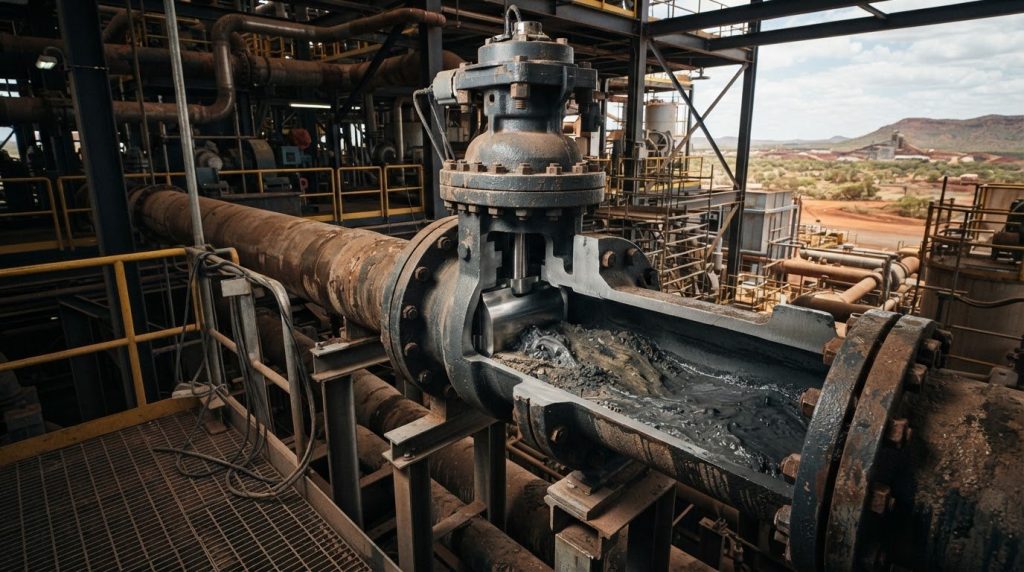
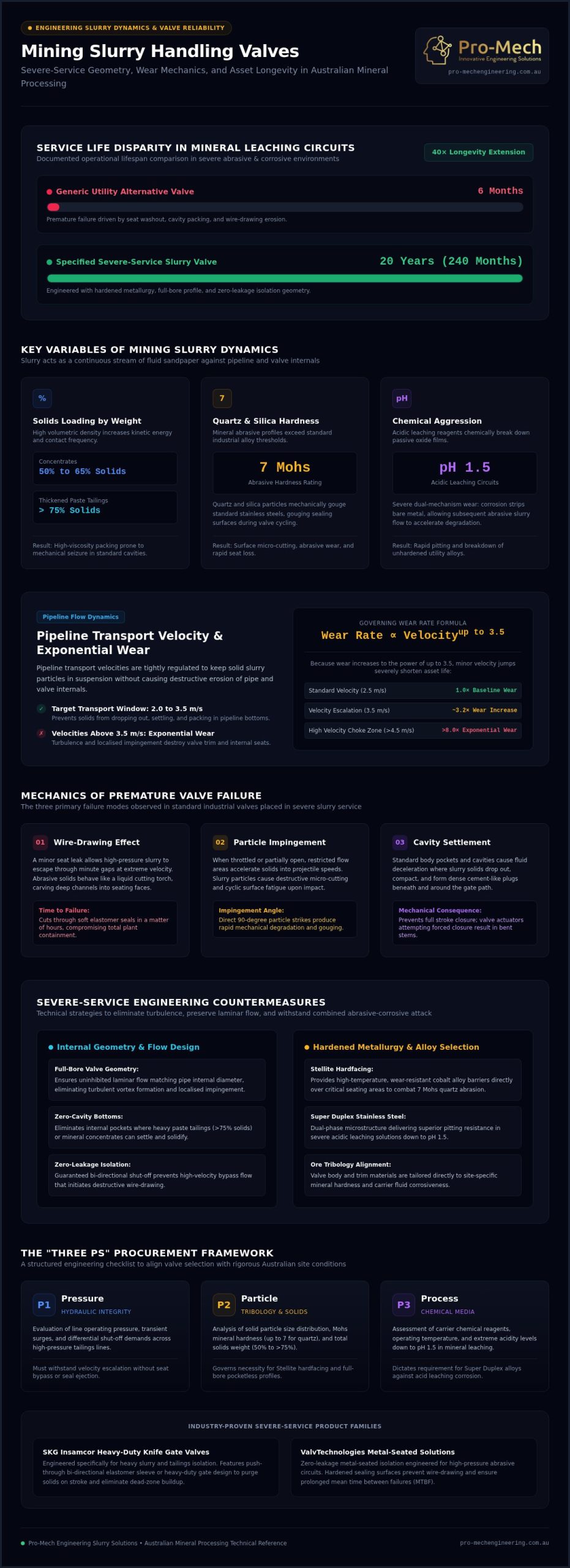
Specifying a severe-service slurry valve over a generic utility alternative in mineral leaching circuits has been documented to extend service life from six months to twenty years. In the demanding context of Australian mineral processing, selecting high-performance mining slurry handling valves is a critical decision that dictates the frequency of unscheduled downtime and the overall safety of high-pressure tailings lines. You’re likely familiar with the high replacement costs and operational risks that arise when abrasive solids compromise valve seat integrity. These failures don’t just impact your maintenance budget; they threaten the reliability of your entire processing circuit.
This article explores how to optimise valve longevity and reduce maintenance downtime in the most abrasive environments. We’ll detail the technical strategies for managing particle impingement through material hardening and refined geometry. By reviewing the capabilities of SKG Insamcor knife gate valves and ValvTechnologies metal-seated solutions, you’ll discover how to achieve a lower total cost of ownership and extended mean time between failures for your critical assets.
Key Takeaways
- Identify the primary variables of slurry dynamics and the mechanics of wire-drawing to prevent premature failure in abrasive processing circuits.
- Compare the performance characteristics of various mining slurry handling valves, including heavy-duty knife gate and pinch designs, for specific isolation and flow control tasks.
- Apply a structured procurement framework based on the Three Ps (Pressure, Particle, and Process) to align valve selection with rigorous site conditions.
- Discover how the technical application of SKG Insamcor and ValvTechnologies solutions can achieve zero-leakage isolation and extend the service life of tailings infrastructure.
- Learn the importance of full-bore geometry and hardened metallurgy in minimising turbulence and reducing the total cost of ownership for valve assets.
Understanding the Dynamics of Mining Slurry Handling
Mining slurry is defined as a complex two-phase flow where solid particles are suspended within a liquid carrier, typically water or chemical reagents. In the Australian mineral processing sector, these fluids are rarely benign. They represent some of the most aggressive media in industrial engineering, acting as a continuous stream of fluid sandpaper against pipeline internals. Selecting effective mining slurry handling valves requires a deep understanding of three primary variables: particle size and hardness, the percentage of solids by weight, and the chemical corrosiveness of the carrier fluid.
Typical mineral processing slurries operate with solids loading between 50% and 65% for concentrates, while thickened paste tailings can exceed 75% solids. When these particles consist of quartz or silica, they often reach ratings of 7 on the Mohs hardness scale. Standard industrial valves, designed for clean liquids or gases, simply cannot survive these conditions. Their internal cavities and pockets quickly become packed with settled solids, which prevents full closure and leads to mechanical seizure or seat washout. Because of this, “Severe Service” engineering is the only viable baseline for procurement in these environments.
The Role of Slurry Velocity in Valve Wear
Pipeline transport velocities are a critical determinant of valve longevity. Engineering standards generally dictate a velocity window between 2.0 and 3.5 metres per second to prevent solids from settling and packing. However, if velocities exceed this range, erosion rates rise exponentially. Because the wear rate is proportional to velocity raised to a power of up to 3.5, even a minor increase in flow speed can significantly reduce the service life of valve components. Maintaining laminar flow through the valve bore is essential. Any poor geometry that creates turbulent zones will result in localised impingement and rapid material loss, making the internal design of mining slurry handling valves a priority for operational integrity.
Abrasive vs. Corrosive Slurries: A Critical Distinction
It’s vital to distinguish between physical abrasion and chemical corrosion during the valve selection process. While abrasion involves the mechanical gouging of surfaces by hard particles, corrosion involves the chemical degradation of the metal itself, often seen in acidic leaching circuits with a pH as low as 1.5. Standard stainless steel often lacks the hardness required to resist abrasive tailings. Effective valve solutions frequently utilise specialised alloys such as Super Duplex or Stellite hardfacing to provide a dual layer of protection. Pro-Mech focuses on matching these metallurgy choices to the specific ore tribology of a site, ensuring that the valve body and trim can withstand both chemical attack and mechanical scouring.
The Mechanics of Erosion: Why Standard Valves Fail
Standard industrial valves fail because their design doesn’t account for the kinetic energy of suspended solids. When mining slurry handling valves are in a partially open position, the flow area is restricted, causing a localised increase in fluid velocity. This acceleration transforms suspended particles into high-velocity projectiles that strike the valve internals. This process, known as particle impingement, causes rapid material loss through micro-cutting and surface fatigue.
A particularly destructive phenomenon is “wire-drawing.” This occurs when a minor seat leak allows high-pressure slurry to escape at extreme velocities. The abrasive particles within the leak act like a liquid cutting torch, grooving the seat and seal until the valve can no longer provide isolation. In soft-seated valves, high-pressure slurry can cut through elastomer seals in a matter of hours, leading to catastrophic failure and safety risks. For operators seeking to avoid these failures, implementing tailored engineering assessments focused on severe-service geometry is essential.
Beyond surface wear, standard valves often contain “dead zones” or internal cavities where flow velocity drops. In these areas, solids settle out of the carrier fluid and harden into a dense plug. This packed material prevents the valve from reaching its full stroke, which either stops the valve from closing completely or causes bent stems when actuators attempt to force the gate through the obstruction. These settlement issues are common in tailings and mineral processing circuits where slurry density is high. Understanding the full scope of slurry valve erosion prevention strategies is essential for operators managing high-solid concentrate lines and gold tailings circuits.
Impingement Angle and Material Degradation
The angle at which particles strike a surface dictates the wear mechanism. A 90-degree impingement angle typically causes brittle fracture or plastic deformation in hardened metals, whereas low-angle sliding abrasion results in scratching and gouging. Material hardness, measured on the Brinell or Rockwell scales, is the primary defence against these forces. The rate of seat erosion is directly proportional to the kinetic energy of the particles and the frequency of their impact against the valve trim.
Cavitation in Slurry Pipelines
Cavitation occurs at high-pressure drop points where static pressure falls below the vapour pressure of the carrier fluid, causing vapour bubbles to form and subsequently implode. In a slurry system, these implosions are particularly destructive because they propel abrasive particles into the valve wall at ultrasonic speeds. This strips away protective oxide films and accelerates erosive wear. Selecting valve designs that manage pressure fluctuations and maintain stable flow profiles is vital to preventing bubble formation and protecting the integrity of the pipeline.
Comparing Heavy-Duty Valve Designs for Slurry Service
Selecting the appropriate architecture for mining slurry handling valves requires a detailed evaluation of pressure ratings, solid concentrations, and required isolation integrity. While generic valves fail under abrasive stress, specialised designs like knife gates, pinch valves, and metal-seated ball valves offer distinct mechanical advantages tailored to specific mineral processing stages. The choice between these designs often dictates the long-term reliability of the entire tailings infrastructure.
Knife Gate Valves: The Workhorse of the Mine Site
The SKG Insamcor knife gate valve is the primary choice for slurry isolation in Australian tailings and mineral processing circuits. These valves are engineered to slice through packed solids that would typically seize a standard wedge gate. A critical differentiator is the bi-directional seal capability, which ensures reliable isolation regardless of the pressure direction. During the closing stroke, the gate performs a “clearing action,” effectively ejecting settled particles from the seat area into the main flow. This prevents the accumulation of solids in the valve chest, maintaining mechanical functionality over thousands of cycles without the risk of a jammed gate.
Severe Service Metal Seated Valves
In high-pressure applications where zero-leakage is mandatory, ValvTechnologies metal seated valves provide the necessary technical assurance. These valves utilise a unique self-cleaning seat technology where the ball and seat remain in constant contact. This wipes the sealing surfaces clean of debris during every operation, preventing the “wire-drawing” effect described in previous sections. To combat the extreme abrasion of quartz and silica particles, these valves often feature Chrome Carbide coatings. This hardening process creates a surface that resists the micro-cutting and impingement forces that typically destroy soft-seated alternatives. This design is particularly effective in high-pressure leaching circuits where traditional elastomers would degrade rapidly.
Maintenance requirements also dictate the selection process. Pinch valves, which use a flexible elastomer sleeve, are highly effective for low-pressure, high-solid flows and offer simple in-line repairability. However, for critical infrastructure where unscheduled downtime is cost-prohibitive, the extended mean time between failures provided by metal-seated designs often justifies the higher initial investment. Balancing the ease of component replacement against the frequency of intervention is a key factor in achieving a lower total cost of ownership for valve assets across the mine site.
Selection Criteria for Mining Slurry Handling Valves
Procuring mining slurry handling valves requires a structured methodology that prioritises operational longevity over the initial purchase price. Engineers should adopt a procurement framework based on the “Three Ps”: Pressure, Particle, and Process. Pressure analysis must account for both static head and dynamic surges. Particle evaluation involves assessing the size, shape, and Mohs hardness of the solids. Finally, the Process criteria encompass flow rates, chemical reagents, and the required frequency of cycles. This comprehensive approach ensures the valve architecture is compatible with the specific tribology of the site.
Full-bore designs are essential for maintaining the laminar flow profiles discussed in previous sections. Any restriction in the flow path creates turbulence and eddy currents, which lead to localised erosion. Furthermore, the role of actuation in mining slurry handling valves extends beyond simple automation. Precisely controlled closing speeds are vital to prevent “water hammer” in high-pressure slurry lines. Rapid closure of a valve against a dense, high-velocity slurry can generate massive pressure spikes that threaten the structural integrity of the entire piping system. To ensure your assets are protected, you can request a technical procurement assessment from our engineering team.
Selecting a valve based on initial cost is often a poor metric for long-term mineral processing success. The Total Cost of Ownership (TCO) provides a more accurate reflection of value, incorporating the costs of unscheduled downtime, labour for replacement, and the loss of production during maintenance windows. A valve with a higher capital cost that extends the mean time between failures from months to years will always provide a superior return on investment.
Assessing Chemical Compatibility and Temperature
Chemical slurries require a careful choice between elastomer sleeves and metal seats. While elastomer sleeves in SKG Insamcor valves offer excellent resistance to many abrasive tailings, aggressive chemical reagents may necessitate the use of specialised metal-seated ValvTechnologies units. Thermal expansion also plays a critical role. In high-temperature mineral processing, the expansion of internal components can tighten tolerances and increase operating torque. Ensuring that all materials comply with Australian standards (AS/NZS) for pressure and temperature certification is a non-negotiable requirement for site safety.
Maintenance Accessibility and In-Situ Serviceability
In-situ serviceability is a major advantage for remote Australian mine sites where logistics are complex. Selecting valve designs that allow for seat or sleeve replacement without removing the valve body from the pipeline significantly reduces downtime. Pro-Mech supports these requirements by providing detailed Installation and Commissioning Plans tailored to specific site conditions. We also emphasise the value of witness testing and rigorous quality audits before delivery, ensuring that every valve arrives on-site ready for immediate and reliable integration into the processing circuit.
Pro-Mech: Technical Excellence in Slurry Valve Engineering
Pro-Mech Engineering Solutions operates as a meticulous industrial partner, providing technical validation and procurement expertise that extends beyond simple equipment supply. For the Australian mining sector, the integration of high-performance mining slurry handling valves requires detailed planning and rigorous testing to ensure long-term operational success. Our portfolio, featuring SKG Insamcor and ValvTechnologies, offers a comprehensive range of solutions designed to address the mechanical challenges of abrasive and corrosive slurry circuits identified throughout this article. This specialist focus ensures that every component is selected based on its ability to withstand specific ore tribology and process chemistry.
Our approach prioritises safety and compliance through systematic execution. By conducting in-situ quality inspections and assisting with the development of safety procedure planning, Pro-Mech ensures that every valve installation meets stringent engineering standards. This oversight is critical for maintaining the integrity of high-pressure lines and minimising the risks associated with slurry leaks. Adopting a long-term view on asset management allows operators to transition from reactive maintenance to a structured, reliable infrastructure model, ultimately lowering the total cost of ownership for critical valve assets.
National Support for Heavy Industry Projects
Pro-Mech provides national engineering support for large-scale mining projects, focusing on the technical nuances that ensure equipment reliability in remote environments. We specialise in the delivery of custom-actuated packages and actuated valve skids, tailored to meet specific mine site automation requirements. These packages integrate precise controls to manage the flow velocities and pressure surges discussed in previous sections. For complex installations, our team is available to collaborate on custom software development and comprehensive commissioning plans to ensure seamless integration into existing processing circuits. This level of technical support is essential for maintaining operational continuity across geographically dispersed assets.
Optimising Your Slurry Circuit Today
Achieving maximum service life in mineral processing requires a disciplined focus on technical integrity and detail-oriented planning. Pro-Mech offers a clear pathway for operators to improve their mean time between failures through professional technical audits and valve specification reviews. Our commitment to reliability and operational integrity ensures that your slurry handling infrastructure remains robust under the most demanding Australian conditions. By aligning valve selection with the specific physical variables of your process, you can achieve predictable performance and enhanced safety.
Enquire with Pro-Mech Engineering Solutions about your slurry handling requirements.
Securing Long-Term Reliability in Slurry Infrastructure
Optimising the service life of mining slurry handling valves requires a transition from generic procurement to a disciplined, severe-service engineering approach. By addressing the physical variables of particle impingement and selecting specialised architectures like SKG Insamcor or ValvTechnologies, operators can achieve zero-leakage isolation and significantly extend the mean time between failures. This strategic focus reduces unscheduled downtime and ensures the stability of high-pressure tailings lines in the most demanding environments.
Pro-Mech Engineering Solutions serves as a technical partner in this process, providing more than mere equipment supply. As an authorised distributor of world-class valve technologies, we offer comprehensive project management and specialised engineering services, including in-situ quality inspections and detailed commissioning plans. These systematic workflows ensure that your infrastructure meets the highest standards of safety and operational integrity. Contact Pro-Mech for technical valve procurement and engineering support to begin reviewing your site requirements. We’re committed to helping you achieve a lower total cost of ownership and reliable performance across your mineral processing circuits.
Frequently Asked Questions
What is the best valve type for high-density mine tailings?
The most effective choice for high-density tailings is typically the SKG Insamcor knife gate valve. These mining slurry handling valves are engineered to slice through packed solids that would cause standard valves to seize. For high-pressure tailings lines where zero-leakage is a mandatory requirement, ValvTechnologies metal-seated valves provide a more robust alternative. The selection depends on the Three Ps: Pressure, Particle, and Process variables specific to the mine site.
How does a knife gate valve handle solids compared to a standard gate valve?
A knife gate valve utilises a sharp-edged gate designed to cut through dense media and packed solids. Standard wedge gate valves contain internal pockets where slurry can settle and harden, preventing the valve from closing completely. In contrast, the clearing action of an SKG Insamcor knife gate ejects particles from the seat into the flow during the closing stroke. This mechanism prevents mechanical seizure and maintains the integrity of the seal over long cycles.
Can metal seated ball valves achieve zero-leakage in abrasive slurry?
Yes, ValvTechnologies metal seated valves are specifically engineered to provide zero-leakage isolation in high-pressure abrasive environments. These valves feature self-cleaning seat technology that wipes the ball surface during every operation, preventing the wire-drawing effect caused by minor leaks. By utilising Chrome Carbide coatings, these valves resist the micro-cutting and impingement forces of quartz or silica particles. This ensures reliable performance in mineral processing circuits where soft-seated valves would fail prematurely.
Why is flow velocity critical when specifying mining slurry valves?
Flow velocity is a primary determinant of the erosion rate within a slurry pipeline. If velocities exceed the critical window of 2.0 to 3.5 metres per second, the wear rate on valve internals rises exponentially. This accelerated degradation occurs because the kinetic energy of suspended particles increases with velocity. Maintaining laminar flow through the valve bore is essential to prevent turbulent zones that cause localised impingement and rapid material loss in the valve chest.
What are the benefits of SKG Insamcor valves in Australian mining?
SKG Insamcor valves are valued for their bi-directional sealing capability and their ability to handle high-solid content flows without packing. These mining slurry handling valves are designed to operate reliably in harsh Australian conditions, where mineral concentrates and thickened tailings are common. Their clearing action ensures that settled solids are moved out of the sealing area, which reduces the risk of gate jamming. This reliability helps operators extend the mean time between failures for critical assets.
How often should slurry handling valves undergo quality inspections?
Inspection frequency depends on the abrasive nature of the ore and the frequency of valve cycles. For severe-service applications, Pro-Mech provides in-situ quality inspections to monitor seat wear and seal integrity before a blowout occurs. Regular audits help identify early signs of cavitation or erosion-corrosion synergy. Implementing a structured inspection schedule allows for planned maintenance during scheduled shutdowns, which avoids the high costs associated with unscheduled downtime and emergency repairs.
What role does actuation play in extending the life of a slurry valve?
Actuation is critical for managing the closing speed of a valve to prevent water hammer in high-pressure slurry lines. Rapid closure against a dense fluid can generate massive pressure spikes that damage both the valve and the surrounding piping. Pro-Mech provides custom-actuated packages that ensure precisely controlled stroke speeds. These systems protect the valve trim from excessive stress and ensure that the gate or ball reaches the fully closed position without damaging the seats.
Does Pro-Mech provide commissioning plans for new valve installations?
Pro-Mech provides detailed Installation and Commissioning Plans as a core part of its technical service offering. These plans are tailored to the specific requirements of remote Australian mine sites, ensuring that every valve is integrated correctly into the processing circuit. Proper commissioning includes verifying actuator settings, checking seal integrity under pressure, and conducting quality audits. This systematic approach ensures that the equipment performs reliably from the first day of operation.