
A valve can look serviceable and still leave important questions unanswered. In-situ valve inspections are a decision-making process, not a visual tick-box or a substitute for every controlled test. What can be assessed while a valve remains installed depends on its type, service conditions, site requirements and the agreed inspection scope.
It’s reasonable to ask whether a visual check is enough, particularly when functional performance or integrity concerns remain. A structured approach separates observable condition from issues that may need further testing, maintenance or removal. It also gives teams a consistent basis for recording findings and planning follow-up.
This guide explains how to define an inspection scope for the valve and its operating context, record traceable observations and measurements, and decide when to escalate to testing or specialist review. It also covers how inspection evidence fits into broader valve engineering support. Applicable procedures, standards and acceptance criteria need to be confirmed for each project.
Key Takeaways
- Set a clear scope for in-situ valve inspections, including the asset boundary, objective and decision criteria.
- Prepare by checking valve identification, service history, drawings, maintenance records and reported issues.
- Record observations, measurements and operator reports separately so the evidence and its limitations are clear.
- Use approved acceptance criteria, manufacturer information and site requirements to determine whether findings need follow-up.
- Build a traceable inspection baseline to support future reviews and maintenance planning based on asset criticality and service conditions.
What an in-situ valve inspection can and cannot tell you
An in-situ inspection assesses a valve while it remains installed, within an agreed scope and the constraints of the site. It can establish visible condition, capture available operating evidence and identify questions for follow-up. The scope should reflect the valve’s design and process duty, as well as what can be safely accessed and observed under approved site procedures.
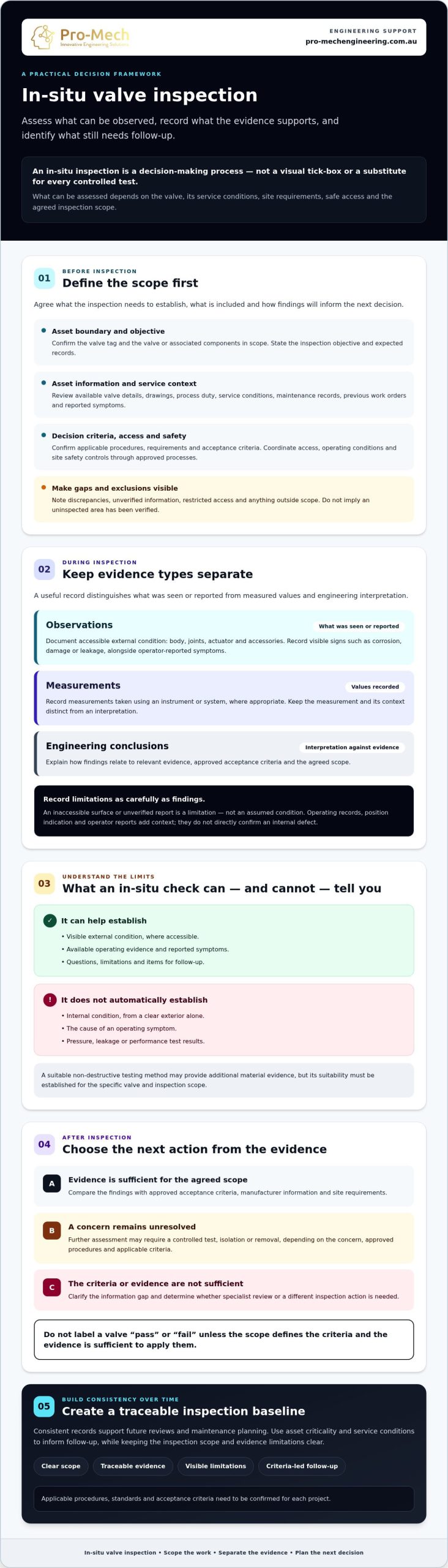
An in-situ inspection is not automatically a pressure, leakage or performance test. Those activities require defined methods and acceptance criteria, and may involve different operating conditions or controls. A useful report distinguishes three types of information: observations (what was seen or reported), measurements (values recorded using an instrument or system) and engineering conclusions (interpretations made against relevant evidence and criteria). Keeping these categories separate makes the basis for each decision clear.
Which valve conditions can be assessed in place?
Where accessible, an inspection can document the external body, joints, actuator, accessories and visible signs of condition, such as corrosion, damage or leakage. Operating records, position indication and operator-reported symptoms can add context, but they are supporting evidence, not direct confirmation of an internal defect. Non-destructive testing methods provide ways to examine materials without damaging them. Whether a method is suitable must be established for the specific valve and inspection scope.
Access, the valve’s operating state and approved procedures determine what can be checked. Record an inaccessible surface or unverified report as a limitation, not as an assumed condition.
When is an in-situ inspection not enough?
Visible condition alone may not resolve suspected internal damage, leakage across the closure element or a performance concern. The valve’s construction and service duty affect what evidence can be gathered without disassembly. A clear exterior does not confirm internal condition, and an operating symptom may warrant investigation without establishing its cause.
Further assessment may require a controlled test, isolation or removal, depending on the concern, approved procedures and applicable acceptance criteria. Don’t label a valve pass or fail unless the scope defines the criteria and the evidence is sufficient to apply them. In-situ valve inspections are most useful when they identify both what the evidence supports and what remains unknown, helping inform the next action rather than replacing every test. Pro-Mech Engineering Solutions Pty. Ltd. provides in-situ quality inspections. Confirm the available inspection methods and deliverables against the valve, service and site requirements.
How to prepare an in-situ valve inspection safely and effectively
Effective preparation starts before site attendance. Define what the inspection needs to establish, which valve and associated components are in scope, what records will be produced and how findings will inform the next decision. Agree the assessment criteria in advance, including the requirements and documents that apply. This helps prevent a limited inspection from being mistaken for a wider verification of valve condition or performance.
Define the inspection scope and gather asset information
Build the scope around available asset records and service context. Confirm the valve tag and, where information is available, its type, size, pressure class, materials and actuator details. Review drawings, process duty, service conditions, maintenance records, previous work orders and reported operating symptoms. Resolve discrepancies between records and the installed asset where possible, and note any information that remains unverified.
Set out exclusions and information gaps explicitly. If internal condition cannot be assessed within the agreed scope, record that limitation rather than implying it has been verified. Define the expected deliverables, such as an observation record, supporting measurements where appropriate and a list of items requiring review. Agree decision criteria with the relevant site or engineering personnel.
Plan access, safety controls and inspection resources
Coordinate access, timing and operating conditions with the site authority. Confirm applicable site safety procedures, permits, hazardous-area controls and personal protective equipment requirements before work proceeds. Access platforms, insulation, adjacent equipment or restricted clearances may limit visibility, so include these constraints in the plan.
Verify operational restrictions, isolation arrangements and test requirements through approved site processes with responsible personnel. Don’t assume a valve can be operated or disturbed as part of an inspection. Select instruments only when they suit the intended measurement and site conditions, and confirm applicable calibration and suitability requirements before relying on readings.
- Before attending: confirm asset identity, records, scope and acceptance criteria.
- With the site authority: coordinate access, operating state, permits and safety controls.
- For each limitation: record what could not be verified and why.
A prepared scope supports consistent, traceable in-situ valve inspections and helps the inspection team distinguish planned checks from follow-up work. Pro-Mech Engineering Solutions Pty. Ltd. provides in-situ quality inspections. Teams can discuss an inspection scope against their valve, service and site requirements.
How to inspect an installed valve and record useful evidence
A consistent field sequence makes findings easier to review and compare. Start by confirming the valve tag against the inspection scope. Record the inspection conditions, then proceed through accessible components. Check operation only when it’s authorised and included in the scope. Document results as you go, including anything that could not be observed or verified.
Keep evidence types distinct. A visible coating defect is an observation; a value recorded by an instrument is a measurement; an operator’s account is a reported symptom. A suspected cause is an interpretation, not a direct finding. Separating these categories helps later reviewers assess what the evidence supports without treating an inference as confirmed fact.
Assess external condition, interfaces and actuator indicators
Record visible corrosion, coating damage, physical damage, unusual deposits and signs of leakage. Note the location and extent where practical. Check accessible connections, supports, actuator condition, accessories and position indicators within the agreed scope. Describe what is present rather than assigning a cause based on appearance alone.
Photographs can help preserve context where site rules permit. Associate each image with the asset tag and a clear location, such as the actuator interface or a specific joint. If a component is obscured or inaccessible, record that limitation instead of implying it was inspected.
Record operating observations without overstating results
Where operation is authorised, capture observed movement or position indication, along with any abnormal noise or reported difficulty. Record the operating state and relevant measurement conditions alongside instrument readings, including the instrument used where applicable. Don’t adjust, operate or test equipment beyond the approved scope and site authorisation.
For a useful inspection record, link each finding to its evidence and context. A simple entry might identify the valve, describe a visible leak indication at an accessible connection, state the operating condition at the time and note whether the information was observed visually or reported by an operator. Avoid treating one observation as proof of an internal defect or overall performance.
- Identity: asset tag and inspected component.
- Evidence: observation, measurement, report or interpretation.
- Context: operating state, location, instrument details where relevant, and access limitations.
- Authorisation: checks completed within the approved scope.
This disciplined approach to in-situ valve inspections creates a traceable record for engineering review and helps identify incomplete evidence. Record internal condition as unverified unless the scope and evidence support a conclusion.
How to interpret findings and choose the next inspection action
An inspection finding becomes useful when it leads to a proportionate, documented decision. Assess each item by considering the observed condition, any operational concern, the strength of the evidence and the potential consequence if the issue is confirmed or worsens. A clear measurement or repeated observation may call for a different response from an unverified report or an area that could not be accessed.
Compare findings with approved acceptance criteria, relevant manufacturer information and site requirements. If criteria are missing, unclear or not applicable to the evidence collected, record the uncertainty and refer it for engineering review. Don’t assign a condition rating or declare a valve acceptable solely to close out the inspection.
Match inspection findings to proportionate follow-up
Use the site asset process to assign an action owner, priority and review timing. The examples below are decision prompts, not universal acceptance rules. Responsible site or engineering personnel should confirm the appropriate response for the asset and its service.
- Visible condition change, no immediate operational concern: confirm the observation and supporting evidence. Consider monitoring or maintenance planning against site criteria.
- Reported operating difficulty, limited corroborating evidence: verify the operating context and refer the concern for engineering review before concluding its cause.
- Measurement outside an approved limit, or repeated concerning symptoms: refer through the site process for assessment and determine whether further testing or maintenance is warranted.
- Potentially serious condition or immediate risk concern: promptly escalate to the responsible site authority under site procedures.
Evidence quality and consequence both matter. A low-confidence finding with potentially serious consequences may still warrant timely review, while a well-documented minor observation may be managed through planned monitoring. Record why the action was selected, who owns it and when it will be reviewed.
Know when further testing or removal may be warranted
Further assessment may be appropriate when the inspection question cannot be answered with the valve installed, available evidence conflicts or a suspected internal or functional issue remains unresolved. Depending on the concern, this may involve controlled testing, maintenance or removal for examination. Confirm the method and acceptance limits against applicable standards, approved procedures, manufacturer information and site requirements for that valve.
Document the unresolved question, the evidence gap and the reason for recommending the next step. This gives decision-makers a traceable basis for action without overstating what the inspection established. Pro-Mech Engineering Solutions Pty. Ltd. provides in-situ quality inspections. Discuss your valve inspection scope and findings against the asset, service and site requirements.
Plan a repeatable in-situ valve inspection programme with engineering support
A repeatable programme turns individual inspection records into a usable asset history. Establish a baseline for each valve that links its identity to the agreed scope, observations, evidence limitations and resulting actions. Future reviewers can then distinguish a new change from a condition recorded previously, rather than relying on informal notes or memory.
Build consistency across assets and inspection records
Use a controlled template with consistent fields, terminology, photograph references and sign-off requirements. Retain completed records alongside relevant drawings, maintenance history, work orders and commissioning information. This makes evidence easier to find and gives teams useful context when reviewing later findings.
Set inspection intervals through the site’s asset governance process, considering asset criticality, service conditions, operating history and applicable site requirements. There’s no universal interval that suits every valve. Review recurring findings and overdue actions to determine whether future scope, monitoring or maintenance planning should change. If inspection outcomes relate to valve installation and commissioning, keep those records connected so later reviews can follow the asset history.
Engage engineering support for complex valve assessments
A defined scope aligns inspection activity with the valve, its service and site requirements. It also clarifies available records, intended deliverables, acceptance criteria and unresolved questions before work is planned. For complex assessments, this shared basis supports a documented quality review without assuming every issue can be resolved through an in-situ inspection.
Pro-Mech Engineering Solutions Pty. Ltd. lists in-situ quality inspections, installation and commissioning planning, project management and quality audits among its support for heavy-industry applications. Confirm the valve types, inspection methods and deliverables available for the specific project, along with relevant site procedures and criteria.
To discuss a potential scope, have the valve identification, service conditions, available drawings and maintenance history, reported concerns, site requirements and desired deliverables ready. Discuss your valve inspection requirements with Pro-Mech Engineering Solutions Pty. Ltd. and confirm what information is needed to assess the project.
With a traceable baseline and site-governed review process, in-situ valve inspections can support consistent asset decisions over time while keeping the limits of each inspection clear.
Turn inspection evidence into a clear asset plan
Effective in-situ valve inspections begin with a defined scope and a safe, site-approved approach. They produce the most useful outcomes when observations, measurements, reported symptoms and limitations are recorded separately, then assessed against applicable criteria. The resulting evidence can guide proportionate follow-up, from monitoring and engineering review to further testing or maintenance.
Over time, consistent records create a traceable asset history. Use that baseline to review recurring findings and plan future inspection activity in line with valve criticality, service conditions and site governance. Where the available evidence does not resolve a concern, document the gap and agree the next step with the responsible personnel.
Pro-Mech lists in-situ quality inspections among its offerings, alongside engineering support that includes installation and commissioning planning and quality audits. To discuss the valve, service conditions and site requirements for a potential inspection scope, discuss your valve inspection requirements.
A structured process helps your team make better-informed decisions and build confidence in the condition records that support industrial assets.
Frequently Asked Questions
What is an in-situ valve inspection?
An in-situ valve inspection assesses a valve while it remains installed, using an agreed scope and evidence available on site. Depending on access and operating conditions, this may include visible condition, accessible components, records and authorised operating observations. In-situ valve inspections don’t automatically establish internal condition, pressure integrity or performance. If those questions need to be answered, further assessment or controlled testing may be required under approved procedures.
Can a valve be inspected without shutting down the process?
Sometimes, but it depends on the inspection objective, valve location, process conditions, access and site controls. Some observations may be possible without changing the operating state; other checks may require isolation or a controlled test. The site authority must confirm permitted work and operating conditions. Don’t assume an inspection can proceed while the process is running simply because the valve remains installed.
What should be included in an in-situ valve inspection report?
A report should identify the asset and record the inspection scope, date, conditions, available records, observations, measurements and instruments used. Include photographs where site rules permit, as well as inaccessible areas, limitations, evidence gaps and recommended follow-up. Separate direct observations from interpretation, and identify the acceptance criteria or site procedure applied. This lets maintenance and engineering teams see what was checked and what remains unverified.
Does an in-situ inspection confirm that a valve is leak-tight?
No, not by itself. An external inspection may identify visible signs of leakage, but it can’t confirm every form of internal leakage or demonstrate compliance with a specified leakage limit. The evidence needed depends on the valve design, inspection scope, operating conditions and approved test method. If leak-tightness must be demonstrated, confirm the applicable method and acceptance criteria with the responsible engineering and site teams.
How often should industrial valves receive in-situ inspections?
There’s no single inspection interval suitable for every valve. Planning should consider the valve’s function, service conditions, asset criticality, operating history, manufacturer information and site requirements. Set or review intervals through the organisation’s approved asset management process. If findings, operating changes or recurring issues raise concerns, ask the responsible engineering team to reassess the inspection scope and timing against the available evidence.
When should an installed valve be removed for further testing or repair?
Removal may be appropriate when a concern can’t be assessed reliably in place, required evidence depends on controlled testing or maintenance access is inadequate. The decision should account for process risk, valve function, uncertainty, site controls and applicable requirements. Document the supporting evidence and reason for the recommendation. Authorised personnel should then plan testing, maintenance or removal through the site’s approved procedures.
Who should carry out an in-situ valve inspection?
Assign the inspection to personnel whose competence suits the valve, scope, site hazards and any required measurements or engineering interpretation. Site procedures may also require permits, supervision or specialist review. Before work starts, confirm responsibilities, authorisations, reporting expectations and escalation pathways. If the evidence doesn’t support a definitive conclusion, document the limitation and refer the matter for further technical assessment.