
A complete valve file doesn’t, by itself, prove that an installed asset matches its approved specification or remains fit for service. An industrial valve quality audit connects records to equipment condition and operating risk, helping teams assess gaps in context rather than treating every missing document as an equipment defect.
For procurement, inspection and operations teams, the challenge is defining a proportionate scope across supplier records, inspection results and valves already in service. Traceability can break between the purchase specification, manufacturing documentation and asset records. A missing certificate and a deteriorating seat aren’t equivalent findings: both deserve attention, but they may require different responses.
This guide explains how to set audit boundaries around project requirements and asset criticality, examine documentation and physical condition, and distinguish evidence gaps from equipment or operational concerns. Verify applicable standards and acceptance criteria against project documentation. You’ll also learn how to record findings with a clear risk basis, accountable owner and verifiable close-out step, so audit observations support defensible decisions about quality, safety and operational integrity across Australian heavy industry.
Key Takeaways
- Set audit boundaries around the decision to be made, project requirements and the consequence of valve failure.
- Use the industrial valve quality audit to connect specifications, records and asset evidence without treating every gap as the same level of risk.
- Choose document review, visual inspection, in-situ inspection or testing according to the question being verified.
- Link each finding to a requirement, affected asset and operating context before assigning corrective action.
- Use recurring findings to improve procurement, maintenance and commissioning processes across the asset lifecycle.
What an industrial valve quality audit examines and why it matters
An industrial valve quality audit is a structured review of requirements, records and asset evidence. It assesses whether a valve and its supporting information align with the intended application. Valves control, isolate or direct flow, and their design and function vary. A foundational overview of industrial valves can help establish context for a more focused audit.
In brief: A valve quality audit evaluates available evidence against defined requirements and records findings for decision-making. It does not, by itself, guarantee condition, performance or future reliability.
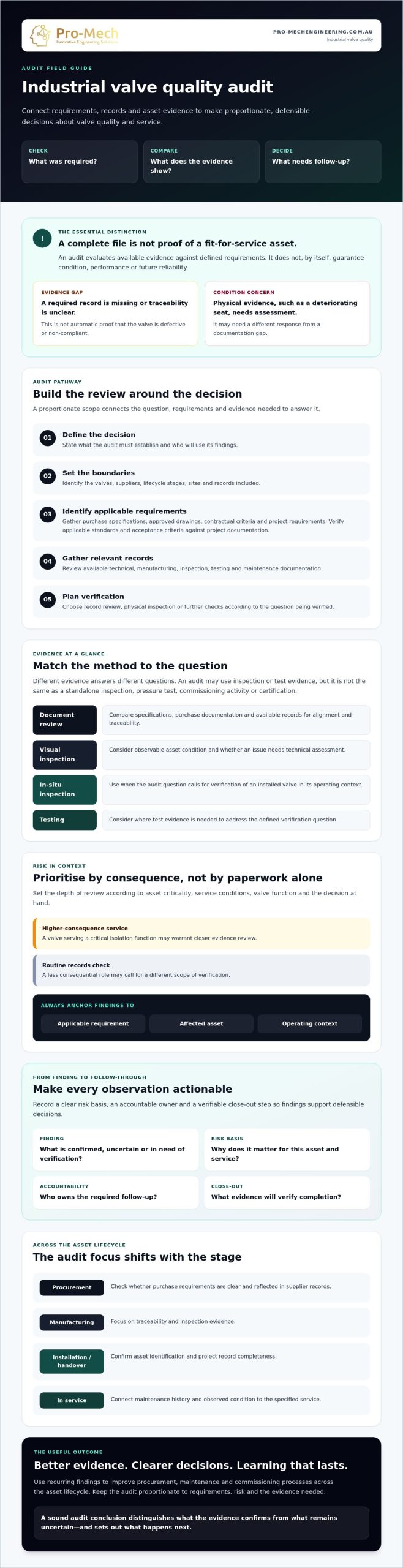
The objective depends on the asset’s lifecycle stage. A procurement review may check whether purchase requirements are clear and reflected in supplier records. A manufacturing audit may focus on traceability and inspection evidence. At installation or handover, the priority may be confirming asset identification and project record completeness. For an operating asset, the review can connect maintenance history and observed condition to the specified service. An audit may use inspection or test evidence, but it is not the same as a standalone inspection, pressure test, commissioning activity or certification. Each has a distinct purpose and scope.
Which valve quality questions should an audit answer?
Start with the decision the audit must support. Then compare the valve’s identity and available evidence with the approved specification, purchase documentation and intended service. The review should establish what is confirmed, what remains uncertain and what needs further verification. For example, a mismatch between records may call for document reconciliation, while visible damage may need technical assessment.
- Does the valve identification match the approved specification and purchase documentation?
- Do available records provide traceability for relevant materials, inspections and testing?
- Are there evidence gaps, documented deviations or condition concerns that need follow-up?
A missing record is an evidence gap, not automatic proof that a valve is non-compliant. Equally, complete paperwork doesn’t establish the current condition of an installed asset. Assess each finding against applicable requirements and the evidence available.
When is an industrial valve audit useful?
An audit can support project handover, procurement review, investigation of recurring defects or maintenance planning. Set the scope according to asset criticality, process conditions and the decision at hand. A review for a high-consequence service may need more verification than a routine records check. The client determines which contractual and regulatory requirements apply. Confirm them against project documentation before assessing conformity.
How to scope a valve quality audit around requirements, risk and evidence
A proportionate audit starts with the decision it needs to support. Is the team reviewing supplier documentation, confirming handover records or prioritising maintenance follow-up? The answer determines which valves, lifecycle stages and records belong in scope, and what evidence is needed to reach a defensible conclusion.
Use a sequence that can be adapted to the project:
- Define the decision: State what the audit must establish and who will use its findings.
- Set boundaries: Identify the assets, suppliers, lifecycle stages, sites and records included.
- Identify requirements: Gather applicable purchase specifications, approved drawings, contractual criteria and project requirements.
- Gather records: Locate relevant technical, manufacturing, inspection, testing and maintenance documentation.
- Plan verification: Decide which records need review and where physical inspection or further checks are warranted.
Prioritise according to service conditions, valve function and the consequence of failure. A valve serving a critical isolation function may warrant closer evidence review than one with a less consequential role. The operating environment and known maintenance history can also affect what needs verification. Check applicable standards and acceptance criteria against project documents and current editions rather than assuming they apply from a generic checklist. A background reference on valve inspection and testing standards can help orient the review, but the project requirements govern the audit criteria.
How should teams define audit scope and sampling?
Document the asset population and selection method before reviewing records. Representative sampling can focus effort across a defined group, but it doesn’t prove that sampled and unsampled valves are equivalent. Record the rationale, exclusions, access limits and assumptions. If identification or records are incomplete, state how that limits the conclusions rather than extending them beyond the evidence.
Which records support valve traceability?
Compare purchase specifications, data sheets, approved drawings and deviations for consistency. Check available material, manufacturing, inspection and test records against specified requirements, then review maintenance history when the audit concerns operating assets. An inspection and test plan is relevant only where it applies to the project scope. Record missing or conflicting documents for follow-up; their absence alone does not prove a technical defect.
Where specialist input could help define boundaries or review valve evidence, Pro-Mech’s valve quality audit support may be relevant. Pro-Mech also offers in-situ quality inspections, which can inform an audit when physical verification is appropriate, without replacing the broader scope and evidence review.
How records, inspection and testing fit into an industrial valve audit
An industrial valve quality audit can draw on different forms of evidence, each of which answers a different question. Document review checks recorded information against specified requirements. Inspection provides observations of the valve or installation. Testing assesses performance under a defined method and acceptance criteria. Select the method that addresses the audit question rather than treating every verification activity as interchangeable.
| Verification method | What it can help establish | Key limitation |
|---|---|---|
| Document review | Whether available records align with approved project documentation and specified criteria. | Records alone don’t confirm the current physical condition of an installed valve. |
| Visual inspection | Visible condition, identification and accessible installation details. | It can’t establish internal condition or performance that isn’t observable. |
| In-situ inspection | Condition or installation evidence at the asset, where these are within scope. | Access and operating conditions can limit what can be verified. |
| Specified testing | Performance against the test method and acceptance criteria defined for the work. | A result applies to the test performed, not automatically to every operating condition. |
What can document review establish about valve quality?
Compare available records with approved project documents and applicable acceptance criteria. Check that identifiers, revisions and relevant material, manufacturing, inspection and test records are consistent and traceable. Record the document title or reference, revision and any unresolved discrepancy. A missing or inconsistent record identifies an evidence gap; by itself, it doesn’t prove a physical defect or non-compliance.
When should an audit include physical inspection or testing?
Consider in-situ inspection when the audit concerns asset condition or installation evidence that records can’t resolve. Include testing only when it is relevant and authorised for the scope. Before witness testing, agree the method, acceptance criteria, responsibilities and required records. Any non-destructive testing should be justified by the audit scope and carried out under approved procedures appropriate to the examination.
For practical detail on field verification, see this guide to in-situ valve inspections. For test-related context, refer to the guide to industrial valve testing standards and check applicable requirements against project documentation.
An audit finding should identify the evidence reviewed, the requirement reference and the asset or record affected. This makes the finding traceable and helps reviewers distinguish a confirmed deviation from an unresolved question that needs further verification.
How to assess audit findings and prioritise corrective actions
Findings should distinguish what the evidence establishes from what still needs investigation. An industrial valve quality audit may identify a confirmed non-conformity against a defined requirement, a potential risk requiring further assessment, a documentation gap, or an improvement opportunity where no requirement has been breached. Keeping these categories separate prevents an incomplete record being treated as proof of equipment failure, or a verified deviation being understated as an administrative issue.
Prioritise follow-up using consequence, likelihood and uncertainty criteria approved by the organisation. Consider the valve’s function, service conditions and potential operational effect, as well as the reliability of the available evidence. Apply the organisation’s established risk process rather than introducing an unapproved scoring scale. If there is not enough evidence to judge the risk, record the uncertainty and identify what further verification is needed.
How should audit findings be documented?
Use a consistent record that links each finding to its requirement, evidence reference, affected asset and operating context. Include the risk rationale, responsible role and any review limitation. Separate observed facts from interpretation and recommendations. For example, state that a particular record could not be located rather than concluding that a required inspection was not performed, unless the evidence supports that conclusion.
A defensible finding connects the evidence, the requirement it is assessed against and the person responsible for the next action. This clarifies the basis for decisions and helps prevent unsupported conclusions about compliance, fitness for service or remaining life.
How can teams close out corrective actions?
Assign each action an accountable owner, an agreed due date and specific close-out evidence. Depending on the finding, that evidence might be a corrected record, a documented technical review or verification against the original requirement. An action’s status alone isn’t proof of resolution.
- Reference the original finding and define the required outcome.
- Record the action owner, due date and evidence needed for closure.
- Verify completion against the finding and document any residual risk or outstanding work.
- Escalate unresolved safety or operational concerns through the site management process.
Closure should confirm that the issue has been addressed, not simply that a task has been marked complete. If an action changes the technical basis or records, retain the revised evidence and make the decision trail accessible to relevant personnel. Physical verification, including an in-situ quality inspection, can contribute evidence where it suits the audit scope.
How to make an industrial valve quality audit useful across the asset lifecycle
An industrial valve quality audit is most useful when its outputs inform decisions beyond the review itself. Procurement teams can use recurring specification or traceability gaps to strengthen purchasing controls. Maintenance planners can consider condition-related findings alongside existing asset information when deciding on follow-up. At handover, audit references can help teams identify missing records and improve the information available for future operation.
Commissioning records also contribute to lifecycle continuity. Clear valve identification, approved documentation and retained verification records help connect project decisions with the operating asset. For more on this stage, see the valve installation and commissioning guide.
Look for patterns across findings, not just individual gaps. If the same document mismatch appears across supplier records or project packages, review whether procurement requirements, document controls or handover processes need improvement. Feed trends into supplier and project quality processes while keeping each corrective action linked to its original evidence and requirement.
What should an audit report provide to decision-makers?
A useful report gives readers enough context to understand and verify its conclusions. Summarise the audit scope, method, records and assets reviewed, limitations and prioritised findings. Separate items requiring immediate escalation from routine corrective actions and preventive improvements. Include traceable references, such as asset identifiers and document revisions, so responsible teams can locate the evidence and confirm the basis for each decision.
State limitations plainly. If access restrictions or incomplete records affected the review, explain what could not be established and what further verification may be needed. This helps prevent conclusions from being applied beyond the evidence examined.
When may specialist valve audit support be appropriate?
Specialist input may be useful when an audit involves complex valve records, site access or physical verification requirements. Pro-Mech Engineering Solutions Pty. Ltd. provides technical quality audits and in-situ quality inspections for heavy-industry applications. An in-situ inspection can contribute evidence about an asset, but it remains one input to the wider audit process. Confirm the proposed scope and deliverables against the project’s needs.
With a defined scope and traceable evidence, audit outputs can support practical decisions across procurement, handover and operation. Discuss industrial valve audit support with Pro-Mech.
Turn valve audit evidence into practical decisions
A well-scoped industrial valve quality audit connects project requirements and available evidence with the decisions teams need to make. Set the review around asset criticality, service conditions and the question at hand, then select document checks, inspection or testing accordingly. Findings should distinguish confirmed deviations from evidence gaps or potential risks, with each follow-up action assigned and verified against its original basis.
Used consistently, audit outputs can strengthen procurement controls, inform maintenance planning and improve commissioning records. They can also help teams identify recurring gaps and address them through supplier and project quality processes.
Pro-Mech Engineering Solutions Pty. Ltd. supports heavy-industry sectors nationally with technical quality audits and in-situ quality inspections. If specialist input could help define your review or assess valve evidence, discuss industrial valve audit support with Pro-Mech.
With clear scope, traceable findings and accountable follow-up, your team can make more informed valve quality decisions across the asset lifecycle.
Frequently Asked Questions
What is an industrial valve quality audit?
An industrial valve quality audit is a structured review of defined requirements, records and asset evidence. It assesses whether available information and observed conditions align with approved project documentation and the intended service. Scope may cover procurement, manufacture, installation or an operating asset. Findings identify what the evidence supports, what remains uncertain and what needs follow-up. An audit doesn’t guarantee valve performance, future reliability or fitness for service.
What does a valve quality audit check?
A valve quality audit checks whether the valve’s identification and available records align with specified requirements. Depending on scope, this can include purchase documentation, approved drawings, material traceability, manufacturing records, inspection and test results, installation information and maintenance history. The review may also identify visible condition concerns or inconsistencies between records and the installed asset. Assess each observation against an applicable requirement rather than treating it as non-compliance without supporting evidence.
How is a valve quality audit different from a valve inspection?
A valve inspection examines an asset or component for defined characteristics, such as visible condition or installation details. An audit is broader: it reviews requirements and evidence, and may use inspection results as one input. It can also examine documentation, traceability and how findings are handled. Neither activity automatically replaces pressure testing, commissioning or certification. Their purpose, method and acceptance criteria depend on the project scope and relevant requirements.
When should an industrial valve quality audit be carried out?
An industrial valve quality audit may be useful during procurement review, project handover, investigation of recurring defects or maintenance planning. Timing and scope should reflect the decision required, valve function, service conditions and potential consequence of failure. A records review before handover, for example, may identify traceability gaps, while an operating-asset review may include condition evidence. The client determines applicable contractual and regulatory requirements, which should be checked against project documentation.
What documents are needed for a valve quality audit?
Relevant documents depend on the audit objective and project requirements. Common records include purchase specifications, data sheets, approved drawings, deviation approvals, material and manufacturing records, inspection and test documentation, and maintenance history for operating assets. Commissioning or installation records may also be relevant at handover. Review document identifiers and revisions, and record missing or conflicting information clearly. An absent record is an evidence gap, not by itself proof of a physical defect.
Does a valve quality audit include pressure testing or non-destructive testing?
Not necessarily. Testing is included only when the audit scope and verification question justify it, and when the method and acceptance criteria are defined and authorised. Pressure testing may provide evidence against specified test requirements, while non-destructive testing may be considered where appropriate to the scope and carried out under approved procedures. An audit plan should state responsibilities and required records. Test results apply to the method and conditions used, not automatically to every service condition.
How are findings from a valve quality audit prioritised?
Prioritise findings using the organisation’s approved criteria for consequence, likelihood and uncertainty. Consider the valve’s function, operating context and strength of available evidence. Separate confirmed non-conformities from potential risks, documentation gaps and improvement opportunities so each receives an appropriate response. Record the requirement, evidence reference, affected asset and risk rationale, then assign an owner, due date and close-out evidence. Escalate unresolved safety or operational concerns through the site management process.