Accepting “allowable leakage” in a severe service environment is often a calculated risk that eventually results in an uncalculated disaster. When standard zero leakage isolation valves fail to maintain integrity in abrasive slurry or high-pressure steam lines, the subsequent degradation of seating surfaces initiates a recurring maintenance cycle. This process drains operational budgets and compromises personnel safety during critical plant shutdowns.
This guide provides a technical deep dive into high-performance valve technology, demonstrating how metal-seated designs and rigorous standards like API 598 (11th Edition) eliminate fugitive emissions and significantly extend mean time between maintenance (MTBM). You’ll gain a comprehensive understanding of zero leakage technology, engineering standards, and the operational advantages of metal-seated isolation in Australian industrial environments. We examine the engineering behind absolute isolation, compare international testing benchmarks, and outline the operational benefits of deploying ValvTechnologies solutions to ensure technical integrity across your site.
Key Takeaways
- Differentiate between “allowable leakage” and true zero leakage to enhance plant safety and meet stringent environmental compliance standards.
- Understand the mechanical principles of zero leakage isolation valves and how metal-to-metal sealing technology maintains integrity in abrasive slurry and high-pressure steam.
- Decipher international testing benchmarks, including API 598 and ISO 5208, to ensure your procurement aligns with rigorous performance classifications.
- Identify strategies to extend mean time between maintenance (MTBM) and reduce unplanned shutdowns in demanding Australian mining and power generation environments.
- Master the strategic selection process by evaluating media, pressure, and temperature requirements alongside technical commissioning and in-situ inspection plans.
Understanding Zero Leakage in Industrial Isolation
Industrial process integrity relies on the absolute segregation of media. While many general-purpose valves offer “low leakage” performance, severe service environments demand a higher threshold of technical validation through the use of zero leakage isolation valves. Zero leakage is technically defined as the absence of any detectable bubbles during high-pressure testing procedures. For engineers managing abrasive slurry or high-pressure steam, this distinction is the difference between operational stability and catastrophic component failure. Integrity is the priority.
Isolation vs. Control: Identifying the Role
A fundamental distinction exists between modulating flow and ensuring absolute shut-off. An Isolation valve serves a safety-critical function, whereas control valves prioritise precise flow regulation and pressure drops. In hazardous fluid handling, “bubble-tight” shut-off is essential to prevent the bypass of volatile or corrosive media. Seat leakage doesn’t just result in process loss; it causes high-velocity erosion that can destroy valve internals in a matter of hours.
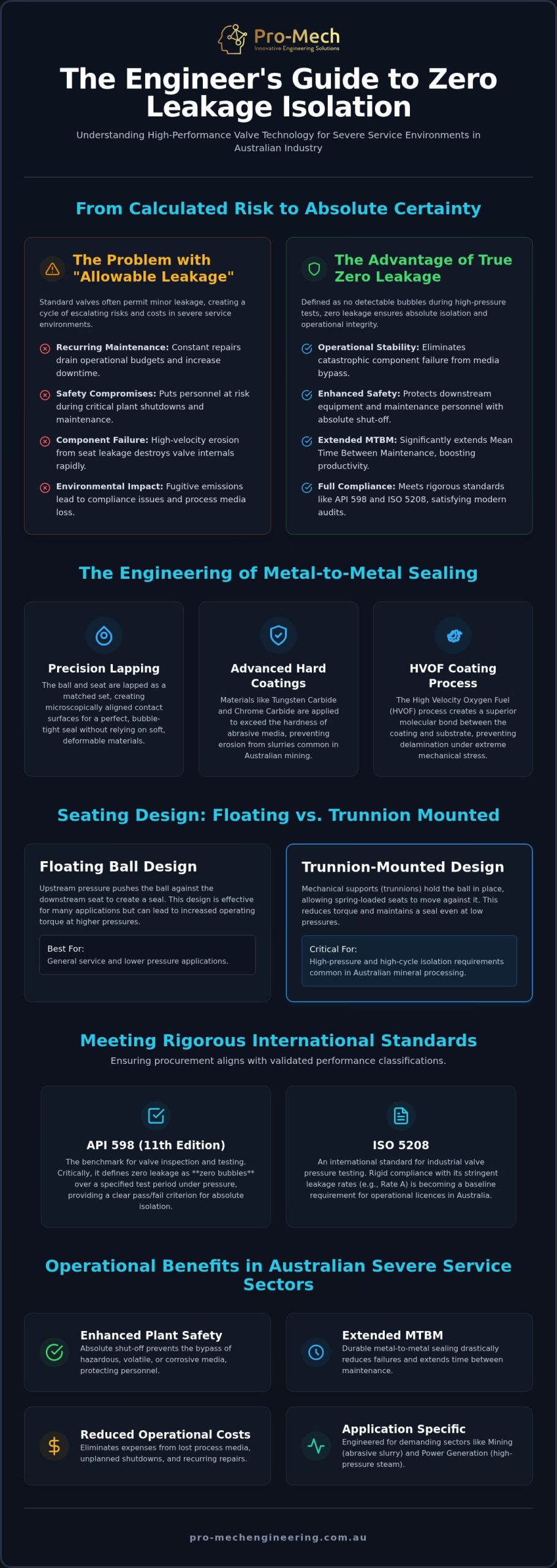
The Problem with “Allowable Leakage”
Standard valves often operate under frameworks that permit a specific volume of loss over time. While these “allowable leakage” rates might be acceptable in low-stakes utilities, they represent a significant liability in high-value mining or oil and gas operations. The cumulative cost of lost process media and the environmental impact of fugitive emissions are no longer tolerated by modern Australian safety audits. Rigid compliance with ISO 5208 and API 598 standards is becoming the baseline requirement for operational licences. Traditional soft-seated valves frequently fail in severe service because elastomers cannot withstand the mechanical shearing of solids or the thermal degradation of steam.
The shift toward metal-to-metal sealing technology represents a critical advancement in heavy industry engineering. By utilising hardened coatings and precision-lapped surfaces, metal-seated zero leakage isolation valves provide a robust barrier that maintains integrity where soft materials fail. This evolution ensures that isolation is absolute, protecting both the downstream equipment and the personnel tasked with maintenance. Reliability is built into the metallurgy.
The Engineering of Metal-to-Metal Sealing Technology
The mechanical integrity of zero leakage isolation valves depends on the precision of the metal-to-metal interface. Unlike soft-seated alternatives that rely on material deformation to create a seal, metal-seated valves utilise high-precision surface finishing and extreme sphericity to achieve absolute shut-off. This engineering approach requires the ball and seat to be lapped as a matched set, ensuring that the contact surfaces are microscopically aligned. Thermal expansion must also be factored into the design phase, particularly for high-temperature applications where material growth could otherwise cause the valve to seize or leak. Precision is the primary safeguard against bypass.
Seating Design: Floating vs. Trunnion Mounted
Pressure management is the core of effective sealing. In floating ball designs, the upstream pressure pushes the ball against the downstream seat to create a seal. This is effective for many applications, though it can increase operating torque at higher pressures. Trunnion mounted ball valves use mechanical supports to hold the ball in place, allowing the seats to move against the ball. Spring-loaded seats are often employed in these architectures to maintain a seal during low-pressure scenarios where line pressure alone is insufficient. Choosing the correct architecture is vital for high-cycle isolation requirements common in Australian mineral processing.
Material Selection for Severe Service
Durability in abrasive environments requires material hardness that exceeds the hardness of the process media. Australian mining slurries often contain silicates and other abrasive particulates that quickly erode standard stainless steel. ValvTechnologies metal-seated designs address this by using advanced hard-facing materials like Chrome Carbide or Tungsten Carbide. These coatings are applied using the High Velocity Oxygen Fuel (HVOF) process. HVOF coatings ensure a molecular bond between the coating and the substrate, preventing delamination under extreme mechanical stress. For those managing complex infrastructure, technical procurement through a specialised partner ensures the metallurgy matches the specific corrosive profile of the site.
The Integral Seat Advantage
Achieving compliance with ISO 5208 testing standards is significantly more reliable with an integral seat design. Traditional valves use replaceable seat rings that are pressed or threaded into the body, creating a secondary leak path behind the seat. Integral seats are machined directly into the valve end-cap, eliminating this potential failure point entirely. This design choice extends the service life of the valve and simplifies maintenance, as there are fewer components prone to bypass. While the initial investment in metal-seated technology is higher than soft-seated options, the long-term economic impact is substantial, primarily through the elimination of unplanned shutdowns and the reduction of seat replacement frequency.
Compliance and Leakage Testing Standards
The procurement of zero leakage isolation valves requires a precise understanding of the testing protocols that validate their performance. Standards such as ISO 5208:2015 and API 598 valve inspection and testing define the rigorous parameters for pressure boundary integrity and closure tightness. While many industrial valves are rated to Class VI under ANSI/FCI 70-2-2021, it’s important to recognise that this classification permits a nominal amount of leakage based on the valve’s port diameter. For severe service, this “allowable” loss is often unacceptable. True zero leakage performance signifies that no visible leakage was detected during the specified test duration, typically involving high-pressure gas or liquid media. Validation is not a suggestion; it’s a requirement for operational integrity.
Deciphering API 598 and MSS SP-61
Comparing international standards reveals varying levels of stringency that impact long-term reliability. MSS SP-61 focuses on pressure testing for newly manufactured valves, while API 598 is more comprehensive, covering inspection, supplementary examinations, and pressure test requirements. Under standard API protocols, metal-to-metal seating often permits a nominal drop count per minute. However, ValvTechnologies engineering often exceeds these mandatory requirements, guaranteeing zero bubbles during high-pressure gas testing for several minutes. Interpreting test certificates correctly ensures that the zero leakage isolation valves delivered match the safety and environmental specifications of the project. A certificate is only as valuable as the test methodology it documents.
Factory Acceptance Testing (FAT) and Witness Testing
Rigorous validation before site delivery is a non-negotiable step in the technical supply chain. Factory Acceptance Testing (FAT) provides a controlled environment to verify that each valve performs to its technical specification before it is shipped to remote Australian sites. Pro-Mech Engineering Solutions Pty. Ltd. facilitates this process by overseeing quality audits and providing witness testing services. This oversight ensures that the valve’s seating integrity and actuator functionality are verified under “as-installed” conditions. Comprehensive documentation and quality audits are essential for maintaining Australian industrial compliance, particularly in high-stakes sectors like power generation and mineral processing. These verified results provide the technical assurance that the isolation will remain absolute once the valve is commissioned in the field, reducing the risk of unplanned shutdowns due to seat failure.
Operational Benefits in Australian Severe Service Sectors
The Australian industrial landscape presents unique geographical and operational hurdles. Remote sites often face logistical delays that turn a simple valve failure into a multi-day shutdown. In these high-stakes environments, zero leakage isolation valves act as a fundamental safeguard for process uptime and site profitability. While utility-grade valves might suffice in controlled urban settings, the extreme pressures and abrasive media found in national heavy industry sectors demand a more robust technical solution. Reliability is the foundation of operational success.
Mining and Mineral Processing
Mining circuits, particularly those involving high-density slurries and tailings, are notoriously destructive to standard valve internals. When solids-laden media bypasses a seat, the high-velocity erosion quickly compromises the valve body. By implementing ValvTechnologies metal-seated designs, operators can significantly extend the service life of their assets in autoclave and leaching circuits. This shift reduces the total cost of ownership by minimising the frequency of specialised maintenance interventions. Reliability ensures that maintenance teams can execute lockout/tagout procedures with absolute confidence, knowing the isolation is bubble-tight and worker safety is protected from high-pressure ingress.
Power Generation and High-Pressure Steam
In the power generation sector, the performance of boiler feed and steam bypass systems directly impacts the plant’s heat rate and overall thermal efficiency. Even a minor leak in high-pressure steam lines represents a constant energy drain, forcing the system to compensate and reducing overall thermal efficiency. Zero leakage technology eliminates these losses, providing a measurable boost to operational performance. Safety is equally paramount; during high-temperature maintenance, technicians rely on the valve’s ability to provide a definitive barrier against hazardous steam exposure. The precision of metal-seated architecture ensures that even at extreme temperatures, the mechanical seal remains intact.
Environmental compliance is another driver for adopting advanced isolation. For oil and gas operators, eliminating fugitive emissions is a non-negotiable regulatory requirement. High-performance isolation prevents the release of volatile organic compounds, ensuring adherence to national environmental standards. To discuss a specialised procurement and commissioning plan tailored to your site’s specific requirements, contact Pro-Mech Engineering Solutions Pty. Ltd.. Technical validation at the procurement stage prevents operational failure in the field.
Strategic Procurement: Selecting Zero Leakage Solutions
The procurement of zero leakage isolation valves is a technical exercise rather than a simple commercial transaction. Engineers must conduct a thorough evaluation of the specific pressure, temperature, and media characteristics of the application before selecting a valve architecture. A mismatch between the valve specification and the process conditions initiates premature seat degradation and substantial downtime. Technical validation is the only path to long-term operational success in abrasive or high-pressure environments. Precision in the selection phase prevents failure in the field.
The Value of Technical Procurement Partners
Selecting equipment based solely on the initial purchase price often results in significantly higher operational expenditures over the asset’s lifecycle. While generalist suppliers may offer lower upfront costs, they frequently lack the engineering depth required to provide technical validation for severe service environments. Pro-Mech Engineering Solutions Pty. Ltd. assists in technical valve selection by aligning complex application requirements with the performance of ValvTechnologies metal-seated designs. This partnership ensures that national engineering support and meticulous project management expertise are available from the initial design phase through to final delivery. Reliability is a collaborative outcome.
Technical integrity extends beyond the valve body to the entire automated assembly. The integration of actuators and actuated packages requires precise torque calculations and timing synchronisation to maintain seating integrity. For high-pressure applications where actuation torque is a critical design parameter, understanding the mechanical differences between trunnion mounted ball valves and floating ball designs is essential to specifying the correct actuator package. The provision of comprehensive Installation and Commissioning Plans alongside in-situ quality inspections ensures the validation of zero leakage isolation valves under site-specific conditions. This systematic approach reduces the risk of installation errors that could compromise the mechanical seal. Thorough documentation remains a cornerstone of this process, providing the technical assurance required for Australian industrial compliance.
Future-Proofing Your Plant Infrastructure
Investing in high-specification valves is a strategic move to meet evolving safety and environmental regulations within the Australian industrial sector. As fugitive emission standards tighten, the cost of retrofitting inferior equipment will far exceed the initial investment in zero leakage technology. Software development also plays a growing role in managing valve assets, allowing for predictive maintenance scheduling based on real-time performance data. Meticulous planning today prevents the obsolescence of plant infrastructure tomorrow. To ensure the technical integrity of your infrastructure, consult with Pro-Mech Engineering Solutions Pty. Ltd. on your severe service valve requirements.
Advancing Technical Integrity in Severe Service Environments
Achieving absolute process isolation is a prerequisite for operational safety and plant efficiency in Australia’s demanding industrial sectors. This guide has detailed how transitioning from standard equipment to metal-seated zero leakage isolation valves eliminates the recurring costs of bypass and seat erosion. By adhering to rigorous testing benchmarks like API 598 and leveraging advanced HVOF coating technologies, operators can significantly extend maintenance intervals and protect downstream infrastructure.
Technical procurement is the primary safeguard against the uncalculated risks of “allowable leakage.” As an authorised ValvTechnologies distributor with national engineering support, Pro-Mech Engineering Solutions specialises in severe service flow control for the most challenging applications. Ensuring that your valve selection aligns with the specific metallurgical and mechanical demands of your site is essential for long-term reliability.
Discuss your severe service isolation requirements with our engineering team to ensure your next project benefits from precision-engineered isolation. We look forward to supporting your site’s operational integrity.
Frequently Asked Questions
What is the difference between bubble-tight and zero leakage?
Bubble-tight shut-off is a term often associated with ANSI/FCI 70-2 Class VI standards, which permit a nominal amount of leakage based on valve diameter. In contrast, zero leakage isolation valves are validated to show no detectable bubbles or drops during rigorous high-pressure testing. This technical distinction is vital for severe service where even minute bypass leads to seat erosion and process contamination. It’s the standard required for absolute safety.
How long do metal-seated zero leakage valves typically last compared to soft-seated?
Metal-seated valves typically offer a service life significantly longer than soft-seated alternatives in harsh environments. While elastomers in soft-seated valves degrade quickly under thermal stress or mechanical abrasion, metal-to-metal sealing technology maintains integrity. In many Australian mining applications, switching to metal-seated designs has extended the mean time between maintenance (MTBM) from months to years. This reduces the total cost of ownership through fewer replacements and less downtime.
Are zero leakage valves suitable for abrasive slurry applications?
Metal-seated valves are specifically engineered for high-density abrasive slurries and tailings. The use of High Velocity Oxygen Fuel (HVOF) coatings, such as Tungsten Carbide, ensures the sealing surfaces are harder than the media itself. This prevents the particulates from scoring the seat or ball, which is the primary cause of failure in standard isolation valves. These designs ensure absolute shut-off even when managing solids-laden fluids in mining circuits.
Which international standards define zero leakage performance?
Several critical standards define the parameters for zero leakage performance. API 598 is the most common for high-pressure testing and inspection, while ISO 5208:2015 provides a global framework for the pressure testing of metallic valves. MSS SP-61 is also utilised for factory testing of new valves. Adherence to these standards ensures that the isolation provided meets the safety and environmental requirements of modern industrial facilities across the country.
Can zero leakage be achieved in high-temperature environments?
Absolute isolation is achievable in extreme temperatures through precise metallurgy and mechanical design. Metal-seated isolation valves are rated for temperatures exceeding 500°C, where soft-seated materials would suffer catastrophic failure. Engineering considerations for thermal expansion ensure that the ball and seat remain aligned without seizing. This makes them ideal for boiler feed systems and high-pressure steam bypass applications in the power generation sector where heat is constant.
What maintenance is required for metal-seated isolation valves?
Metal-seated valves are designed for low-maintenance operation, though periodic verification is essential. Routine maintenance typically involves checking actuator torque settings and ensuring the stem packing remains tight. Because the seats are often integral or hard-faced, they don’t require the frequent replacement cycles common with soft-seated valves. In-situ quality inspections help identify potential issues before they lead to unplanned shutdowns, maintaining the long-term operational integrity of the plant.
Why is ValvTechnologies considered the leader in zero leakage technology?
ValvTechnologies is recognised as a leader due to their commitment to zero leakage isolation valves through innovative engineering. Their use of proprietary HVOF coatings and integral seat designs eliminates common leak paths found in traditional valves. Each ball and seat is lapped as a matched set to ensure a molecularly tight seal. This focus on severe service performance provides a level of reliability that generalist manufacturers cannot match in complex environments.
How does Pro-Mech support the commissioning of isolation valves in Australia?
Pro-Mech Engineering Solutions provides comprehensive national support for the entire valve lifecycle. This includes developing detailed Installation and Commissioning Plans to ensure correct site integration. They also facilitate in-situ quality inspections and witness testing to verify that each valve meets its technical specification before and after installation. Their expertise in project management ensures that complex infrastructure projects are supported with technical precision and reliable hardware from the start.