
A single valve failure in a high-pressure system doesn’t just halt production; it compromises the structural integrity of your entire asset and triggers immediate regulatory scrutiny under the updated AS/NZS 3788:2024 standards. When evaluating industrial valve suppliers Australia, you understand that procurement is no longer a simple matter of checking stock levels. It’s a complex engineering challenge where incorrect material selection or a lack of technical commissioning leads to avoidable downtime and compromised safety protocols.
This guide, from Pro-Mech Engineering Solutions Pty. Ltd., provides a definitive technical framework for identifying partners capable of supporting severe service applications and national infrastructure projects. We’ll examine the transition from hardware-only supply to engineering-led partnerships, focusing on high-performance valve hardware and the critical role of site-specific commissioning plans. By aligning procurement with the latest risk-based inspection protocols, your facility can achieve the high degree of technical assurance and operational longevity required in the 2026 industrial landscape.
Key Takeaways
- Learn how to evaluate industrial valve suppliers Australia by moving beyond basic stock availability toward an engineering-led procurement model that prioritises technical validation.
- Understand the critical material selection strategies required for severe service and mining slurries to prevent premature valve erosion and unplanned plant downtime.
- Identify the core criteria for assessing a supplier’s technical competence, focusing on the total cost of ownership rather than just the initial procurement price.
- Discover why professional commissioning and in-situ quality inspections are the most vital phases for ensuring long-term operational integrity and compliance with AS/NZS 3788:2024.
- Explore the advantages of a national technical partnership that offers exclusive access to high-spec hardware like ValvTechnologies alongside custom engineering solutions.
The Landscape of Industrial Valve Supply in Australia
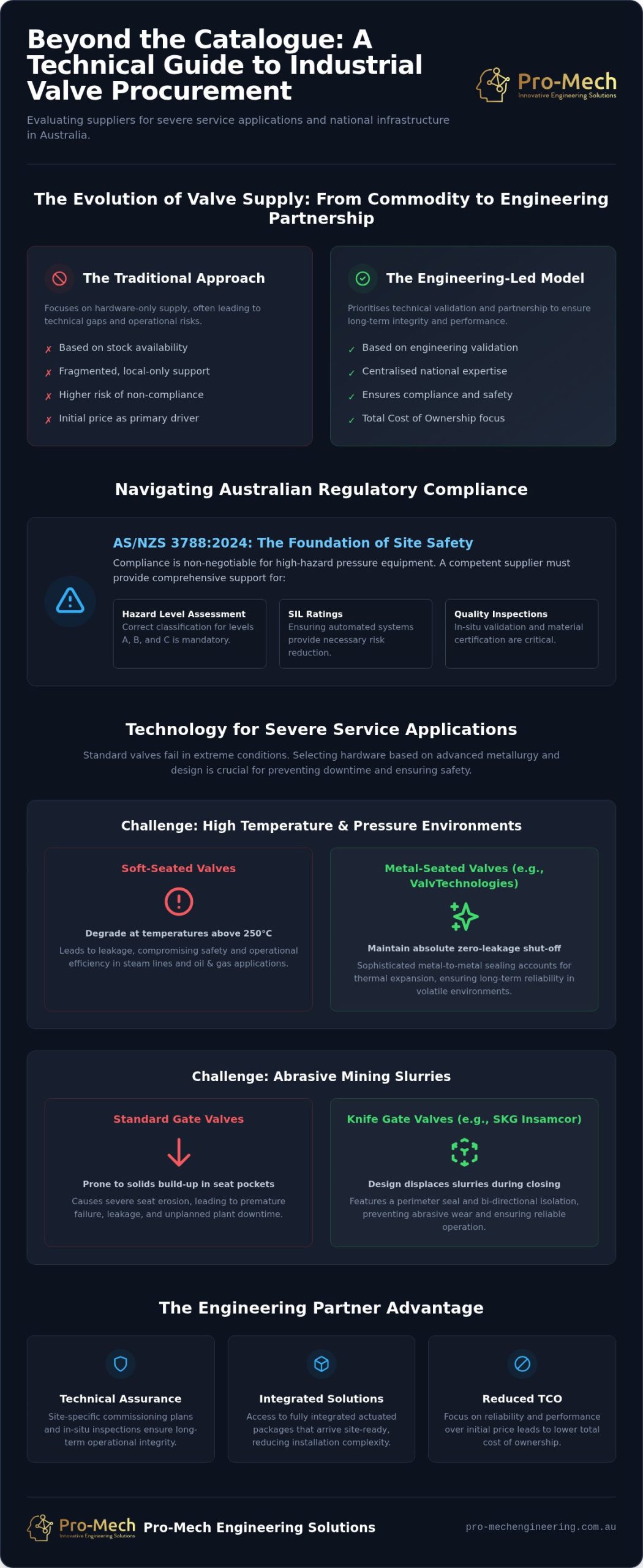
The Australian heavy industry sector demands a level of precision that generalist wholesalers can’t provide. Critical infrastructure projects in mining and power generation require more than just off-the-shelf components. The shift toward engineering-led procurement reflects a growing recognition that valve performance is intrinsically linked to plant uptime. Expert industrial valve suppliers Australia now prioritise technical validation over simple inventory management, ensuring that every component matches the specific pressure and temperature requirements of the application.
National supply chains are vital for maintaining operational integrity across remote sites. Relying on fragmented, local-only stockists often leads to inconsistent material standards and technical support gaps. A centralised, engineering-focused supply model ensures that high-spec hardware, such as a specialised industrial control valve, is backed by consistent commissioning protocols regardless of the project’s geographic location. This systematic approach reduces the risk of non-compliance with Australian standards and ensures that the technical nuances of the equipment are understood before it reaches the site.
Current Trends in National Valve Procurement
Modern plant automation has driven a significant increase in the demand for zero-leakage isolation, particularly within the power and chemical processing sectors. It’s no longer sufficient to supply a standalone valve; the industry now expects fully integrated actuated packages that arrive site-ready. Proximity to technical expertise has surpassed the importance of local warehouse footprints. Engineers require immediate access to specialists who understand the nuances of ValvTechnologies metal-seated designs or DelVal’s seating technologies to ensure long-term reliability.
Regulatory Compliance and Safety Standards
Compliance with Australian standards is the foundation of site safety. Navigating the complexities of AS/NZS 3788:2024 requires a disciplined approach to documentation and inspection. High-hazard pressure equipment (Hazard Levels A, B, and C) must meet strict registration and witness testing requirements before commissioning. Professional suppliers facilitate this through in-situ quality inspections and rigorous validation of material certifications. Safety Integrity Level (SIL) ratings have become a mandatory benchmark in 2026 valve selection to ensure that automated safety systems provide the necessary risk reduction in volatile environments.
Technical Standards for Severe Service and Mining
Severe service environments in Australian mining and power generation demand a departure from conventional valve design. High-temperature and high-pressure applications subject components to extreme thermal cycling and mechanical stress that standard isolation valves cannot survive. Leading industrial valve suppliers Australia now specify hardware based on advanced metallurgy and sealing technologies that align with rigorous Australian technical standards. Selecting the correct material is the primary defence against premature failure and environmental discharge in these high-stakes settings.
Metal Seated Valves for High-Risk Environments
ValvTechnologies has redefined zero-leakage performance through sophisticated metal-to-metal sealing. Unlike soft-seated alternatives that degrade at temperatures exceeding 250 degrees Celsius, these metal-seated ball valves maintain absolute shut-off in the most volatile oil and gas applications. The design accounts for thermal expansion, a critical factor for check valves operating in high-pressure steam lines. This level of technical assurance is essential for maintaining site safety and meeting 2026 compliance targets. For complex projects, consult with the experts at Pro-Mech Engineering to ensure your hardware matches your specific pressure-temperature curve.
Mining Slurry Handling and Knife Gate Technology
Abrasive wear is the leading cause of valve failure in mineral processing. Standard gate valves often suffer from solids build-up in the seat pocket, leading to seat erosion and eventual leakage. SKG Insamcor knife gate valves address this through a perimeter seal and a gate design that displaces slurries during the closing stroke. Bi-directional isolation is increasingly preferred in 2026 mining circuits because it allows for flow in either direction without compromising seat integrity. These maintenance-friendly designs are purpose-built for remote Australian sites where reducing plant downtime is a commercial necessity. Collaborating with specialised industrial valve suppliers Australia ensures your infrastructure is equipped to withstand these unique geological challenges.
Evaluating Industrial Valve Suppliers: Selection Criteria
Procurement professionals in the Australian heavy industry sector are moving away from simple price-per-unit metrics. The focus has shifted toward Total Cost of Ownership (TCO), a metric that accounts for maintenance intervals, energy efficiency, and the catastrophic costs of unplanned downtime. While some legacy firms rely on historical reputation, modern project requirements demand more than heritage. Leading industrial valve suppliers Australia must demonstrate a deep understanding of current Australian Standards for industrial valves to ensure every component is fit for its specific pressure-retaining purpose.
Choosing a national technical partner over a state-based distributor provides essential consistency across geographically dispersed assets. National partners maintain a unified engineering standard, ensuring that a commissioning plan developed for a remote extraction site matches the technical rigour applied in a metropolitan processing facility. This level of oversight is critical for infrastructure projects where the failure of a single isolation point can compromise an entire network’s safety and profitability.
Wholesale Distribution vs. Technical Partnership
The distinction between a generalist wholesaler and a technical partner lies in the deliverables provided beyond the hardware. Procurement officers now prioritise suppliers who offer comprehensive installation and commissioning plans alongside their stock lists. A technical valve procurement partner doesn’t just ship a crate; they provide the engineering validation required for high-stakes environments. This includes the ability to conduct in-situ quality inspections, which are vital for verifying that the equipment performs as specified once integrated into the plant’s existing pipework. These inspections mitigate the risk of installation errors that often lead to premature seat degradation or seal failure.
Actuation and Control System Integration
Efficiency in 2026 plant operations depends on the seamless integration of valve hardware with sophisticated automation systems. Sourcing complete actuated valve packages from a single supplier eliminates the compatibility issues that arise when mixing components from multiple vendors. Whether the application requires electric or pneumatic actuator systems, the technical requirements for torque, speed, and fail-safe positions must be precisely calculated. It’s also essential to ensure that OCV control valves are fully compatible with existing plant instrumentation to maintain precise flow regulation. A specialist supplier handles these technical nuances during the assembly phase, delivering a pre-tested, site-ready solution that simplifies the final commissioning process.
The Strategic Role of Commissioning and Engineering Audits
Technical validation reaches its most critical point during the transition from procurement to operation. Experienced industrial valve suppliers Australia recognise that the commissioning phase is the ultimate test of engineering alignment. It’s during this stage that the theoretical performance of high-spec hardware is verified against actual site conditions. Under the updated AS/NZS 3788:2024 standards, a documented inspection plan is now mandatory for every piece of pressure equipment. This regulatory shift emphasizes that commissioning is no longer a checklist but a vital component of lifecycle management and statutory compliance.
Professional engineering audits identify systemic risks before they manifest as costly plant downtime. These audits go beyond superficial checks, examining the interaction between the valve, the actuator, and the process medium. For high-hazard sites (Hazard Levels A, B, and C), rigorous witness testing ensures that the equipment meets the specified safety and performance benchmarks. This process-oriented approach provides a level of quality assurance that standard wholesale delivery cannot match. It ensures that every component is technically validated and safe for long-term service in volatile environments.
Installation and Commissioning Planning
Developing site-specific plans for complex valve integrations is essential for reducing installation errors. A comprehensive commissioning plan includes detailed torque sequences, seal integrity checks, and functional testing of actuated packages under site-specific load conditions. Technical oversight during this phase prevents common mistakes such as incorrect orientation or improper seal seating. Detailed Operation and Maintenance (O&M) manuals must be provided to ensure site personnel can maintain the equipment’s integrity throughout its service life. This disciplined planning phase is what distinguishes a technical partner from a simple hardware distributor.
Software and Digital Management Solutions
The industry is moving away from traditional paper-based compliance management toward digital frameworks. Custom industrial software now allows plant managers to track maintenance schedules and valve performance in real time. These digital tools provide a centralized repository for material certifications and historical inspection data. Custom industrial software improves quality audit accuracy by providing a verifiable, time-stamped digital trail of every inspection and maintenance event. This transparency is vital for meeting the risk-based inspection requirements outlined in modern Australian safety regulations. To ensure your assets are managed with this level of technical precision, partner with Pro-Mech Engineering Solutions for your next infrastructure project.
Pro-Mech Engineering: Your National Technical Partner
Pro-Mech Engineering Solutions Pty. Ltd. functions as an authoritative technical partner for the Australian heavy industry sector. While many industrial valve suppliers Australia focus primarily on physical inventory and regional logistics, Pro-Mech Engineering Solutions Pty. Ltd. prioritises the engineering nuances that ensure long-term operational success. The firm’s methodology is grounded in technical integrity, offering a steady hand in both equipment supply and complex project management across national infrastructure. By positioning itself as a specialist’s specialist, the company ensures that every procurement decision is backed by rigorous technical validation and a commitment to operational safety.
Authorised Distribution of Premium Hardware
Pro-Mech Engineering Solutions Pty. Ltd. provides exclusive access to world-class valve technologies designed for the most demanding environments. As an authorised distributor for ValvTechnologies, the firm supplies metal-seated ball valves that guarantee absolute shut-off in severe service applications. For diverse industrial sectors, the DelVal range of butterfly and ball valves offers high-performance isolation and control, meeting the strict requirements of power generation and chemical processing. The selection of hardware is based on proven reliability in high-pressure and high-temperature settings.
Mining operations benefit from the inclusion of SKG Insamcor knife gate valves, which are engineered specifically for abrasive slurry handling and high-solids environments. These solutions are complemented by OCV control valves and custom-assembled actuated packages, ensuring that every component of the flow control system is technically validated before site arrival. This selection of premium hardware ensures that procurement officers don’t have to compromise on material standards or technical support when sourcing critical infrastructure components for remote or high-risk sites.
Professional Engineering and Software Services
The advantage of partnering with Pro-Mech Engineering Solutions Pty. Ltd. extends beyond hardware delivery into the realm of professional engineering oversight and lifecycle support. The firm conducts in-situ quality audits and technical witness testing to verify that equipment performs to the required safety benchmarks under actual operating conditions. This systematic approach to validation is essential for maintaining compliance with modern pressure equipment standards and reducing the risk of catastrophic asset failure in high-hazard environments. The focus remains on providing a disciplined framework for asset integrity.
Innovation is integrated through custom software development for industrial valve management. These digital solutions enable plant operators to track maintenance schedules and monitor asset health with precision, moving away from fragmented paper-based records toward a more disciplined, data-driven framework. This integration of traditional engineering standards with modern digital oversight ensures that industrial valve suppliers Australia can provide the comprehensive coverage required for 2026 operational integrity. This dual focus on high-end hardware and technical commissioning creates a stable foundation for long-term project success.
Contact Pro-Mech Engineering Solutions Pty. Ltd. for a technical consultation on your next project.
Securing Long-Term Asset Integrity through Engineering Excellence
The transition toward engineering-led procurement is essential for maintaining the structural and operational integrity of Australian heavy industry. Identifying industrial valve suppliers Australia capable of delivering both high-performance hardware and technical validation ensures that your assets comply with the updated AS/NZS 3788:2024 standards. Success in the 2026 industrial landscape requires a focus on the total cost of ownership, where the value of a technical partnership far outweighs the convenience of a generalist wholesaler.
Pro-Mech Engineering Solutions provides this necessary technical gravity through a national Australian supply chain and specialised engineering audit services. As an authorised ValvTechnologies distributor, the firm offers the precise hardware and commissioning expertise required for severe service and mining applications. By prioritising meticulous planning and rigorous witness testing, your facility can achieve superior reliability and safety outcomes. It’s time to move beyond stock availability toward a disciplined, engineering-focused supply model.
Request a Technical Valve Procurement Quote to align your infrastructure with world-class technical standards. We look forward to supporting your site’s operational success.
Frequently Asked Questions
How do I choose the right industrial valve supplier in Australia?
Selecting a partner requires assessing their engineering depth beyond basic inventory levels. Leading industrial valve suppliers Australia must demonstrate a thorough understanding of the total cost of ownership and provide technical validation for severe service environments. It’s essential to partner with a firm that offers national consistency and a disciplined approach to material certification. This ensures that every component selected is fit for its specific pressure-retaining purpose and aligns with the latest statutory safety requirements.
What is the difference between a standard and a severe service valve?
Standard valves are typically designed for general-purpose flow control in stable environments with minimal pressure fluctuations. Severe service valves, however, are engineered to withstand extreme thermal cycling, high pressures, and abrasive media. These specialised components often utilise advanced metal-seated technology, such as ValvTechnologies designs, to maintain zero-leakage performance where soft-seated alternatives would fail. This distinction is critical for preventing catastrophic asset failure in high-hazard power generation and mining applications.
Why is zero leakage critical in power generation applications?
Zero leakage is the primary defence against energy loss and the degradation of downstream equipment in high-pressure steam systems. Even minor internal bypass can lead to seat erosion and eventual valve failure, triggering unplanned downtime and safety risks. Utilising metal-seated isolation valves ensures that critical systems remain secure during operational cycles. This technical assurance is vital for maintaining plant efficiency and meeting the rigorous safety benchmarks required for modern Australian energy infrastructure.
What are the benefits of using bi-directional knife gate valves in mining?
Bi-directional knife gate valves, such as the SKG Insamcor range, provide the flexibility to isolate flow from either direction without compromising the seal. This is particularly advantageous in mineral processing circuits where pressure surges or backflow are common. The design features a perimeter seal and a gate that displaces abrasive slurries during operation, preventing the solids build-up that often causes seat damage. This results in extended maintenance intervals and improved reliability in remote sites.
Can Pro-Mech provide technical commissioning plans for new installations?
Pro-Mech Engineering Solutions Pty. Ltd. specialises in developing site-specific commissioning plans that reduce the risk of installation errors. These technical deliverables include functional testing protocols, torque sequences, and seal integrity checks designed for complex valve integrations. By providing professional oversight during the final assembly and installation phases, the company ensures that the hardware performs as specified. This engineering-led approach is essential for achieving long-term operational integrity and meeting all relevant Australian compliance standards.
What standards must industrial valves meet for Australian oil and gas projects?
Valves in the oil and gas sector must comply with the AS/NZS 3788:2024 standards for in-service inspection of pressure equipment. This involves meeting specific Hazard Level registrations (A, B, or C) as defined by AS 4343 and ensuring all components undergo rigorous witness testing. Professional industrial valve suppliers Australia facilitate this through meticulous documentation and material validation. Adhering to these standards is mandatory for ensuring site safety and preventing environmental discharge in high-pressure processing environments.
How does custom software assist in industrial valve management?
Custom industrial software enables plant operators to move away from fragmented paper records toward a disciplined digital management framework. This technology allows for real-time tracking of valve performance, maintenance schedules, and material certifications across national assets. It significantly improves the accuracy of quality audits by providing a verifiable, time-stamped digital trail of every inspection event. This level of digital oversight is critical for meeting the risk-based inspection requirements outlined in the latest Australian safety regulations.
Does Pro-Mech supply actuated valve packages nationally?
Pro-Mech Engineering Solutions Pty. Ltd. supplies fully integrated actuated valve packages to heavy industry projects across the entire country. These packages arrive site-ready, featuring pre-tested combinations of valves, actuators, and control instrumentation. The firm provides the technical expertise required to calculate torque, speed, and fail-safe requirements for both electric and pneumatic systems. This national supply capability ensures that critical infrastructure projects receive consistent engineering standards and high-performance hardware regardless of their geographic location.