
Effective isolation in mineral processing isn’t achieved by hardware alone, but through the precise synchronisation of metallurgy, seat design, and actuation logic. Many site engineers find that standard knife gate valves for mining often fail prematurely because they’re specified for pressure rather than the aggressive abrasive profile of Australian slurry lines. This mismatch leads to frequent erosion, bypassed seals, and the inevitable unscheduled downtime that compromises plant production targets.
We recognise that maintaining operational integrity in tailings management requires more than a reactive maintenance cycle. This technical guide outlines the professional standards for selecting and specifying high-performance valves capable of delivering zero downstream leakage in severe service. You’ll gain a detailed understanding of SKG Insamcor hardware capabilities, the integration of reliable actuators, and the essential role of in-situ quality inspections. By following these rigorous commissioning protocols, your facility can achieve extended service life and seamless automation within even the most demanding mineral processing environments.
Key Takeaways
- Understand the mechanical advantage of sharpened gate edges for shearing through settled solids to ensure reliable isolation in high-density media.
- Distinguish between unidirectional and bi-directional designs to select the appropriate pressure-assisted sealing mechanism for specific tailings applications.
- Evaluate the performance benefits of SKG Insamcor perimeter seals in eliminating bottom cavities and preventing detrimental material accumulation.
- Optimise component longevity by aligning valve bore specifications and metallurgy with the unique rheology and flow velocity of abrasive slurries.
- Establish robust commissioning protocols and in-situ quality inspections to maximise the operational integrity of knife gate valves for mining.
Understanding the Critical Role of Knife Gate Valves in Mining Slurry Isolation
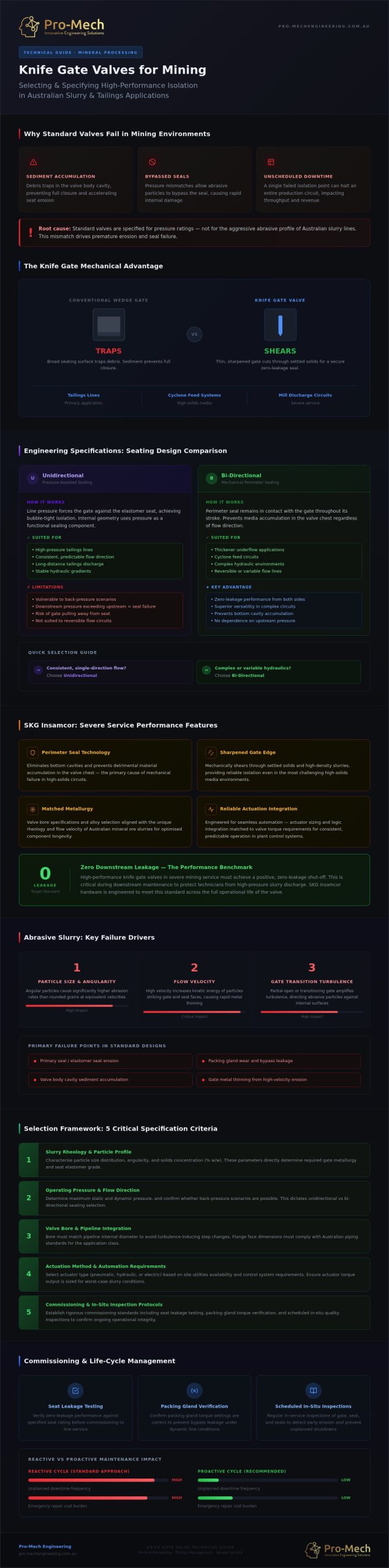
A knife gate valve serves as a critical isolation component specifically engineered to handle high-solids media within mineral processing circuits. Unlike conventional wedge gate valves, which rely on a broad seating surface that often traps debris, these units utilise a thin, sharpened gate. This mechanical design provides a significant advantage by shearing through settled solids and high-density slurries to achieve a secure seal. In the demanding context of Australian mineral extraction, knife gate valves for mining are essential for maintaining flow control in tailings lines, cyclone feed systems, and mill discharge circuits. Standard gate valves frequently fail in these environments because sediment accumulates in the body cavity, preventing full closure and accelerating seat erosion through high-velocity effects.
The Challenge of Abrasive Slurry Handling
The handling of abrasive slurry introduces extreme mechanical stress on internal valve components. Particle size, angularity, and flow velocity dictate the rate of material loss. When a valve is partially open or during the transition of the gate, turbulence increases significantly. This localised agitation directs abrasive particles against the seat and gate faces with high kinetic energy, leading to rapid thinning of the metal. Traditional isolation hardware often fails at the primary seal or the packing gland because standard designs don’t account for the aggressive rheology of Australian mineral ores. Identifying these failure points is the first step in moving toward a more resilient procurement strategy.
Operational Integrity and Safety Standards
Operational safety in a processing plant relies on the ability to achieve a positive, zero-leakage shut-off. This is particularly vital during downstream maintenance where technicians must be protected from high-pressure slurry discharge. High-performance knife gate valves for mining must adhere to rigorous Australian engineering standards to ensure they withstand the static and dynamic loads of heavy-duty piping. The financial impact of unscheduled downtime is substantial. A single failed isolation point can halt an entire production circuit, resulting in a significant loss of throughput and revenue. Reliable hardware ensures that maintenance windows remain predictable and that site safety protocols are never compromised by equipment failure. By prioritising hardware with proven performance in severe service, operators can maintain the long-term integrity of their infrastructure.
Engineering Specifications: Bi-Directional vs Unidirectional Designs
The engineering specification process for knife gate valves for mining requires a fundamental decision between unidirectional and bi-directional seating designs. This choice dictates the valve’s ability to maintain isolation under varying hydraulic conditions. Unidirectional valves rely on line pressure to force the gate against the elastomer seat. This pressure-assisted sealing is highly effective in high-pressure tailings lines where flow is constant and predictable. However, these designs are vulnerable to back-pressure scenarios. If the downstream pressure exceeds the upstream pressure, the seal integrity is compromised, often leading to leakage and seat displacement. Bi-directional designs utilise a mechanical seating arrangement, typically featuring a perimeter seal that remains in contact with the gate throughout its stroke. This configuration prevents media from accumulating in the valve chest, which is a common cause of mechanical failure in high-solids circuits.
Unidirectional Valve Dynamics
Unidirectional valves are engineered for specific flow paths where line pressure acts as a functional component of the seal. The internal geometry allows the pressure to press the gate into the seat, achieving bubble-tight isolation. While efficient, their application is limited to lines where back-flow is physically impossible. In Australian mining operations, these are often specified for long-distance tailings discharge where the hydraulic gradient remains consistent. Failure to respect these pressure limits can result in the gate pulling away from the seat. This allows abrasive particles to bypass the seal and cause rapid internal damage to the valve body.
Bi-Directional Performance for Complex Circuits
Bi-directional units offer superior versatility in thickener underflow or cyclone feed applications. The perimeter seal design ensures zero-leakage performance regardless of the pressure direction. One significant maintenance benefit is the self-cleaning action. As the gate moves through the perimeter seal, settled solids are wiped from the gate surface, preventing material build-up that could hinder the next actuation cycle. This is particularly relevant when specifying knife gate valves for mining where slurry densities vary throughout the production day. These designs facilitate more reliable automation by reducing the torque required for operation over time.
Gate metallurgy must be matched to the slurry’s chemical and abrasive profile. While 316 Stainless Steel is standard for general service, severe service often demands Duplex or specialised alloys to resist pitting and erosion. Selecting the correct alloy ensures the gate maintains its sharpened edge. This is essential for shearing through settled solids and maintaining the integrity of the perimeter seal over thousands of cycles. Professional procurement involves a detailed analysis of these material properties against the expected life-cycle costs of the installation to ensure long-term operational stability.
SKG Insamcor Knife Gate Valves: Performance in Severe Service
SKG Insamcor represents a technical benchmark in Australian mineral processing. These valves are engineered to overcome the specific limitations of standard isolation hardware in severe service. While previous sections highlighted the general failure points of standard gate designs, the SKG Insamcor range addresses these issues through targeted mechanical engineering. The hardware is designed for the most demanding applications, including high-density paste backfill and abrasive tailings lines where reliable shut-off is non-negotiable.
The Insamcor Perimeter Seal Advantage
Traditional knife gate valves for mining often struggle with solids packing in the base. The SKG Insamcor design utilises a unique perimeter seal that effectively eliminates the bottom cavity. This prevents material from settling and hardening at the bottom of the stroke, ensuring the gate can achieve full closure every time. By removing this obstruction, the force required for actuation remains consistent even in high-density media. The selection of specialised elastomers for these seals extends the maintenance interval by resisting the abrasive nature of tailings. This design ensures that the gate is wiped clean during each stroke, maintaining the integrity of the sealing surface and reducing the risk of seat damage.
Severe Service Capability
For applications involving extreme pressures or high-cycle requirements, the integration of ValvTechnologies metal-seated valves provides a zero-leakage solution. These are particularly effective in leaching circuits where corrosive mineral acids demand superior material standards beyond standard stainless steels. SKG Insamcor hardware maintains its operational integrity in these high-demand environments, offering a reliable alternative to less robust designs. The ability to handle abrasive tailings and thickener underflow without frequent seat replacements is a primary driver for its adoption across national mining projects. These units are built to withstand the rigours of continuous operation in environments where equipment failure results in significant production losses.
Operational flexibility is achieved through modular actuation packages. Whether the site requires manual handwheels for infrequent isolation or fully automated pneumatic and electric configurations for plant-wide control, the hardware integrates seamlessly. This adaptability is crucial for modern Australian mines focusing on remote operations and precise process automation. The combination of robust valve bodies and precise actuation logic ensures that the equipment meets the rigorous safety and performance standards expected in the local industry. By matching the actuation method to the specific frequency of use and the required closing speed, operators can further extend the life of the internal components.
Selection Framework for Mining Slurry and Tailings Applications
Selecting knife gate valves for mining requires a systematic analysis of slurry rheology rather than a simple matching of nominal pipe diameters. The density, viscosity, and particle angularity of the media dictate the internal wear patterns. If the valve bore is not matched to the pipeline flow velocity, turbulence increases at the transition points, leading to localised erosion. High-velocity lines often necessitate a reduced port design or specialised liners to protect the valve body from the kinetic energy of the solids. Seat material selection is equally critical. Natural rubber provides excellent resilience for abrasive slurries with moderate temperatures. EPDM is preferred for chemical resistance and higher thermal loads, while Polyurethane offers the highest level of abrasion resistance for coarse tailings. External environmental factors, such as extreme temperature fluctuations and corrosive coastal atmospheres, also influence the choice of protective coatings for the valve exterior to prevent atmospheric corrosion of the yoke and housing.
Slurry Characteristics and Valve Metallurgy
High-silica iron ore slurries require gates with hardened coatings, such as tungsten carbide, to resist mechanical scratching and surface degradation. In the expanding lithium and rare earth sectors, the presence of aggressive reagents necessitates superior corrosion resistance. Material selection must be pH-specific. Engineers must specify chemically inert alloys or linings when the slurry pH deviates from neutral to prevent accelerated galvanic or chemical corrosion. This level of technical specification ensures that the valve does not become the weak link in a complex chemical processing circuit.
Actuation and Control Integration
Actuation logic must be integrated into the selection framework to ensure fail-safe operation during power or air loss. Sizing pneumatic actuators requires a precise calculation of the breakout torque, particularly when handling settled solids that increase mechanical resistance. Limit switches and positioners allow for seamless integration into plant automation systems, providing real-time feedback on valve status. Pro-Mech specialises in developing actuated valve packages that are pre-configured for these rigorous mining requirements. This approach ensures that the actuator and valve hardware are perfectly synchronised, reducing the risk of mechanical binding or incomplete closure in the field. By treating the valve and actuator as a single engineered unit, site teams can avoid the common compatibility issues that lead to unscheduled maintenance and compromised safety protocols.
Strategic Procurement: Commissioning and Life-Cycle Management
Strategic procurement of knife gate valves for mining extends far beyond the initial capital expenditure. It requires a disciplined approach to installation planning and long-term asset management to ensure operational stability. For heavy-duty valve hardware, the transition from warehouse to operational line represents a high-risk phase where improper handling can compromise seal integrity. Site teams must conduct thorough in-situ quality inspections to verify that the equipment is operational and ready for the specific pressures of the slurry circuit. Establishing a robust maintenance schedule based on actual cycle counts and media abrasiveness ensures that the valves reach their intended service life without causing unscheduled production halts. These schedules should include periodic seal inspections and actuator testing to identify wear before it leads to a loss of isolation.
Installation and Commissioning Plans
Developing site-specific commissioning procedures is essential for new mining projects and facility upgrades. These plans should outline the exact steps for verifying actuator calibration and testing seal performance under simulated line pressures prior to full start-up. Professional engineering oversight during this stage reduces the likelihood of early-life failures caused by misalignment or incorrect torque settings. By documenting these processes, operators create a technical baseline that simplifies future troubleshooting and maintenance audits. This systematic validation ensures that the valve assembly functions as a cohesive unit within the broader plant automation architecture. It isn’t enough to simply bolt the valve into the line; the entire actuated package must be tuned to the process requirements.
Quality Audits and Technical Support
Witness testing and quality audits provide a necessary layer of validation for high-specification valve procurement. These audits allow engineers to confirm that the hardware meets the precise metallurgical and mechanical standards required for severe service. Conducting these audits at the factory level prevents the delivery of non-compliant hardware and ensures that all quality control documentation is complete before the equipment arrives on site. Pro-Mech provides national technical support to assist with the integration of complex valve management software and the execution of comprehensive commissioning plans. This oversight ensures that every component, from the perimeter seal to the pneumatic actuator, performs according to the design specification. Engaging with a partner that understands the intersection of procurement and operational integrity is vital for long-term project success. To ensure your site infrastructure meets these rigorous standards, you should contact Pro-Mech for technical valve procurement and lifecycle support.
Advancing Operational Reliability through Precision Engineering
Achieving zero-leakage isolation in high-density slurry lines requires a transition from generic hardware procurement to a specialised engineering framework. As established throughout this guide, the precise alignment of metallurgy, seat design, and actuation logic is the only way to mitigate the high costs of unscheduled downtime. Selecting high-performance knife gate valves for mining, such as the SKG Insamcor range, ensures that your facility can handle abrasive tailings and complex paste backfill with mechanical certainty. It isn’t enough to install a valve; the entire package must be tuned to the specific rheology of your circuit.
Operational success is ultimately secured through disciplined commissioning, witness testing, and in-situ quality inspections. As an official distributor of SKG Insamcor and ValvTechnologies, Pro-Mech provides the technical validation and national Australian engineering support necessary to maintain infrastructure integrity. We invite you to consult with our engineering team for technical valve procurement and commissioning to ensure your next project meets the highest standards of safety and performance. Reliability in mineral processing is built on precision, and we look forward to supporting your site requirements.
Frequently Asked Questions
What is the difference between a gate valve and a knife gate valve for mining?
Standard gate valves utilise a thick wedge that often traps solids in the valve body, leading to mechanical failure. In contrast, knife gate valves for mining feature a thin, sharpened gate designed to shear through dense slurries and settled solids. This design prevents material accumulation in the seating area, ensuring a positive shut-off in high-solids environments. The absence of a deep body cavity reduces the risk of sediment build-up during operation.
How do bi-directional knife gate valves prevent slurry build-up?
Bi-directional designs often utilise a perimeter seal that remains in constant contact with the gate surface. As the gate moves, the seal acts as a wiper, removing abrasive particles and preventing them from entering the valve chest. This self-cleaning action is critical for maintaining low operating torque and preventing the valve from seizing. Because there is no bottom cavity for solids to settle, the valve maintains operational integrity over thousands of cycles.
Which seat materials are best for abrasive mining tailings?
The selection of seat materials depends on the specific rheology of the tailings. Polyurethane is typically specified for its superior resistance to coarse, abrasive particles. Natural rubber offers excellent resilience and is often used for general slurry duties with moderate temperatures. For applications involving chemical reagents or higher thermal loads, EPDM is the preferred choice. Matching the elastomer to the particle angularity and flow velocity is essential for extending the valve’s life-cycle.
Can knife gate valves be used for high-pressure slurry lines?
Yes, specifically engineered knife gate valves can handle high-pressure applications. While standard designs have pressure limitations, specialised models like those from ValvTechnologies feature metal-to-metal seating for zero-leakage performance under extreme loads. These units are designed to withstand the hydraulic forces found in deep-pit tailings discharge and long-distance transport lines. It’s critical to verify the pressure rating against Australian engineering standards during the procurement process to ensure site safety and long-term reliability.
How often should mining knife gate valves be inspected for erosion?
Inspection intervals are determined by the cycle frequency and the abrasive profile of the media. For high-cycle applications like cyclone feeds, monthly visual inspections of the gate and seal are recommended. In less aggressive tailings lines, quarterly audits may be sufficient. Pro-Mech provides in-situ quality inspections to assist site teams in identifying early signs of seat erosion or gate thinning. Regular monitoring prevents unscheduled downtime by allowing for proactive part replacement before failure occurs.
What are the benefits of using SKG Insamcor valves in mineral processing?
SKG Insamcor valves are widely recognised for their perimeter seal design, which eliminates the bottom cavity where solids typically pack and harden. This feature ensures consistent actuation and a reliable seal even in high-density slurries or paste backfill. The modular design allows for the easy integration of manual, pneumatic, or electric actuators. Their robust construction is specifically tailored for the severe service conditions found in Australian circuits, offering lower life-cycle costs and improved safety.
Does Pro-Mech provide installation and commissioning for mining valves?
Pro-Mech Engineering Solutions provides comprehensive installation and commissioning plans as part of our technical support services. This includes drafting site-specific procedures to verify actuator calibration and seal integrity before the valve enters service. Our engineers conduct in-situ quality inspections and witness testing to ensure all hardware meets the required performance specifications. This oversight is vital for reducing early-life failures and ensuring the long-term operational integrity of your high-value valve assets.
How do I select the right actuator for a knife gate valve?
Selecting an actuator requires a precise calculation of the breakout torque, which must account for the resistance of settled solids. Pneumatic actuators are commonly used for their fail-safe capabilities, while electric actuators are preferred for precise process control and remote automation. The frequency of operation and the required closing speed also influence the choice. Pro-Mech develops pre-configured actuated packages where the hardware and control logic are synchronised for seamless integration into existing plant systems.