In severe service environments, a check valve isn’t merely a flow component; it’s a precision-engineered safety barrier that dictates the operational longevity of the entire facility. You recognise that unscheduled downtime and the violent impacts of water hammer represent more than just maintenance hurdles. They’re direct threats to infrastructure integrity and site safety protocols. Selecting the correct high pressure check valves Australia needs for these rigorous conditions requires a disciplined approach to technical specification and mechanical validation.
This article serves as a comprehensive engineering guide for the selection, specification, and maintenance of high-pressure equipment within Australia’s industrial sector. We’ll explore the necessity of zero leakage performance and the role of metal seated valves in managing erosive media. The discussion covers critical compliance frameworks, including the requirements of the AS/NZS 3788:2024 standard for pressure equipment inspection. By prioritising rigorous quality audits and witness testing, engineers can ensure full alignment with safety standards while extending the service life of critical assets in hydrogen, carbon capture, or mining applications.
Key Takeaways
- Identify the mechanical requirements for protecting high-value assets like pumps and compressors from the destructive effects of reverse flow and water hammer.
- Navigate the 2026 landscape of engineering standards, including ASME B16.34 and AS 1210, to ensure full site compliance and pressure equipment safety.
- Compare the operational advantages of swing check versus tilting disc designs for managing erosive mining slurries and high-temperature steam applications.
- Optimise procurement by selecting high pressure check valves Australia through a technical partner offering specialised solutions like ValvTechnologies metal seated valves.
- Implement rigorous installation and commissioning plans that account for orientation constraints and mandatory in-situ quality inspections.
Understanding High Pressure Check Valves in Australian Industrial Applications
In heavy industrial sectors like mining, power generation, and oil and gas, check valves serve as the primary mechanical defence against reverse flow. They aren’t simple pipe fittings. Understanding High Pressure Check Valves requires a deep appreciation for the extreme forces at play within high-velocity systems. In Australia, where remote operations and severe service conditions are standard, procuring high pressure check valves Australia requires a focus on the protection of high-value assets like multi-stage centrifugal pumps and reciprocating compressors. The reliability of these components is a cornerstone of site safety and process efficiency in demanding environments.
Generic or commodity valves often fail in these environments because they aren’t engineered for the abrasive nature of slurry systems or the thermal cycling of high-pressure steam. In the Australian mining sector, erosive particulates quickly degrade standard seals, which leads to bypass leakage and eventual component failure. When a valve fails to close instantaneously or seal effectively, the operational consequences range from minor energy loss to violent water hammer events and catastrophic pipe bursts. These failures don’t just stop production; they endanger personnel and require extensive, costly remediation of the pipeline infrastructure.
The Physics of Backflow in High-Pressure Systems
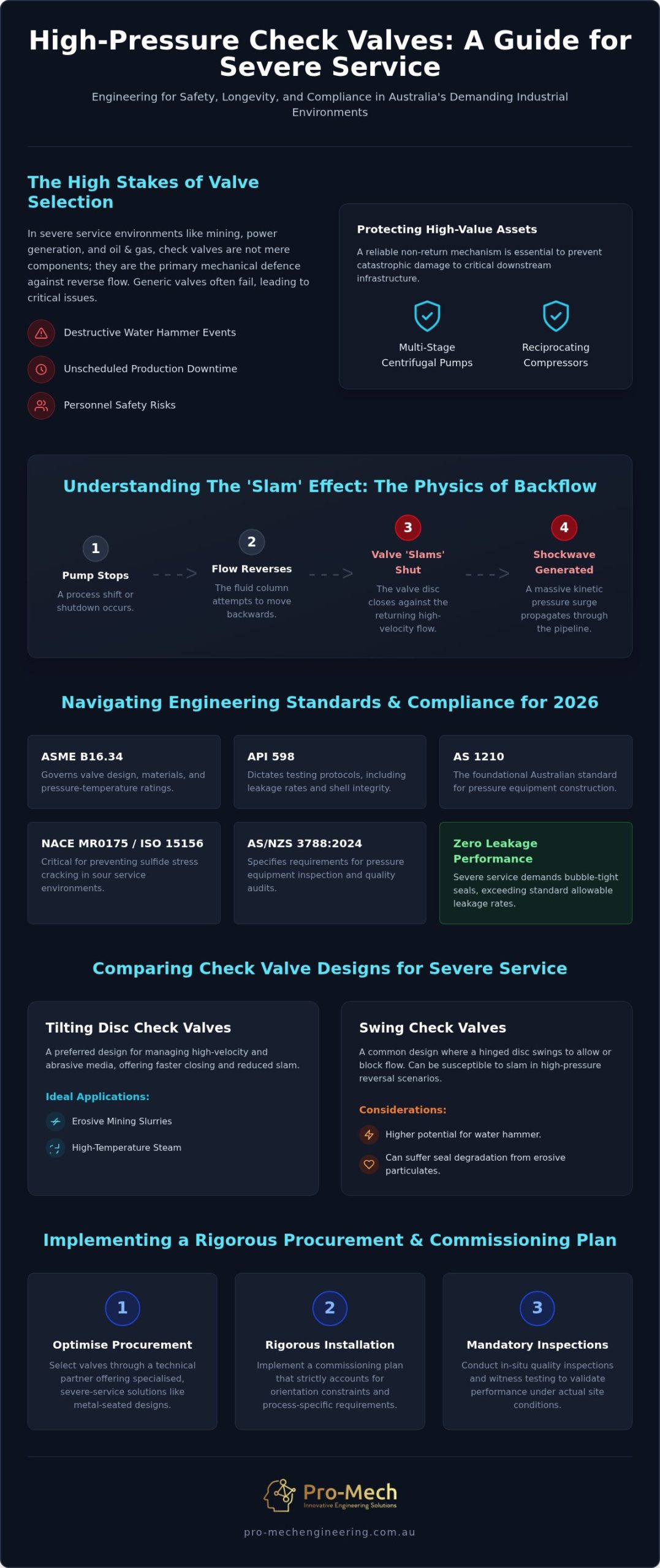
When a pump stops or a process shift occurs, the fluid column attempts to reverse direction. This creates the ‘slam’ effect, a phenomenon where the valve disc closes against the returning flow with enough force to generate a massive kinetic shockwave. These pressure surges propagate through industrial pipelines at the speed of sound, potentially rupturing flanges or damaging sensitive instrumentation downstream. Cracking pressure is the minimum upstream pressure required to overcome the internal resistance of the valve mechanism to allow the flow to commence.
Critical Protection for Downstream Infrastructure
The most critical application for specifying high pressure check valves Australia for heavy industry is the protection of multi-stage centrifugal pumps. Without a reliable non-return mechanism, reverse flow can cause the pump to rotate backwards at high speeds, leading to bearing seizure or shaft breakage. Maintaining system pressure during both planned and unplanned shutdowns is essential for process stability and restart efficiency. Modern safety protocols often involve integrating these mechanical barriers with automated control valve packages, creating a redundant safety layer that ensures operational integrity even during total power failures or site-wide control system glitches. This level of technical integration minimises the risk of mechanical failure during critical transitions.
Engineering Standards and Material Specifications for 2026
Technical compliance in 2026 requires strict adherence to updated international and local frameworks. Specifying high pressure check valves Australia involves navigating the rigorous requirements of ASME B16.34 for design and API 598 for testing protocols. Additionally, AS 1210 remains the foundational Australian standard for pressure equipment construction. These benchmarks ensure that every valve can withstand the design pressures of severe service without compromising structural integrity. For oil and gas projects, compliance with NACE MR0175/ISO 15156 is critical to prevent sulfide stress cracking in sour environments.
Testing procedures distinguish between allowable leakage rates and the superior “zero leakage” performance required for critical isolation. While many standards permit a specific drops-per-minute rate, severe service often demands a bubble-tight seal. Achieving this requires meticulous seat design and technical validation through in-situ quality inspections to verify performance under actual site conditions.
Pressure-Temperature Ratings and Wall Thickness
Designers must account for the inverse relationship between temperature and pressure. ASME Class 900, 1500, and 2500 ratings define the maximum allowable working pressure at specific temperature points. As temperatures rise, material tensile strength decreases, necessitating thicker walls or superior alloys. Forged bodies are often preferred over cast alternatives in high-pressure applications. Forging provides a refined grain structure that offers higher resistance to fatigue and internal defects.
Corrosion and Erosion Resistance Strategies
Material selection dictates the valve’s lifespan in harsh Australian conditions. High-temperature steam systems often utilise chrome-moly alloys like ASTM A182 F22 or F91 to resist creep and oxidation. In contrast, abrasive mining slurries require hard-facing techniques to protect internal components. Applying Stellite or Tungsten Carbide coatings to the disc and seat area significantly reduces wear from particulate impingement. Full material traceability ensures that every pressure-containing component meets the verified chemical and mechanical properties required to prevent catastrophic failure on Australian high-risk sites.
Comparing Check Valve Designs for Severe Service
Selecting the optimal configuration for high pressure check valves Australia requires a precise assessment of fluid dynamics and closure speeds specific to the application. While swing check valves remain a traditional choice for general purpose flow control, their utility in high-pressure systems is often limited. The significant mass of the disc and the long travel distance to the seat create a delay during flow reversal. In systems with rapid deceleration, the disc’s inertia prevents it from seating before the backflow gains velocity, which frequently results in the destructive slamming events discussed earlier. A comprehensive approach to severe service valve selection requires evaluating closure dynamics alongside material integrity to ensure the chosen design withstands the full range of operational stresses.
Tilting disc check valves offer a refined dynamic response by pivoting the disc closer to its centre of gravity. This design reduces the travel distance and allows for faster closure. For small-bore lines and high-pressure steam services, piston or lift check valves are frequently specified. These designs rely on a guided plunger mechanism that provides excellent shut-off capabilities, though they are generally restricted to horizontal or vertical upward flow orientations due to their reliance on gravity or spring tension for reset.
The Evolution of Non-Slam Technology
Nozzle check valves, often referred to as non-slam valves, represent the superior engineering choice for surge prevention in critical infrastructure. The mechanics involve a short-stroke, spring-assisted disc that remains in the flow stream. Because the disc only travels a few centimetres, it can close almost instantaneously the moment forward flow ceases. This proactive closure eliminates the possibility of backflow-induced slamming. In Australian desalination plants and high-lift mining dewatering systems, nozzle checks are prioritised because they maintain system integrity while providing a streamlined flow path that reduces permanent pressure drop across the valve.
Metal Seated vs. Soft Seated Check Valves
The choice between seat materials is a primary factor in determining the valve’s service life and maintenance requirements. Soft seated valves utilise elastomeric or polymer inserts to achieve a seal, but these materials quickly degrade under the thermal and mechanical stresses of high-pressure chemical processing or steam service. Once the soft seal is compromised, the valve’s ability to prevent backflow is lost.
ValvTechnologies Metal Seated Valves are essential for these severe service environments. By utilising high-integrity metal-to-metal contact, these valves maintain zero leakage performance even in high-temperature and abrasive conditions. While soft seals may require frequent replacement intervals, metal seated designs offer extended service life and consistent sealing performance. This reliability is critical for reducing total cost of ownership and ensuring site safety during long-term operational cycles.
Installation, Commissioning, and Safety Procedures
The successful deployment of high pressure check valves Australia relies on a disciplined transition from procurement to active service. This process begins with rigorous pre-installation checks that verify the equipment’s flow direction and pressure ratings against the certified engineering drawings. Technicians must confirm that the valve’s ASME class and material grade match the specific requirements of the pipeline. Any discrepancy at this stage can lead to catastrophic failure once the system’s pressurised. Commissioning plans should be established early in the project lifecycle to ensure all stakeholders understand the sequence of testing and validation.
Orientation constraints are a primary consideration during the layout phase. While certain spring-assisted designs allow for flexible mounting, many heavy-duty check valves are restricted to horizontal or vertical-upward flow paths. Installing a gravity-dependent valve in an incorrect orientation prevents the disc from seating effectively, which compromises the backflow prevention capability. Pro-Mech prioritises in-situ quality inspections and witness testing to confirm that every unit operates within its design parameters before the plant reaches full operational capacity.
Best Practices for High-Pressure Installation
Flange integrity is paramount in severe service environments. Installers should utilise a cross-pattern bolting sequence and calibrated torque equipment to ensure even gasket compression and prevent flange face distortion. Turbulence is a leading cause of premature internal wear, so engineers must provide adequate straight-pipe runs, typically five to ten pipe diameters, before and after the valve. Integrating local pressure gauges or sensors allows for real-time performance monitoring, providing immediate feedback on seat integrity during the initial commissioning phase.
Ongoing Maintenance and Safety Audits
Site safety protocols require regular diagnostic audits to identify signs of seat erosion, wire-drawing, or spring fatigue. Advanced diagnostic industrial software can assist in tracking valve performance and predicting maintenance intervals based on actual cycle counts rather than arbitrary timelines. During high-risk site shutdowns, safety procedures must include verified isolation and depressurisation steps. Adopting a proactive maintenance stance ensures that these critical safety barriers remain functional throughout their intended service life.
To ensure your infrastructure meets these rigorous standards, Pro-Mech Engineering develops detailed Installation & Commissioning Plans tailored to the specific demands of Australian heavy industry.
Specialised Valve Solutions with Pro-Mech Engineering
Pro-Mech Engineering Solutions operates as a technical procurement partner rather than a conventional equipment distributor. This distinction is critical for facilities requiring high pressure check valves Australia, where the stakes of component selection include both operational safety and long-term financial viability. By providing access to global leaders like ValvTechnologies and DelVal, the company ensures that Australian industrial projects are equipped with hardware capable of withstanding the most demanding severe service conditions. Precision dictates performance.
The firm’s capabilities extend beyond hardware supply to include custom engineering and software development for complex flow control systems. This integrated approach allows for the creation of bespoke solutions that standard off-the-shelf components cannot provide. National support for project management and quality audits ensures that every technical specification is met with precision from the initial design phase through to active service. This systematic execution provides a level of oversight that is essential for maintaining the operational integrity of large-scale infrastructure.
Severe Service Expertise
Reliability in the power and mining sectors depends on zero leakage isolation. Pro-Mech specialises in providing ValvTechnologies metal seated valves, which are engineered to maintain a bubble-tight seal in high-temperature and high-pressure environments. Technical validation is a core component of this service. The company performs rigorous in-situ quality inspections to verify that every valve meets site-specific safety protocols and engineering standards. Quality ensures compliance. Consulting on material selection is also provided to ensure that high temperature check valves are constructed from alloys capable of resisting creep and thermal fatigue over extended operational cycles.
Seamless Project Integration
A full-lifecycle approach ensures that procurement is only the first step in a broader engineering workflow. Pro-Mech reduces operational risk by leading the development of comprehensive Installation & Commissioning Plans. These plans account for the mechanical nuances of the equipment and the specific orientation constraints of the site’s pipeline infrastructure. By managing the process from initial specification to final witness testing, the firm provides a steady hand in both equipment supply and project execution. Safety remains the priority. This methodical pace of project delivery ensures that internal processes are as disciplined and reliable as the technical information presented. To discuss the specific requirements of your infrastructure, Contact Pro-Mech for a technical consultation on your next project.
Advancing Operational Integrity in Severe Service
Securing the long-term reliability of industrial infrastructure requires a move beyond commodity procurement. The transition to advanced engineering standards and the adoption of metal seated technology are essential steps in eliminating unscheduled downtime and protecting high-value assets. By prioritising zero leakage performance and adhering to the latest 2026 compliance frameworks, engineers can effectively mitigate the risks of water hammer and mechanical failure. Selecting the correct high pressure check valves Australia needs for these environments isn’t just a procurement choice; it’s a matter of technical validation and disciplined planning.
Pro-Mech Engineering Solutions serves as a specialised partner in this process. As an authorised ValvTechnologies partner, the firm provides access to industry-leading metal seated valves alongside comprehensive engineering and commissioning support. Ensuring that your facility operates with maximum stability and safety is our primary focus. We invite you to Request a Technical Valve Audit from Pro-Mech Engineering to evaluate your current flow control systems. Strengthening your site’s operational resilience starts with precise technical oversight.
Frequently Asked Questions
What is the difference between a standard check valve and a high pressure check valve?
High pressure check valves are distinguished by their robust wall thickness, superior material grades, and stringent pressure-temperature ratings as defined by ASME B16.34. While standard valves manage lower pressures and non-corrosive media, high-pressure variants are engineered for severe service. They feature forged bodies and specialised seating mechanisms that maintain structural integrity under extreme mechanical stress. These valves are essential for the rigorous demands of mining and power generation where standard components would fail prematurely.
How do I prevent water hammer in high-pressure Australian pipelines?
Preventing water hammer requires the selection of check valves with rapid closure characteristics, such as nozzle or non-slam designs. These valves utilise spring-assisted mechanisms to close the disc the moment forward flow deceleration occurs, preventing the fluid column from gaining reverse velocity. Proper installation of high pressure check valves Australia also involves providing adequate straight-pipe runs and integrating surge vessels where necessary. These engineering measures effectively dampen pressure spikes and protect the pipeline infrastructure from kinetic shock.
What are the common causes of check valve failure in severe service?
Failure in severe service is often attributed to seat erosion, wire-drawing, and mechanical fatigue caused by abrasive media or high-velocity flows. In Australian mining applications, particulate impingement can quickly degrade standard seals, leading to bypass leakage. Other common causes include incorrect valve orientation, which prevents proper seating, and the accumulation of debris within the valve body. Regular inspections and the use of hard-faced metal seats are critical strategies for mitigating these risks in high-stress environments.
Are metal seated check valves necessary for all high-temperature applications?
Metal seated valves are essential for high-temperature and abrasive applications where elastomeric or soft seals would suffer thermal degradation. While soft seats provide bubble-tight shut-off at lower temperatures, they cannot withstand the mechanical stresses of high-pressure steam or chemical processing. ValvTechnologies metal seated valves are specifically designed for these severe conditions, offering zero leakage performance and extended service life. For any application exceeding the thermal limits of polymers, metal-to-metal contact is the only reliable sealing method.
What international standards govern high pressure check valves in Australia?
High pressure check valves in Australia are governed by a combination of international and local standards, including ASME B16.34 for design and API 598 for valve inspection and testing. AS 1210 remains the primary Australian standard for the construction of pressure vessels and related equipment. The 2024 update to AS/NZS 3788 provides mandatory rules for the in-service inspection of pressure equipment. Compliance with these standards ensures that every component meets the verified mechanical properties required for safe operation.
How does a non-slam check valve improve plant safety?
Non-slam check valves improve plant safety by eliminating the violent pressure surges associated with flow reversal. The short-stroke, spring-assisted disc closes proactively, preventing the ‘slam’ effect that can rupture pipes or damage sensitive downstream instrumentation. By maintaining a stable pressure environment, these valves reduce the risk of catastrophic asset failure and personnel injury. Their streamlined internal geometry also minimises pressure drop, which enhances the overall efficiency and reliability of high-lift pumping systems in critical infrastructure.
Can Pro-Mech assist with in-situ valve inspections for existing sites?
Pro-Mech Engineering Solutions provides comprehensive in-situ quality inspections for existing industrial sites across the country. These technical audits are designed to assess the current condition of pressure equipment and identify potential failure points before they lead to unscheduled downtime. Using diagnostic tools and technical expertise, the firm’s specialists verify seat integrity and mechanical functionality. These inspections are a vital component of a proactive maintenance strategy, ensuring that all high-pressure assets remain compliant with Australian safety protocols.
What information is required for an accurate check valve specification?
Accurate specification requires detailed data on the process media, including its chemical composition, temperature range, and the presence of abrasive particulates. Engineers must also provide the maximum operating pressure, required flow rates, and the allowable pressure drop across the valve. Information regarding the pipeline orientation and the desired leakage class is equally critical. Providing these technical nuances allows for the selection of high pressure check valves Australia that are perfectly matched to the specific mechanical demands of the project.