
Why do most slurry valves in Australian tailings lines fail within months, while high-specification engineering can extend that same lifecycle by years? Maintenance teams often accept frequent valve replacements and the resulting operational downtime as an unavoidable burden in abrasive environments. Reliability engineers often manage the constant cycle of unplanned shutdowns and the significant safety risks that stem from leakage in high-pressure lines. This article details the engineering principles and material strategies required for effective slurry valve erosion prevention, focusing on how technical validation can mitigate abrasive wear.
The following analysis outlines how to extend the mean time between failures by aligning flow geometry with advanced material science. We provide a structured overview of the selection criteria for valves capable of surviving the harshest Australian concentrate lines, including iron ore fines and gold tailings. By prioritising technical integrity and precise material selection, your site can achieve a reduced total cost of ownership while maintaining rigorous safety standards across all critical infrastructure. This systematic approach ensures that your equipment remains reliable even in the most demanding severe service applications.
Key Takeaways
- Distinguish between impingement and sliding abrasion to identify the specific mechanical wear patterns affecting your site infrastructure.
- Evaluate the performance of advanced metal-seated materials over traditional elastomers to enhance your strategy for slurry valve erosion prevention.
- Identify critical design features, such as recessed seats and straight-through flow paths, that protect sealing surfaces from high-velocity particle impact.
- Optimise operational longevity through precise valve orientation and the use of high-performance actuation to eliminate ‘wiredrawing’ erosion.
- Leverage technical partnerships with specialists like Pro-Mech to access market-leading technologies from ValvTechnologies and SKG Insamcor for severe service isolation.
Understanding the Mechanisms of Slurry Valve Erosion
Slurry erosion is defined as the progressive loss of material from a solid surface due to the mechanical interaction of suspended particles in a carrier fluid. For Australian mining operations dealing with iron ore fines or gold tailings, this process represents a constant threat to infrastructure integrity. Effective slurry valve erosion prevention requires a deep understanding of how these solids interact with valve internals under varying flow conditions. It’s not just the presence of solids that causes damage, but the kinetic energy they carry as they navigate the valve’s internal geometry.
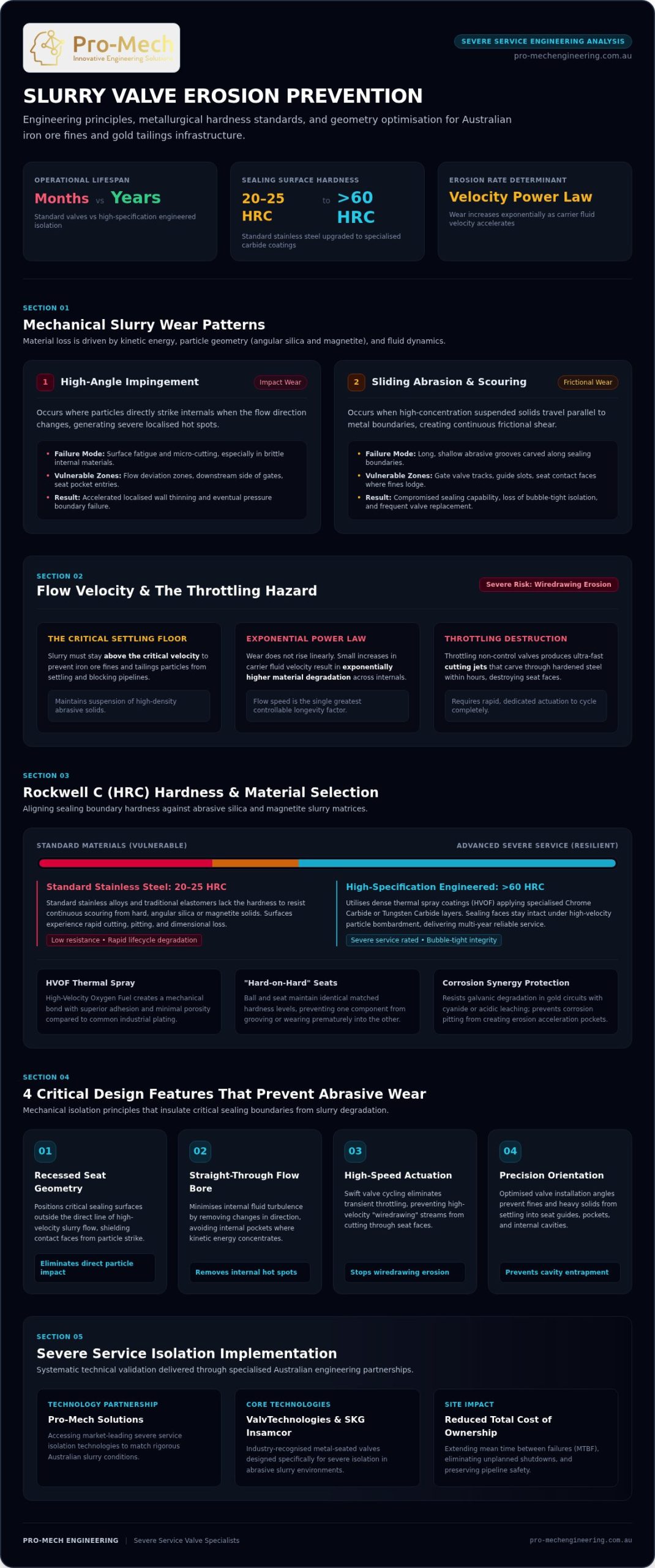
Material loss is rarely uniform. It is dictated by the physical characteristics of the slurry, including particle size, shape, and overall concentration. Angular, hard particles like silica or magnetite cause significantly more damage than rounded grains. Within a valve, ‘hot spots’ typically develop in areas of high turbulence, such as the downstream side of a gate or around the seat pocket. These regions experience accelerated wear because the fluid’s kinetic energy is concentrated against the valve’s protective boundaries, often leading to localised thinning and eventual pressure boundary failure.
Impingement vs. Sliding Abrasion
High-angle impingement occurs when particles strike the valve internals directly, often at the point where flow direction changes. This impact can cause surface fatigue or micro-cutting, especially in brittle materials. Sliding abrasion, or scouring, happens when solids move parallel to the surface, creating long, shallow grooves through friction. Traditional gate valves are particularly vulnerable because their design often allows solids to accumulate in the seat track. This leads to a combination of both wear types that prevents the valve from achieving a bubble-tight seal and necessitates frequent, costly replacements.
The Role of Velocity in Erosion Rates
The relationship between fluid velocity and erosion is often expressed as a power law, where wear rates increase exponentially as flow speeds rise. This makes velocity the most significant controllable factor in valve longevity. Throttling a valve not designed for control service creates high-velocity ‘jets’ that can cut through hardened steel in hours. Engineers must balance the need to stay above the critical velocity, which prevents solids from settling and blocking the line, with the need to limit peak velocities that drive rapid material degradation. Precision in flow management is a cornerstone of any robust slurry valve erosion prevention strategy.
Selecting Materials for Severe Service Slurry Applications
Material selection represents the most critical decision in the engineering of a reliable slurry system. While traditional elastomers and rubber liners are common in low-pressure applications, they often lack the structural resilience required for high-concentration tailings. In these severe environments, metal-seated valves are the primary solution for effective slurry valve erosion prevention. The effectiveness of these components is often measured using the Rockwell C (HRC) hardness scale. Standard stainless steels typically offer a hardness of 20 to 25 HRC, which is insufficient for resisting the abrasive nature of magnetite or silica. High-specification valves instead utilise surfaces that exceed 60 HRC to ensure the sealing face remains intact under constant particle bombardment.
Chemical compatibility is a secondary but vital consideration for Australian mineral processing. In gold circuits involving cyanide or acidic leaching, the material must resist both mechanical abrasion and chemical degradation. If the base metal or coating is susceptible to galvanic corrosion, the resulting surface pitting creates ‘pockets’ where erosion can accelerate. Selecting inert, high-chromium alloys or specialised carbides ensures that the valve internals don’t lose their structural integrity before the abrasive forces even begin to take hold. This dual-layer protection is essential for maintaining a predictable service life.
Hard-Facing and Thermal Spray Coatings
ValvTechnologies employs the High-Velocity Oxygen Fuel (HVOF) coating process to apply ultra-dense layers of Chrome Carbide or Tungsten Carbide to valve internals. This method differs from standard plating because it creates a mechanical bond with superior adhesion and minimal porosity. The resulting ‘hard-on-hard’ seat design allows both the ball and the seat to maintain identical hardness levels. This configuration is particularly effective in iron ore processing, as it enables the valve to shear through trapped solids without damaging the sealing surfaces. It’s a robust alternative to spray-and-fuse coatings, which can be prone to inconsistencies in bond strength.
Base Metal Integrity and Yield Strength
The substrate material must provide adequate support for any applied hard-facing. If an ultra-hard coating is applied to a soft base metal, the assembly becomes vulnerable to ‘eggshell’ cracking. Under the extreme pressures found in high-head tailings lines, a soft substrate can deform slightly, causing the brittle outer coating to fracture and delaminate. To prevent this, Pro-Mech specifies high-yield alloys like 410 stainless steel or specialised chrome-moly steels for Australian mining projects. These materials provide the necessary rigidity to support advanced coatings under load. For assistance in matching material specifications to your specific mineralogy, you can consult with Pro-Mech Engineering Solutions to ensure long-term operational success.
Design Features That Minimise Abrasive Wear
The internal geometry of a valve is as critical as its metallurgy in achieving long-term slurry valve erosion prevention. Even the hardest materials will eventually succumb to abrasive wear if the design allows for high-velocity impingement on critical sealing faces. Engineering a valve with a ‘straight-through’ flow path is the primary method for reducing this risk. By eliminating internal cavities and obstructions, the fluid maintains a more laminar flow profile. This significantly reduces the turbulence that drives material loss in traditional gate or globe valves, which often feature dead zones where solids can accumulate and cause localised scouring.
Another essential design feature is the implementation of recessed seats. By positioning the sealing surface outside the primary flow stream, the valve protects its most vulnerable components from the constant scouring of solid particles. As the gate cycles, it performs a mechanical ‘clearing action,’ shearing through accumulated solids to ensure a clean closure. This functionality is supported by robust secondary seals and precision-engineered packing glands. These components act as a final line of defence to prevent external leakage, which is a major safety risk in high-pressure Australian tailings lines.
Flow Path Optimisation
Full-bore designs are the industry standard for minimising pressure drops and turbulence. When the valve’s internal diameter matches the pipeline, there’s no ledge or transition point to trigger localised erosion. Internal body contours are also shaped to guide particle trajectories away from the housing walls. In Australian tailings management, bi-directional sealing is a non-negotiable requirement. This ensures that the valve remains secure regardless of flow direction, providing a critical safety barrier during maintenance or pump failures.
The SKG Insamcor Advantage
The SKG Insamcor knife gate valves supplied by Pro-Mech feature a unique sleeve design that provides a comprehensive barrier between the slurry and the valve body. These heavy-duty sleeves are compressed to create a bubble-tight seal, effectively lining the entire flow path. This configuration means the abrasive media never makes contact with the metal housing, preventing the internal ‘washout’ common in lesser designs. The gate’s self-cleaning nature is another hallmark of this technology. As the gate retracts, the sleeves expand to flush away any trapped solids, maintaining operational integrity in the thickest Australian concentrate lines.
Operational Strategies and Maintenance for Longevity
Hardware selection is only the first step in a robust reliability strategy. Operational practices and installation accuracy are equally critical for effective slurry valve erosion prevention. Correct valve orientation during installation ensures that gravity does not assist solids in settling into the seat track or chest area. When valves are mounted incorrectly, the accumulation of iron ore fines or tailings can prevent full closure, leading to high-velocity leak paths that destroy sealing faces in a matter of days. The inclusion of flushing ports is a mandatory requirement for these environments, as they allow operators to clear the valve chest of compacted solids before every cycle.
A systematic maintenance programme must also account for the external factors that drive internal wear. This involves the regular validation of packing gland integrity and the verification of secondary seals. By maintaining these components, sites can prevent the atmospheric leakage that often leads to external body erosion and safety hazards. Standardising these operational checks ensures that the technical advantages of high-specification valves are not undermined by avoidable installation errors.
Precision Actuation and Control
The speed and precision of valve actuation directly influence the rate of material degradation. Rapid, jarring cycles can cause water hammer and mechanical stress, while excessively slow movement increases the time the gate spends in the ‘scour zone’. Precision actuation prevents ‘wiredrawing’ erosion, which occurs when a valve is partially open and creates a concentrated, high-velocity jet of slurry. Using limit switches ensures the gate is always fully retracted, protecting the sealing edge from the flow stream. For applications requiring precise pressure management to reduce downstream turbulence, OCV control valves provide the necessary modulation to maintain stable flow velocities and minimise abrasive impact.
In-Situ Inspection and Quality Audits
Identifying early signs of seat wear before a total pressure boundary failure occurs is essential for preventing unplanned plant shutdowns. Routine in-situ inspections allow maintenance teams to document wear patterns and adjust material specifications for future upgrades. This data-driven approach transforms maintenance from a reactive burden into a predictable engineering workflow. Pro-Mech supports this process through detailed Installation & Commissioning Plans that ensure every unit is set up for maximum service life from day one. To optimise your site’s maintenance schedule and extend equipment lifecycles, you can request In-situ Quality Inspections from the Pro-Mech technical team to validate your critical valve assets.
Implementing High-Performance Valve Solutions with Pro-Mech
Pro-Mech Engineering Solutions serves as a specialised technical procurement partner for the Australian mining sector, prioritising operational integrity in severe service environments. Effective slurry valve erosion prevention requires more than the selection of a generic component; it demands a systematic alignment of application-specific engineering and market-leading technology. By focusing on high-specification assets, Pro-Mech enables sites to move away from the cycle of frequent, low-cost replacements toward a model of long-term reliability and reduced total cost of ownership. This approach is essential for maintaining the stability of critical infrastructure in iron ore and gold processing facilities.
The product portfolio includes specialised solutions for high-density slurry management, such as the SKG Insamcor knife gate valve range. These units are engineered specifically for the challenges of thick concentrate and tailings lines, where solids accumulation often leads to the failure of standard industrial valves. Pro-Mech provides the technical oversight required to integrate these solutions into existing infrastructure, often involving custom engineering assessments. The application of technical service fees reflects the value of this bespoke engineering input, ensuring that each valve is precisely matched to the specific mineralogy and flow conditions of the site.
ValvTechnologies: The Gold Standard for Severe Service
The partnership with ValvTechnologies addresses the industry’s critical need for zero-leakage isolation in high-pressure environments. Unlike standard valves that rely on separate seat inserts, ValvTechnologies features an integral seat design. This construction eliminates the leak paths typically found behind seat rings, which are common points of failure in abrasive service. In specific severe service applications, these valves are backed by a four-year zero-leakage guarantee, providing a level of technical assurance that is unmatched in the Australian power and mining sectors. This reliability directly translates to reduced plant downtime and the mitigation of safety risks associated with high-pressure line leakage.
National Support and Technical Expertise
Choosing an Australian-owned technical partner ensures that procurement decisions are informed by a deep understanding of local operational conditions. Pro-Mech manages the entire procurement lifecycle, extending from initial site audits and material selection to the final commissioning phase. This comprehensive oversight ensures that the engineering principles discussed throughout this article are correctly applied in the field. This systematic execution of project management reduces the burden on site engineers and procurement professionals. To discuss a tailored approach to your site’s specific challenges, you can consult with Pro-Mech for your slurry valve requirements and secure the technical validation necessary for long-term operational success.
Optimising Operational Reliability in Severe Slurry Service
Mitigating wear in abrasive environments requires a systematic approach that integrates advanced material coatings with precise valve geometry. By prioritising high-hardness surfaces and straight-through flow designs, Australian mining operations can effectively manage the mechanical mechanisms of impingement and sliding abrasion. This technical validation is the cornerstone of long-term slurry valve erosion prevention, ensuring that critical concentrate and tailings lines remain operational under extreme pressures. Implementing these engineering standards transforms maintenance from a reactive cycle into a predictable, value-driven workflow.
Pro-Mech Engineering Solutions, as an authorised ValvTechnologies distributor, provides the comprehensive national engineering support required to audit and upgrade your existing infrastructure. Our specialised mining slurry solutions are designed to deliver zero-leakage isolation and extended service life. To secure your site’s operational integrity, Contact Pro-Mech Engineering Solutions for a Technical Valve Audit and begin the transition toward a more resilient infrastructure model.
Frequently Asked Questions
What is the best valve type for highly abrasive mining slurry?
Metal-seated ball valves and heavy-duty knife gate valves are the most effective options for abrasive mining slurries. ValvTechnologies units are particularly suitable for high-pressure isolation where zero leakage is mandatory. For high-density tailings, SKG Insamcor knife gate valves provide a robust solution due to their self-cleaning sleeves. These designs prioritise internal geometry that guides solids away from sealing faces, which is a fundamental requirement for effective slurry valve erosion prevention in Australian mineral processing circuits.
How does fluid velocity affect the rate of valve erosion?
Material degradation rates increase exponentially as fluid velocity rises, often following a power law relationship. High-velocity flow concentrates kinetic energy against valve internals, causing rapid impingement and scouring. Maintaining flow speeds slightly above the critical velocity prevents solids from settling without reaching the peak velocities that drive aggressive wear. Careful system design and the use of OCV control valves help manage these pressure differentials, ensuring that velocities remain within safe engineering limits to protect the valve’s structural integrity.
Why is a metal-seated valve often better than a rubber-lined valve for slurries?
Metal-seated valves offer superior structural resilience and pressure handling compared to elastomer-lined alternatives. While rubber provides initial abrasion resistance, it’s susceptible to tearing and degradation at high pressures or temperatures. Advanced metal seats, often exceeding 60 HRC, withstand the constant bombardment of hard particles like magnetite or silica iron ore fines. This material hardness ensures the sealing surface remains intact, providing a more predictable service life and reducing the frequency of unplanned maintenance shutdowns across the site infrastructure.
Can I repair a slurry valve after the seat has eroded?
Repairability depends on the specific valve design and the extent of the material loss. Some valve types allow for the replacement of seat rings or sleeves, while others feature integral seats that require specialised resurfacing. If the erosion has reached the base metal or compromised the pressure boundary, the unit often requires full replacement to maintain site safety standards. Routine in-situ quality inspections help identify early wear patterns, allowing for proactive maintenance before the damage becomes unrepairable and leads to total failure.
What are the common causes of knife gate valve failure in tailings lines?
Knife gate valve failures in tailings lines often stem from solids build-up in the chest area or incorrect installation orientation. When slurry compacts within the valve body, it prevents the gate from achieving a full stroke, leading to high-velocity leak paths. Other common causes include:
- Deterioration of secondary seals due to abrasive ingress.
- Inadequate flushing of the valve chest before cycling.
- Selection of insufficient hardness for the gate material.
These issues underscore the importance of following a comprehensive installation and commissioning plan.
How do Tungsten Carbide coatings help in erosion prevention?
Tungsten Carbide coatings provide an ultra-hard barrier that protects the softer base metal from abrasive slurry particles. When applied via the High-Velocity Oxygen Fuel (HVOF) process, these coatings achieve high bond strength and minimal porosity. This prevents the ‘scouring’ effect of solids moving parallel to the valve surface. By maintaining a hardness level significantly higher than the minerals being processed, these coatings ensure that the sealing faces remain smooth and capable of providing a reliable isolation barrier over thousands of cycles.
Is ‘Zero Leakage’ actually possible in abrasive slurry service?
Absolute zero leakage is achievable in abrasive service through the use of high-specification metal-seated valves. ValvTechnologies units utilise an integral seat and a patented ‘hard-on-hard’ design to maintain a bubble-tight seal even after prolonged exposure to slurries. This capability is verified through rigorous witness testing and quality audits. Achieving this standard requires a combination of precise flow-path engineering and advanced material science, moving away from the industry assumption that minor leakage is an acceptable byproduct of slurry handling.
How often should I perform maintenance on my slurry isolation valves?
Maintenance intervals should be determined by a condition-based monitoring programme rather than fixed timeframes. Factors such as particle concentration, mineral hardness, and cycle frequency dictate the wear rate. High-wear ‘hot spots’ should be inspected during every planned shutdown to document degradation patterns. Pro-Mech recommends performing in-situ quality inspections every six to twelve months for critical assets. This data-driven approach allows reliability engineers to adjust material specifications and optimise the slurry valve erosion prevention strategy based on actual site performance data.