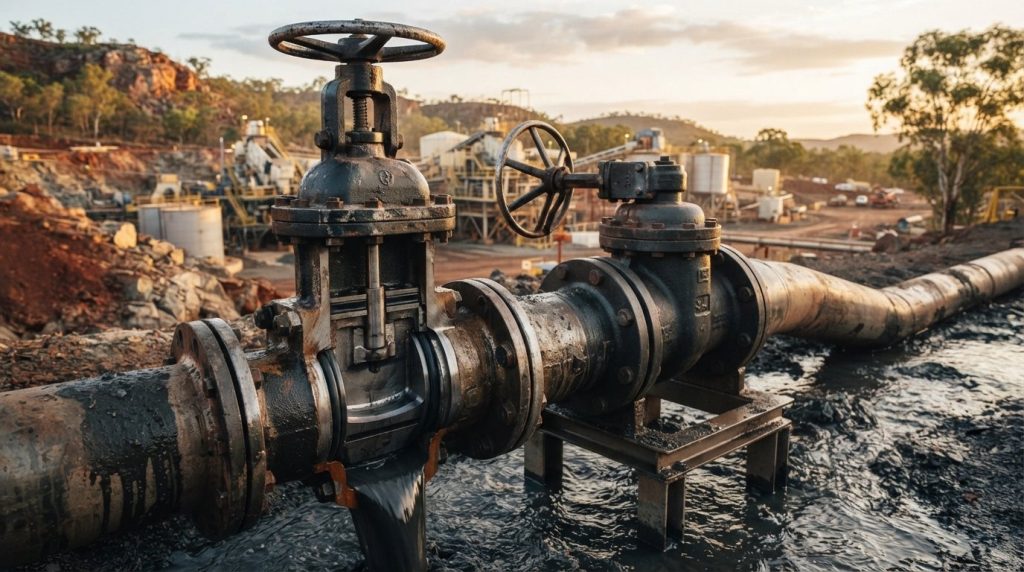
What if the primary cause of your unscheduled downtime isn’t the severity of the slurry, but a fundamental misalignment in your valve material selection for mining? In the demanding environments of Australian mineral processing, the difference between a three-year service life and a three-month failure often rests on the nuanced interaction of metallurgy and chemical compatibility. You’re likely all too familiar with the high maintenance costs and production losses that stem from premature valve failure in abrasive or corrosive circuits. The confusion surrounding alloy compatibility in complex acidic leaching processes only adds to the operational risk.
We recognise that achieving long-term reliability requires more than just selecting the hardest material available. It demands a systematic approach to engineering that prioritises safety, compliance, and operational integrity. This technical guide will help you master the principles of metallurgy and elastomer selection to eliminate premature failures and significantly reduce your Total Cost of Ownership (TCO). By aligning your procurement strategy with rigorous Australian engineering standards, you can secure the stability of your infrastructure.
We will examine the performance of specialised equipment like ValvTechnologies metal-seated valves and SKG Insamcor knife gate valves in severe service applications. From understanding the mechanical nuances of zero-leakage designs to selecting the correct alloys for harsh chemical environments, this overview provides the technical validation required for informed decision-making. Prepare to transition from reactive maintenance to a disciplined, proactive strategy for valve longevity.
Key Takeaways
- Identify the specific impact of abrasive slurries and corrosive fluids on valve longevity to prevent costly unscheduled shutdowns and production losses.
- Compare advanced metallurgy and hard-facing strategies, including Chrome-Moly alloys and Tungsten Carbide overlays, for high-wear severe service applications.
- Master a structured framework for valve material selection for mining that aligns chemical composition mapping with operational pressure and temperature requirements.
- Distinguish between natural rubbers and synthetic elastomers to ensure chemical compatibility in complex leaching and solvent extraction circuits.
- Explore the technical advantages of high-specification equipment, such as ValvTechnologies metal-seated valves, in achieving zero-leakage performance and reduced maintenance overheads.
The Mining Environment: Why Material Selection Dictates Valve Longevity
The resilience of a mineral processing plant depends on the durability of its flow control infrastructure. In these high-stakes environments, valve material selection for mining isn’t merely a procurement decision; it’s a critical engineering exercise. The media encountered in Australian mine sites, ranging from tailings to highly corrosive leaching fluids, presents a unique set of challenges that standard industrial valves aren’t designed to withstand. When selection is incorrect, the financial repercussions extend far beyond the initial purchase price. Production shutdowns for valve replacement incur significant labour costs and lost revenue.
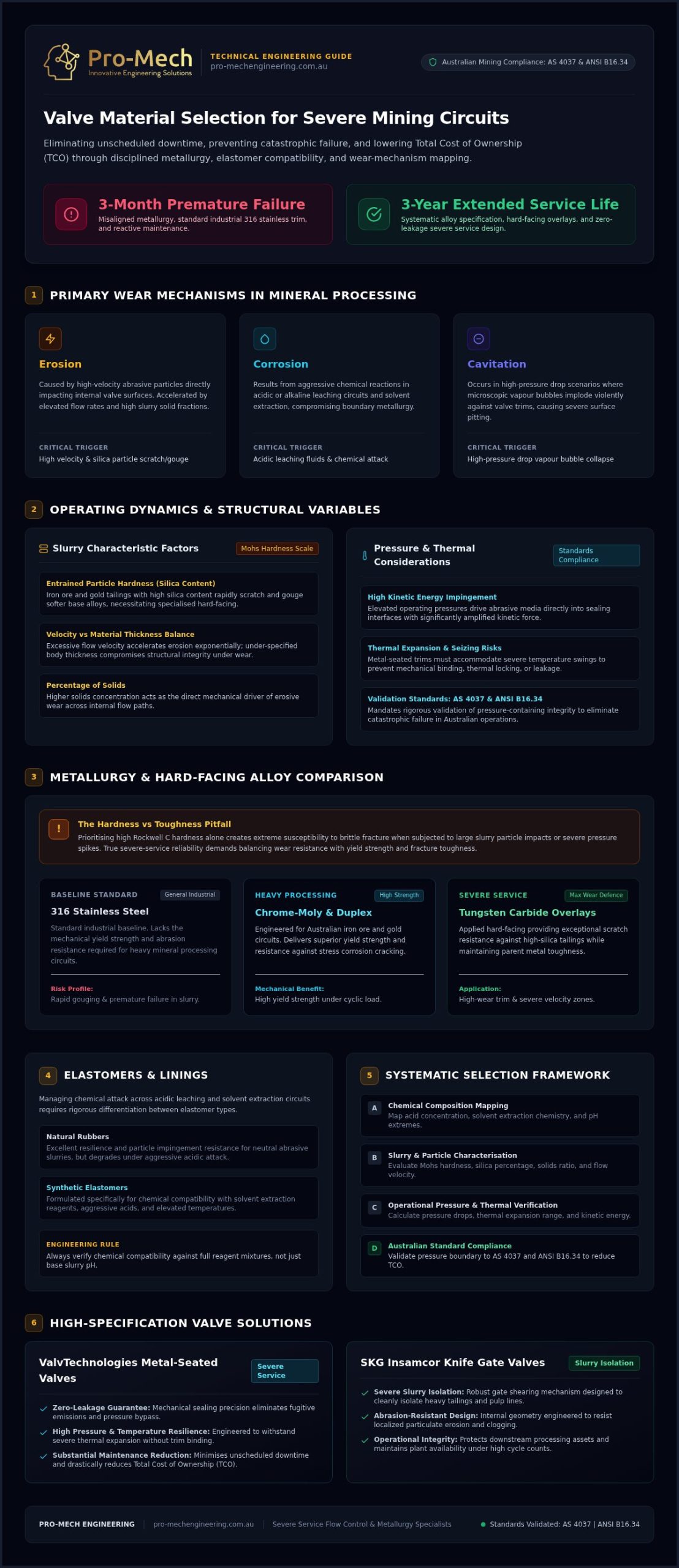
Operational reliability is achieved by identifying and mitigating the primary wear mechanisms present in the circuit:
- Erosion: Caused by high-velocity abrasive particles impacting internal surfaces.
- Corrosion: Resulting from chemical reactions in acidic or alkaline leaching circuits.
- Cavitation: Occurring in high-pressure drop scenarios where vapour bubbles collapse and pit the valve trim.
Adhering to Australian safety requirements for high-pressure circuits ensures that equipment doesn’t just perform, but also maintains site safety standards. A thorough understanding of valve types and material classifications is the first step in building a robust system that resists these destructive forces. Proactive planning during the design phase is the most effective way to secure a lower Total Cost of Ownership (TCO).
Understanding Slurry Characteristics
Slurries are complex and often unpredictable. The hardness of entrained particles, measured on the Mohs scale, dictates the required hardness of valve internals. For instance, iron ore or gold tailings with high silica content require specialised hard-facing to resist scratching and gouging. The percentage of solids and flow velocity act as the primary drivers of erosive wear. Engineers must identify the “sweet spot” where material thickness and flow rate are balanced. If the velocity is too high, even the hardest alloys will fail prematurely; if the material is too thin, the valve body’s structural integrity is compromised during the valve material selection for mining process. A structured approach to slurry valve erosion prevention is essential for extending service life in these high-wear tailings applications.
The Interplay of Pressure and Temperature
High-pressure systems accelerate material degradation by forcing abrasive particles into seal surfaces with greater kinetic energy. Thermal expansion is another critical factor that engineers must account for in their specifications. In metal-seated valve selection, the metallurgy must accommodate temperature fluctuations to prevent seizing or leakage. Compliance with standards such as AS 4037 or ANSI B16.34 is essential for ensuring the pressure-containing integrity of the valve under operational stress. These standards provide a framework for validating that the chosen materials can withstand the rigours of the specific mining application without risking catastrophic failure.
Metallurgy for Abrasive Media: Hard-Facing and Alloy Strategies
While 316 stainless steel serves as a baseline for many industrial applications, it often lacks the mechanical properties required for heavy mineral processing. In Australian iron ore and gold circuits, valve material selection for mining must move towards Chrome-Moly and Duplex alloys. These materials provide the necessary yield strength and resistance to stress corrosion cracking that standard grades cannot offer. Slurries don’t forgive poor metallurgy.
A common engineering pitfall is prioritising hardness at the expense of toughness. While a material with a high Rockwell C rating resists scratching, it may be susceptible to brittle failure under the impact of large particles or sudden pressure spikes. Reliability is found in the balance between surface hardness and the ability of the substrate to absorb energy without fracturing. This is particularly relevant in high-velocity tailings lines where particle impact is constant.
The evolution of metal-to-metal seating has redefined expectations for zero-leakage performance in abrasive service. Unlike soft-seated valves that fail when grit becomes embedded in the elastomer, precision-lapped metal seats wipe the sealing surface clean during every cycle. This mechanical action maintains a gas-tight seal even in the presence of entrained solids, extending the interval between required maintenance interventions.
Severe Service Alloy Selection
Metallurgy in mining valves is the science of balancing sacrificial wear with structural integrity. While Duplex 2205 offers a significant upgrade over 316SS in terms of pitting resistance, Super Duplex 2507 is frequently specified for highly saline or chloride-rich environments. In aggressive acidic leaching or solvent extraction processes, exotic alloys such as Hastelloy or Inconel are necessary to prevent rapid chemical degradation. Selecting the correct alloy requires a precise mapping of the fluid’s pH levels and temperature profile to ensure the valve body remains structurally sound throughout its intended service life.
Hard-Facing and Surface Treatments
Tungsten Carbide remains the gold standard for erosion resistance in severe service. Applying this material via High-Velocity Oxy-Fuel (HVOF) thermal spray creates a dense, non-porous coating that is significantly more durable than traditional weld overlays. While weld overlays like Stellite or Chrome Carbide are effective for large-bore gate valves, thermal spray provides superior bond strength and a smoother finish for ball valve internals. The lifecycle benefits of ValvTechnologies metal-seated designs demonstrate that a specialised coating strategy can reduce maintenance costs by up to 50% in high-cycle mining applications. Understanding the full scope of abrasive wear and slurry valve erosion prevention strategies can further inform your hard-facing selection for concentrate and tailings lines. You can consult with our technical team for a quality audit of your current valve specifications to ensure your metallurgy is optimised for your site’s specific mineralogy.
Elastomers and Linings: Managing Corrosive Leaching and Chemical Attack
While metallurgy provides the structural foundation for flow control, soft materials often serve as the primary barrier against aggressive chemical attack and fine-particle erosion. In hydrometallurgical processes, the selection of an inappropriate polymer can lead to rapid swelling, loss of sealing integrity, and catastrophic valve failure. Understanding the chemical resistance profiles of various elastomers is a fundamental component of valve material selection for mining. Engineers must look beyond simple pressure ratings to account for the complex interactions between process fluids and polymer matrices.
Chemical permeation occurs when fluid molecules migrate through the polymer, eventually attacking the valve body or causing the liner to delaminate. This is particularly prevalent in high-pressure applications where the pressure gradient forces the media into the material. Another critical failure mode is explosive decompression, where gas trapped within the elastomer expands rapidly during a pressure drop, tearing the seal from the inside out. Preventing these failures requires a disciplined approach to material specification that prioritises density and chemical inertness.
Lining Materials for Slurry Handling
Polyurethane and natural rubber are the industry standards for abrasive slurry handling. Natural rubber offers excellent resilience against impingement by larger particles, whereas polyurethane provides superior sliding abrasion resistance for fine-grained tailings. For scenarios involving extreme flow velocities or highly concentrated slurries, ceramic linings offer a level of durability that polymers cannot match. The choice between bonded and replaceable liners often dictates the long-term maintenance strategy. Replaceable liners reduce the need for full valve replacement, though bonded liners typically offer better protection against fluid bypass behind the lining in high-pressure circuits.
Chemical Compatibility in Leaching Circuits
Leaching circuits involve aggressive reagents like sulphuric acid and cyanide. EPDM is often favoured for its resistance to various acids and alkalis, yet it fails in the presence of hydrocarbons. Conversely, Viton (FKM) provides exceptional resistance to high temperatures and chemical attack in solvent extraction (SX-EW) processes. When evaluating valve material selection for mining, engineers must account for the potential for elastomer swelling in the presence of organic solvents. For the most severe chemical environments, PTFE or PFA linings serve as an inert barrier, preventing the underlying metal from coming into contact with the process media. The role of sleeve materials in knife gate valves is particularly critical for tailings management. These sleeves must provide a bubble-tight seal while withstanding the constant movement of the gate. High-quality sleeves, such as those found in SKG Insamcor knife gate valves, are engineered to resist the tearing and abrasion that occur during repeated cycling.
The Engineering Framework: A Systematic Approach to Material Specification
Effective valve material selection for mining requires a disciplined methodology rather than reliance on historical precedent. A structured engineering framework ensures that every variable, from chemical composition to mechanical stress, is accounted for before procurement begins. This systematic approach mitigates the risk of catastrophic failure in high-pressure circuits and ensures operational integrity across the plant. By following a logical progression, engineers can move from reactive replacement to proactive asset management.
The standard engineering workflow for material specification involves five critical stages:
- Step 1: Fluid Analysis: Mapping the chemical composition and solid content of the media.
- Step 2: Operating Parameter Assessment: Evaluating the intersection of pressure, temperature, and flow velocity.
- Step 3: Wear Mechanism Identification: Determining if the primary threat is erosion, corrosion, or a synergistic combination of both.
- Step 4: Mechanical Design Compatibility: Assessing whether a knife gate, ball valve, or control valve design best suits the process conditions.
- Step 5: TCO and Maintenance Planning: Projecting maintenance intervals and total lifecycle costs.
This framework provides a repeatable process for technical validation. It allows procurement teams to justify the selection of high-specification materials based on empirical data rather than upfront cost alone.
Conducting a Thorough Media Analysis
Accurate fluid data is the foundation of technical procurement. Chemical profiles, specifically pH levels and chloride concentrations, dictate the necessity for high-performance alloys. Beyond chemistry, the physical nature of the solids is vital. Assessing particle angularity helps engineers predict impingement angles and choose the correct hard-facing. While rounder particles might allow for the use of resilient elastomers, angular silica requires the extreme hardness of Tungsten Carbide to prevent rapid surface degradation. Without this data, valve material selection for mining becomes a matter of guesswork, often leading to premature failure.
Calculating Total Cost of Ownership (TCO)
Initial procurement costs represent only a fraction of a valve’s true expense over its service life. A lower-cost valve that requires quarterly servicing is far more expensive than a high-specification unit that operates for years without intervention. High-spec solutions reduce unplanned downtime and the substantial labour costs associated with frequent change-outs. Pro-Mech assists sites by conducting comprehensive technical audits to optimise valve lifecycles and ensure that chosen equipment meets specific infrastructure demands. You can partner with Pro-Mech for a detailed engineering assessment to refine your material specifications and lower your site’s TCO.
Implementation: High-Specification Valve Solutions for Australian Mining
Successful valve material selection for mining culminates in the deployment of field-proven equipment that aligns with site-specific engineering data. In Australian mineral processing, this involves the integration of specialised heavy-duty components designed to survive severe service. Implementation isn’t just about hardware; it’s about the alignment of mechanical design, metallurgy, and actuation packages to the unique stresses of remote mining environments. Even the most advanced alloys will underperform if the valve’s mechanical integration isn’t meticulously planned.
Specialised Mining Valve Portfolios
SKG Insamcor knife gate valves have established themselves as an industry standard for bi-directional slurry isolation. Their robust design allows for reliable shut-off in tailings lines where standard valves often fail due to solids build-up or gate deflection. For applications requiring absolute isolation in high-cycle or high-pressure circuits, ValvTechnologies metal-seated solutions provide the necessary operational autonomy. These valves achieve zero-leakage performance by utilising precision-lapped seats that maintain sealing integrity under the harshest abrasive conditions. When these units are paired with custom actuators and actuated packages, they provide a reliable foundation for automated flow control, even in the most isolated processing plants.
Software development plays an increasingly vital role in modern mining infrastructure. Custom software solutions allow for the precise monitoring of valve performance and the automation of complex flow sequences. This digital layer provides a level of oversight that traditional mechanical systems cannot match, allowing for the early detection of wear patterns and the optimisation of maintenance schedules across the entire circuit. It’s a proactive approach that reinforces the stability of the plant’s flow control systems.
Partnering for Operational Integrity
Technical procurement doesn’t end at the delivery of hardware. Pro-Mech provides comprehensive support through the development of detailed Installation & Commissioning Plans and the execution of In-situ Quality Inspections. These services ensure that the engineering principles discussed in earlier sections are correctly applied during site integration. Quality audits and witness testing are conducted to verify compliance with Australian safety and engineering standards, providing the technical validation required for high-stakes infrastructure. This meticulous approach to technical project management reduces the risk of equipment failure and validates the initial valve material selection for mining.
To ensure your flow control infrastructure is optimised for long-term performance and reliability, you can organise a technical consultation with Pro-Mech Engineering. Our team provides the seasoned professional oversight required to navigate the complexities of severe service valve implementation.
Securing Long-Term Operational Integrity
Achieving sustained reliability in mineral processing requires a disciplined transition from generic procurement to precise engineering. Precision dictates longevity. Success rests on the intersection of advanced metallurgy, such as ValvTechnologies metal-seated designs, and the chemical resilience of SKG Insamcor knife gate sleeves. By implementing a systematic framework for valve material selection for mining, your team can effectively balance surface hardness with structural toughness to mitigate the destructive forces of erosion and corrosion.
Pro-Mech Engineering Solutions serves as a meticulous partner in this process, offering national technical support and specialised engineering audit and commissioning services. As a distributor of high-performance brands like ValvTechnologies and SKG Insamcor, we provide the technical validation necessary to meet Australian safety and engineering standards. This rigorous approach ensures your infrastructure remains stable while reducing the Total Cost of Ownership across the plant’s lifecycle. We encourage you to Consult Pro-Mech Engineering for Technical Valve Selection to refine your site’s specifications. Secure the future of your operations with a partner dedicated to technical integrity and operational excellence.
Frequently Asked Questions
What is the best valve material for abrasive iron ore slurry?
High-chrome alloys or Tungsten Carbide overlays are generally the most effective materials for abrasive iron ore slurries. These materials provide the necessary hardness to resist the constant impingement of silica and iron particles. While 316 stainless steel often fails prematurely in these circuits, hard-faced internals maintain their sealing integrity for significantly longer periods. Selecting the correct metallurgy is a critical step in the valve material selection for mining to prevent rapid erosive wear.
How do I choose between stainless steel and duplex for mining valves?
You should specify Duplex or Super Duplex alloys when your process involves high chloride concentrations or saline water. While standard 316 stainless steel provides basic corrosion resistance, it’s susceptible to pitting and stress corrosion cracking in aggressive mining fluids. Duplex 2205 offers nearly double the yield strength of 316SS, providing superior structural integrity. For highly corrosive leaching circuits, Super Duplex 2507 ensures the valve remains functional in environments where standard alloys would fail.
When should I specify a metal-seated valve over a soft-seated one?
Metal-seated valves are necessary for applications involving extreme temperatures, high cycle frequencies, or highly abrasive media. Soft-seated valves rely on elastomers that can tear or become embedded with grit, leading to seal failure. In contrast, precision-lapped metal seats, such as those in ValvTechnologies products, use a mechanical wiping action to clear the sealing surface. This ensures zero-leakage performance and extends the time between required maintenance interventions in severe service circuits across Australian sites.
What are the benefits of Tungsten Carbide hard-facing in mining?
Tungsten Carbide hard-facing provides an exceptional barrier against erosion in high-velocity slurry lines. When applied via High-Velocity Oxy-Fuel (HVOF) thermal spray, it creates a dense coating with a bond strength exceeding 10,000 psi. This treatment significantly increases the surface hardness of valve internals, allowing them to withstand the abrasive forces of mineral processing. It’s an essential strategy for extending the service life of valves in gold and iron ore tailings where standard hardening isn’t sufficient.
How does pH level affect material selection in leaching circuits?
The pH level is a primary driver of chemical degradation in hydrometallurgical leaching circuits. Highly acidic environments, such as those using sulphuric acid, require inert linings like PTFE or PFA to protect the valve body. If the pH is extremely low or the temperature is elevated, specialised alloys like Hastelloy may be necessary. Correct valve material selection for mining must account for these chemical interactions to prevent rapid thinning of the valve walls and potential leaks.
Can I use standard knife gate valves for high-pressure tailings?
Standard knife gate valves are generally unsuitable for high-pressure tailings due to the risk of gate deflection and sleeve failure. High-pressure applications require specialised designs like SKG Insamcor knife gate valves, which feature reinforced sleeves and robust mechanical structures. These valves are engineered to maintain a bubble-tight seal under increased pressure gradients. Using standard-duty valves in high-pressure circuits often leads to premature failure and significant safety risks for site personnel during operation.
What Australian standards apply to valve material selection for mining?
Valve specifications in Australia must comply with several key engineering standards to ensure safety and performance. These include AS 4037 for pressure equipment and AS 2129 for flange dimensions, alongside international standards like ANSI B16.34. Adhering to these requirements ensures that the chosen materials can safely contain the process pressure at operational temperatures. Compliance provides a technical foundation for operational integrity and helps sites meet their rigorous safety and environmental obligations nationwide.
How does Pro-Mech assist with technical valve procurement in Australia?
Pro-Mech Engineering Solutions acts as a technical procurement partner by providing comprehensive engineering audits and national support. We develop detailed Installation & Commissioning Plans and conduct In-situ Quality Inspections to ensure equipment is correctly integrated. Our team assists with the selection of high-performance hardware from ValvTechnologies and SKG Insamcor, ensuring that every valve meets specific site mineralogy and chemical profiles. This disciplined approach reduces the Total Cost of Ownership for heavy industry projects.