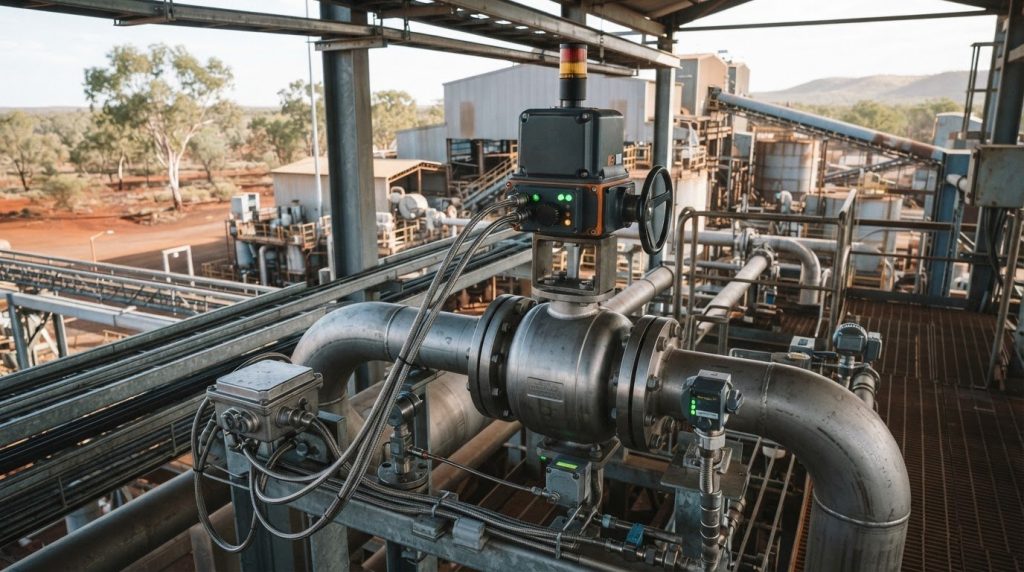
In Australian heavy industry, a valve that fails or needs manual operation in a hazardous area can quickly become a safety and uptime concern. That’s why process automation valve solutions are more than isolated efficiency upgrades. Carefully engineered automation can support safer operation, more consistent control and better condition data for maintenance decisions. Integrating new actuators with legacy control systems remains a practical challenge, and hardware selection alone won’t solve it.
Reliability depends on matching equipment to process conditions and ensuring the wider control arrangement works as intended. In 2026, the priority is to connect valve, actuator and control requirements while accounting for operational risk and applicable Australian standards. Better visibility of valve performance can also help maintenance teams make informed decisions. This article explains how automation affects valve reliability across mining, energy and other heavy industries, what to consider when specifying actuated packages for severe service, and how system integration and operating data can support maintenance planning. It also looks at the role of technical procurement partners, including Pro-Mech Engineering Solutions Pty. Ltd., in aligning valve hardware with software and commissioning requirements.
Key Takeaways
- Assess the valve, actuator and control system as one package, including actuator sizing and the valve-actuator interface.
- Match control capability to process demands, from isolation duties to modulating control.
- Consider onboard diagnostics and connected operating data to support informed maintenance planning in severe service environments.
- Check applicable Australian standards and safety requirements for the equipment, installation and intended operating environment.
- Compare procurement options using lifecycle considerations, not purchase price alone, and involve a technical partner who understands hardware and software integration.
Defining Modern Process Automation Valve Solutions
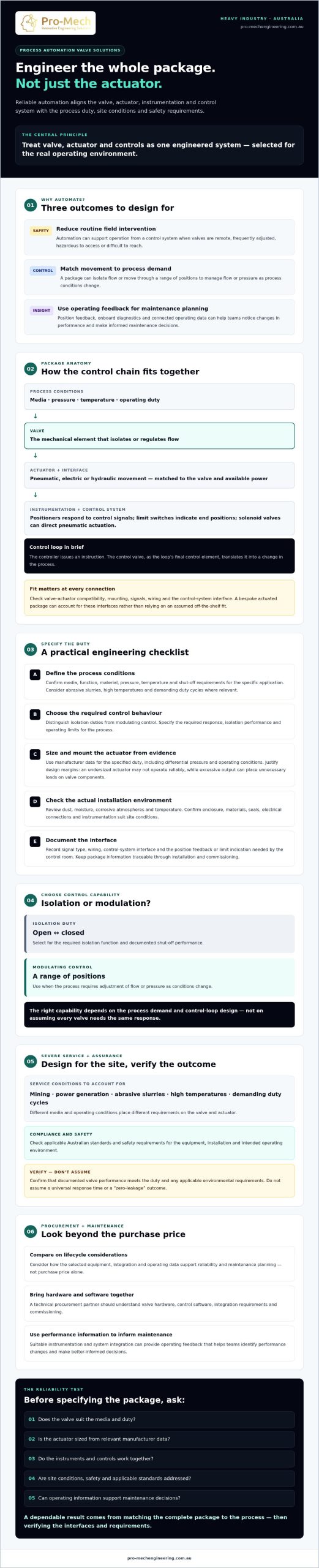
Modern process automation valve solutions combine a mechanical valve with an actuator and control instrumentation to regulate or isolate flow without routine manual operation. The system can respond to a control signal, hold a specified position or adjust flow as process conditions change. A control valve is the final control element in an automation loop, translating a controller’s instruction into a change in the process.
This moves beyond basic open-or-closed operation to modulating control, where the valve can travel through a range of positions to manage flow or pressure. In severe service, such as mining or power generation, the package must suit the process media and operating conditions. Abrasive slurries, high temperatures and demanding duty cycles place different requirements on the valve and actuator. Automation can reduce the need for personnel to operate valves in hazardous or difficult-to-access locations. Position and operating data can also inform maintenance planning.
The Core Components of an Automated Package
Start package selection with the complete duty, not an individual component. The valve body must suit the media and function. Ball and butterfly valves may serve different isolation or control duties, while knife gate valves are used in applications such as mining where process conditions call for that configuration. Confirm material, pressure, temperature and shut-off requirements for the specific application.
The actuator provides movement using pneumatic, electric or hydraulic power. Select it to suit the valve’s operating requirements and the available power and control arrangements. Positioners support accurate response to control signals, limit switches indicate end positions, and solenoid valves can direct pneumatic actuation. Compatibility across the valve, actuator and control system is essential. A bespoke actuated valve packages specification can account for these interfaces instead of relying on an assumed off-the-shelf fit.
When Automation Is Useful, and When Manual Operation Remains Suitable
Manual operation remains appropriate for some duties, but it can be impractical when valves are remote, frequently adjusted or located in hazardous areas. Automation enables operation from a control system, reducing the need for routine field intervention. The value is not simply faster movement. The package must achieve the required response safely and consistently, based on the process and control-loop design.
For high-pressure steam, chemicals or abrasive service, specify the required response, isolation performance and operating limits. Don’t assume a universal response time or a “zero-leakage” outcome. Confirm that the selected valve’s documented performance meets the duty and any applicable environmental requirements. With suitable instrumentation and system integration, operating feedback can also help teams identify changes in performance and make better-informed maintenance decisions.
Pro-Mech Engineering Solutions Pty. Ltd. works across high-specification valves, actuated packages and software development, reflecting the close relationship between mechanical hardware and control systems. This broader view helps frame automation as an engineered package for reliability, safety and process control, not simply an actuator added to a valve.
The Engineering Hierarchy of Actuated Valve Packages
Package engineering turns process requirements into verifiable equipment selections. For process automation valve solutions, the valve’s operating data must inform actuator sizing, mounting and control interfaces. Torque or thrust calculations should use manufacturer data for the specified duty, including differential pressure and operating conditions. Design margins need engineering justification. An undersized actuator may not operate the valve reliably, while excessive output can place unnecessary loads on valve components.
Review environmental compatibility for the actual installation. Dust, moisture, corrosive atmospheres and temperature can affect actuator housings, seals, electrical connections and instrumentation. Confirm enclosure and material suitability against site conditions, and specify position feedback or limit indication to meet control-room requirements. Document the signal type, wiring and control-system interface so package information remains traceable through installation and commissioning.
Integrating Butterfly and Ball Valves
DelVal butterfly valves and ValvTechnologies metal seated valves should be assessed for their intended service, not treated as interchangeable components. For an automated loop, confirm the required operating range, shut-off performance, cycle frequency and relevant material limits. In high-temperature duties, verify that the selected valve and actuator configuration suits the process conditions. Balance cycle speed with component loading to avoid specifying faster operation than the application requires.
Automating Knife Gate Valves for Slurry Service
For mining slurry duties, assess SKG Insamcor knife gate valves against the slurry characteristics and isolation requirements. Solids content, pressure conditions and operating sequence all inform the actuation specification. If bi-directional isolation is required, confirm the valve’s documented directionality and performance rather than assuming this capability from the valve type alone. Actuation timing should follow manufacturer guidance and project requirements, with inspection findings used to inform maintenance decisions.
Interface verification is part of the engineering review. The Australian and international standards reference for ISO 22109:2026 covers valve gearboxes in automated systems. Project teams should confirm its relevance to the specified equipment. Pro-Mech Engineering Solutions Pty. Ltd. supplies high-specification valves and actuated packages, with installation and commissioning plans and software development among its offerings. Review actuated package options when defining equipment and control interfaces.
2026 Trends: Intelligence in Severe Service Environments
In severe service, automation data is valuable only when it helps teams make sound operational decisions. Depending on its capabilities and configuration, a smart positioner may report operating status or diagnostic indicators as well as a position command. For metal-seated valves exposed to demanding temperatures or pressures, this information can help flag changes for investigation. It doesn’t replace inspection or engineering judgement, but it can give maintenance teams a clearer view of equipment behaviour between planned checks.
Connectivity can extend that view beyond individual instruments. With suitable interfaces and data handling, valve information can be brought into plant systems for trend analysis. A digital twin takes this further by using a model to represent expected valve or process behaviour. In a high-pressure steam application, engineers could compare modelled responses with operating data, provided the model is validated and its assumptions are understood. It’s a tool for analysis, not a substitute for safe operating limits or equipment verification.
Predictive Diagnostics and Condition Monitoring
Stiction, or resistance that prevents a valve from responding smoothly, can affect control performance. Changes in friction, travel or response may appear in positioner diagnostics when those functions are available. Teams can review indicators alongside process conditions and inspection findings to decide whether further assessment is warranted. This supports better-informed maintenance planning. It doesn’t justify extending shutdown intervals without a documented risk assessment and appropriate engineering approval.
Fleet-wide software can help organise asset records, operating data and maintenance observations across multiple valves. Bespoke software development can also address how that information is presented and used within a site’s existing workflows. The practical priority is data quality and integration, so alerts remain interpretable and useful rather than adding noise to control-room or maintenance systems.
Materials, Energy and Emissions Considerations
Material selection remains central to automated longevity. HVOF coatings may be considered for some severe-service applications, but suitability depends on the valve design, substrate, process media and operating conditions. Weight is another design factor for offshore packages, where the complete assembly must meet project-specific structural and environmental requirements. Neither a coating nor a lighter package is a universal solution. Both require technical validation against the duty.
Energy efficiency also depends on the actuation method, operating frequency and required performance. Compare pneumatic, electric and hydraulic options against the actual duty to identify where energy use and system demands may be reduced. For emissions management, specify and verify the required leakage performance for the application rather than assuming every automated valve is “zero-leakage”. Clear acceptance criteria, supported by suitable inspection and operating data, connect process automation valve solutions with credible reliability and environmental objectives.
Navigating Australian Standards and Safety Compliance
Compliance for an automated valve package involves more than checking the valve’s product documentation. Project teams need to consider the complete installation, including pressure equipment, piping, electrical connections, control functions and site procedures. Relevant requirements depend on the equipment and application, so confirm them against the project specification and with appropriately qualified personnel.
Several Australian standards address different parts of this work. AS 4041 applies to pressure piping, while AS 1210 covers pressure vessels and AS 4343 is used for pressure equipment hazard classification. For electric actuator installation, AS/NZS 3000 is relevant. A 240 V AC actuator installation requires a licensed electrician and RCD protection, as specified in the applicable requirements. These standards don’t replace project-specific engineering verification. Pressure equipment may also require independent design verification and registration with the relevant SafeWork authority under applicable WHS requirements.
Commissioning documentation should make the basis for acceptance traceable. Depending on the project, this may include equipment records, installation checks, control-system interfaces, test results, outstanding items and approvals. For machinery, WHS requirements also address controlling hydraulic energy, including blocking or bleeding sources as required. During commissioning, site procedures should define work authorisation, isolation and the controls for testing in the actual operating environment.
Safety Integrity Levels in High-Risk Applications
A Safety Integrity Level (SIL) is a measure used in the design and assessment of a safety instrumented function, not a label that makes a valve package safe by itself. For an emergency shutdown function, probability of failure on demand (PFD) is assessed at system level. The calculation considers factors such as component failure data, architecture, proof-test coverage and interval, and common-cause failures. A competent functional safety assessment should confirm the method, assumptions and target for the specific application.
Component selection must support the function’s required performance, but the complete loop matters: sensors, logic solver, actuator, valve and their interfaces. Independent witness testing may be specified by the project or its verification plan. Don’t assume it is universally mandatory. Define acceptance criteria and responsibilities before testing begins.
Inspection, Verification and Audit Records
Consistent inspection protocols help project teams compare results without overlooking local requirements. Checks should verify the installed package against approved drawings and specifications, including orientation, connections, identification and control response. Record any deviation and assess it before acceptance.
Hot commissioning requires particular discipline because equipment is tested under live process conditions. Apply the site’s approved procedures and risk controls, and retain inspection and test records in the project file. Pro-Mech Engineering Solutions offers installation and commissioning plans and in-situ quality inspections. Discuss valve commissioning and inspection requirements when planning a compliant package.
Strategic Procurement: Partnering for Automation Success
For automated valve procurement, the lowest unit price is only one part of the decision. A total cost of ownership (TCO) assessment considers costs and operational implications across the equipment lifecycle, including installation, commissioning, maintenance, integration and potential downtime. The weight assigned to each factor depends on the application. For a valve in a difficult-to-access or high-risk area, maintainability and control-system compatibility may matter as much as the initial purchase price.
A technical procurement partner can help translate process requirements into an equipment specification, then check the fit between the valve, actuator and control interfaces. This is especially useful when new actuators need to work with legacy systems or severe-service conditions rule out a standard configuration. Consider procurement, installation and commissioning plans together so the selected package can be evaluated against site engineering requirements before it enters operation. For a detailed overview of selection criteria, torque safety margins and ISO 5211 mounting standards, the actuated valve packages buying guide for Australian industry provides practical guidance for specifying factory-integrated, pre-tested equipment.
Pro-Mech Engineering Solutions: Hardware and Software Expertise
Pro-Mech Engineering Solutions supplies high-specification valves, including DelVal, OCV, ValvTechnologies and SKG Insamcor options, as well as actuators and actuated packages. Its offering includes ValvTechnologies metal seated valves and SKG Insamcor knife gate valves for mining applications. Selection still needs to be based on the process duty and verified equipment requirements.
Automation also depends on the connection between mechanical equipment and control systems. Pro-Mech’s software development capability complements its valve and actuated package offering, bringing hardware and software considerations into procurement discussions. Installation and commissioning plans and in-situ quality inspections are also among its services. This gives project teams a practical basis for assessing process automation valve solutions beyond a component-only purchase.
Planning the Next Modernisation Steps
Begin by documenting manually operated valves, their function, process conditions, access requirements and maintenance history. Use that information to prioritise further engineering review of assets where manual intervention presents a safety concern, or where maintenance demands and operating consequences warrant closer assessment. Confirm control-system interfaces and applicable project requirements before specifying actuators. A staged approach aligns investment decisions with operational priorities rather than treating every asset alike.
For technical discussions about valve selection, actuated packages and commissioning requirements, discuss your automation requirements with Pro-Mech.
Make Your Next Automation Decision Count
Reliable process automation valve solutions depend on more than selecting an actuator. The valve, control interface, operating conditions and compliance requirements need to work as one engineered package. Diagnostic data can support informed maintenance planning, while a lifecycle view of procurement helps teams weigh installation and operational needs alongside initial cost.
Pro-Mech Engineering Solutions brings together specialised distribution of ValvTechnologies metal seated valves and SKG Insamcor knife gate valves, actuated packages, installation and commissioning plans, in-situ quality inspections and software development. Its nationwide support for projects can help teams consider equipment and implementation requirements together.
For a technical discussion about your plant’s automation requirements, contact Pro-Mech Engineering Solutions. Assessing priority assets and system interfaces is a practical starting point for modernisation. With the right information and package design, your team can plan for safer, more reliable valve operation.
Frequently Asked Questions
What are the primary advantages of electric actuators over pneumatic systems?
Electric actuators can offer precise positioning and straightforward integration with electrical control systems, without requiring an instrument-air supply at the valve. Pneumatic actuators can provide fast operation and may suit sites with established compressed-air infrastructure. The better choice depends on duty cycle, required force, response, available utilities, environment and control-system compatibility. Compare the complete package, including power supply, maintenance needs and hazardous-area requirements, rather than selecting by actuator type alone.
How do I ensure my automated valve package meets Australian safety standards?
Identify the standards and safety obligations that apply to the specific equipment, installation and process. AS 4041 covers pressure piping, AS 1210 pressure vessels, and AS 4343 pressure equipment hazard classification. Electric actuator installation must be assessed against AS/NZS 3000. A 240 V AC actuator installation requires a licensed electrician and RCD protection. Hazardous-area actuators also need appropriate certification. Confirm project requirements with qualified personnel, and retain design, installation and commissioning records.
Can legacy manual valves be retrofitted with modern automation solutions?
Often, but retrofit suitability must be verified for the individual valve and duty. Check the valve’s condition, operating torque or thrust, mounting interface, process limits and required fail position. Then confirm that the actuator, control signals and instrumentation can integrate with the existing control system. Older equipment may need modification or replacement if its condition, performance or interfaces are unsuitable. A documented engineering assessment is a sound first step before specifying process automation valve solutions.
What is the typical lifespan of an automated severe service valve in mining?
There isn’t a reliable single lifespan figure for automated severe service valves in mining. Service life depends on factors such as slurry composition, solids, pressure, operating frequency, valve and sealing materials, actuator sizing and maintenance practices. Abrasive media can accelerate wear, while poor actuation or unsuitable selection can affect performance. Use the manufacturer’s guidance and site operating history to plan inspections, and assess condition against the valve’s actual duty rather than an assumed replacement interval.
How does zero-leakage technology impact the ROI of an automated system?
“Zero leakage” should be treated as a specified performance claim, not an assumption. Confirm the valve’s documented shut-off performance and test criteria for the process conditions. Reduced leakage may help limit product loss, emissions or other process impacts, but the financial return depends on the application, operating costs, maintenance and the consequences of leakage. Compare the whole lifecycle against a suitable alternative, and verify any environmental or safety requirements that apply to the installation.
What role does custom software play in modern process automation?
Custom software can help connect valve and actuator data with a site’s control or asset-management workflows. Depending on the design, it may organise operating information, present status indicators or support maintenance review across a valve fleet. Its value depends on reliable data, compatible interfaces and clear user requirements. Software doesn’t replace suitable instrumentation, safety-system design or engineering judgement. Pro-Mech Engineering Solutions offers software development alongside valves and actuated packages.
How often should automated valve packages undergo in-situ inspections?
Inspection frequency should follow the equipment manufacturer’s guidance, site maintenance strategy, process risk and operating history. There is no single interval appropriate for every automated valve package. Severe service, changing performance indicators or a safety-critical duty may warrant closer review under site procedures. Inspections should record condition, function and any deviations from the approved design. Pro-Mech Engineering Solutions offers in-situ quality inspections, with project requirements and inspection scope established for the application.
What information is required to correctly size an actuator for a slurry valve?
Provide the valve type and size, slurry characteristics, operating pressure and differential pressure, temperature, required cycle frequency and control duty. Include the valve manufacturer’s torque or thrust data, expected seating and unseating requirements, and any required fail position. Actuator selection must also account for available power, mounting interface, control signals and environmental conditions. For abrasive slurry, specify solids and operating sequence details so the package can be assessed against the actual service.