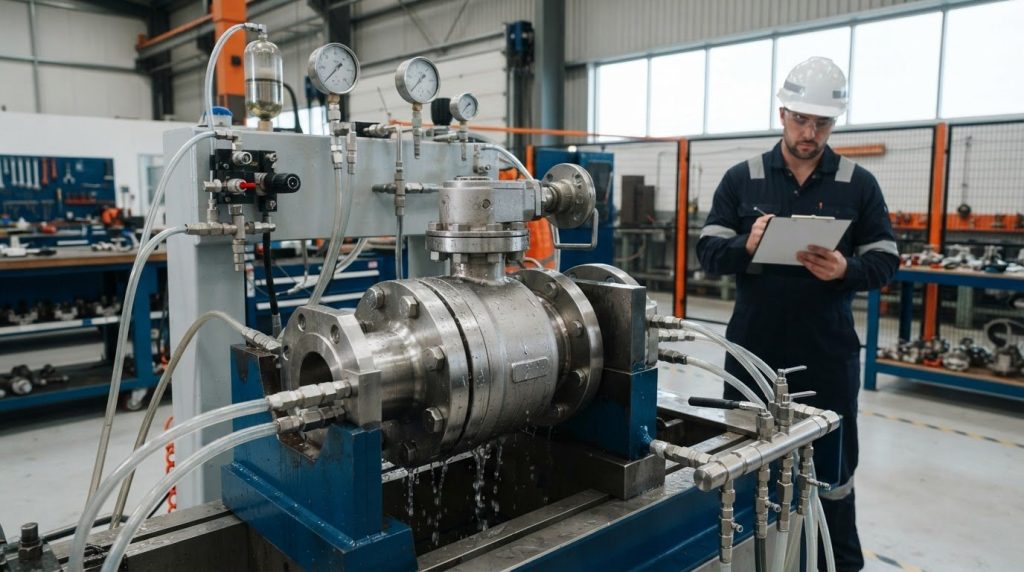
A valve test marked “passed” doesn’t, by itself, prove that the valve meets your project’s acceptance requirements. Industrial valve testing standards can overlap in scope, so the test basis, conditions and acceptance criteria behind the result matter as much as the certificate.
If you’re comparing standards or reviewing procurement records, start by asking which requirements apply and what the test needs to demonstrate. This guide explains the roles of commonly referenced standards, how to select and document the right test basis, and what evidence to check before accepting a valve.
We’ll cover key factory tests, including shell, seat and backseat testing, and the records that help verify the results. We’ll also distinguish factory testing from site commissioning and in-service inspection, which serve different purposes. If the specification, certificate or test evidence leaves a gap, you’ll see when engineering or project clarification is needed before acceptance.
Key Takeaways
- Industrial valve testing standards provide a documented basis for inspection and acceptance, but the purchase specification and service conditions determine which requirements apply.
- Compare API 598, ISO 5208 and API 6D by scope, then confirm the selected standard and edition against the project documents.
- Distinguish what shell, closure and backseat tests demonstrate, and check that each required test has a corresponding record.
- Use a clear review sequence: confirm valve type and service, identify governing documents, then check test stages, witness points and notification requirements.
- Assess results against the specified conditions and acceptance criteria. A successful factory test alone doesn’t establish suitability for every operating scenario.
What industrial valve testing standards establish – and what they do not
Industrial valve testing standards provide a documented basis for inspection, test methods and acceptance requirements. They help manufacturers, purchasers and inspectors assess a valve against defined criteria, but they don’t determine the right test basis for a project on their own. That depends on the valve type, service conditions, purchase specification and other governing documents.
Keep four activities distinct. Design qualification assesses whether a design meets specified requirements. Factory acceptance testing checks an individual valve against its specified tests. Site commissioning verifies installation and operation in the plant context, while in-service inspection assesses equipment after it has entered operation. Evidence from one stage shouldn’t be treated as a substitute for another.
What does a valve pressure test verify?
Pressure-boundary integrity and closure performance are separate objectives. A shell test assesses the pressure-containing parts under specified conditions. A closure test checks leakage through the closed valve against the applicable acceptance level. The selected standard and project documents determine the test method, medium, pressure and duration. Passing demonstrates the result under those defined conditions, not lifetime reliability or suitability for every process fluid, temperature or operating scenario.
How do standards, codes and project specifications relate?
A product standard sets requirements within its scope. Project specifications may select a standard and edition, add supplementary tests or set stricter acceptance criteria. Applicable codes and regulatory obligations may also affect the required basis, depending on the project and installation. Read these documents together: a certificate referring to a standard alone may not show whether all project requirements were met.
Before manufacture or testing, check the purchase order, valve data sheet, inspection and test plan, and any referenced codes or specifications. Confirm which requirements apply and how conflicts are to be resolved. If documents specify different editions, test conditions or acceptance criteria, refer the discrepancy to the responsible engineer before proceeding. Don’t assume which requirement takes precedence.
Not every test is a pressure test. For example, Partial Stroke Testing (PST) checks some emergency shutdown valve function without fully closing the valve. It does not replace specified pressure testing. Confirm the purpose, acceptance criteria and timing of each test in the project documents, including whether it is a factory, commissioning or in-service activity. Witness testing and quality inspections can support review, but the governing requirements remain the acceptance basis.
Which industrial valve testing standards are commonly referenced?
Several industrial valve testing standards appear in procurement and inspection documents, but they don’t have identical scopes. API 598 and ISO 5208 address valve inspection and pressure testing, while API 6D applies to pipeline valves. The project specification determines which standard and edition govern. Citing one standard doesn’t automatically satisfy another.
API 598, ISO 5208 and API 6D: how do their scopes differ?
API 598 sets inspection and testing requirements for valves within its scope. Its 11th edition was published in 2023. ISO 5208 addresses pressure testing of metallic valves. Although the standards cover related testing, don’t assume their requirements or acceptance criteria are interchangeable. API 6D is specific to pipeline valves and may be called up by project documents where that application is relevant.
| Standard | General scope | Typical relevance | Verify for the project |
|---|---|---|---|
| API 598 | Valve inspection and testing | Factory inspection and pressure tests where specified | Applicable valve type, edition, required tests and acceptance criteria |
| ISO 5208 | Pressure testing of metallic valves | Pressure-test basis where selected by the specification | Edition, test requirements and alignment with other project documents |
| API 6D | Pipeline valves | Pipeline valve procurement and testing when invoked | Whether the valve and service fall within the project’s intended scope |
Use the table as an initial scope check, not as a substitute for reviewing the published standard. Confirm the exact edition and any supplementary requirements in the purchase order, data sheet and inspection and test plan. If documents name multiple standards, establish how their requirements are to be applied before testing begins.
Where does ASME B16.34 fit in valve testing?
ASME B16.34 addresses valve design and construction, including materials and pressure-temperature ratings for valves within its scope. It can inform the basis for a valve’s design, but it isn’t a universal test procedure and shouldn’t replace a specified inspection or pressure-testing standard. The ASME B16.34 standard reference outlines its scope. Check the applicable edition and any testing provisions it references against the project requirements.
If a purchase specification pairs a design standard with a separate test standard, record both along with any project-specific additions. If the requirements appear inconsistent, request clarification from the responsible engineer before manufacture or testing. Technical procurement support can help identify questions for resolution. Valve specification support is one option for Australian projects.
Shell, closure and backseat tests: what does each test demonstrate?
Each test addresses a different potential leakage path. To interpret a result, identify what was pressurised, how the valve was configured and which acceptance criteria applied. The governing standard and purchase specification determine the test medium, pressure, duration and permitted leakage. There is no single set of limits that applies to every valve.
What is the difference between shell and seat testing?
Shell testing assesses the pressure boundary, including the body and pressure-containing joints, under specified test conditions. It focuses on leakage through or from the valve pressure-retaining envelope. Closure testing, also described as seat testing, evaluates leakage past the closed obturator and seating surfaces. It addresses whether the valve isolates flow in the specified configuration, not whether the body itself is leak-tight.
Test direction and valve configuration matter. The procedure may specify which side is pressurised, the position of the obturator and how leakage is observed. These details can vary with valve design and the governing requirements. Don’t apply a universal leakage limit. Check the selected standard, valve type and purchase specification. For the governing procedure, refer to the API 598: Valve Inspection and Testing scope and the edition named in the contract.
A backseat test is relevant only when the valve design includes a backseat feature and the specified procedure requires it. It evaluates the seal associated with that feature in the prescribed valve position. It isn’t a substitute for shell or closure testing, and shouldn’t be assumed to apply to every valve.
When are functional, fugitive-emissions or special tests required?
Operational cycling checks movement and function, such as opening and closing. Pressure-boundary and closure tests assess integrity and leakage under defined conditions. Successful cycling alone doesn’t establish pressure-test acceptance. Treat each test as a separate requirement, with its own method and evidence.
Additional testing may be specified for a particular service or design. Examples include fire-safe, cryogenic and fugitive-emissions testing. Their applicability depends on the project requirements and the valve’s intended service. Don’t assume they are covered by a general pressure-test certificate.
- Confirm the required test and applicable valve configuration.
- Check the specified medium, pressure, duration and acceptance criteria.
- Review the test record for results and any required witnessing or approvals.
For metal-seated valves, check whether the specification requires a measured leakage rate rather than a pass/fail statement alone. A clear record links the result to the test performed and the acceptance basis, making it easier to judge whether the evidence supports the project requirement. When reviewing records across multiple valves or suppliers, an industrial valve quality audit can help teams assess documentation gaps in context and distinguish evidence issues from equipment concerns.
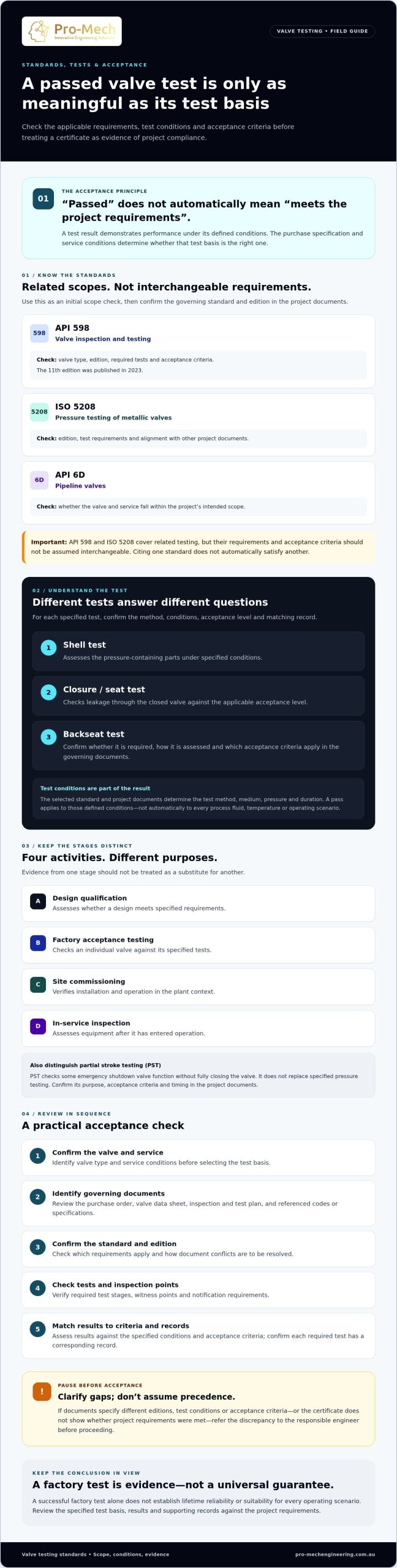
How to select and verify the right valve test requirements
Set the test basis before the valve reaches the test bench. A practical review starts with the application, identifies the governing documents, then checks that the procedure and evidence match. This helps prevent a certificate from being accepted simply because it records a pass without showing whether the specified requirements were followed.
- Confirm the valve type, size, pressure class, materials, end connections and intended service.
- Identify the governing standard and edition, plus any supplementary requirements and acceptance criteria in the purchase documents.
- Check the inspection and test plan for required test stages, sequence, witness and hold points, and notification periods.
- Confirm the test medium, conditions, safety controls and documentation requirements with the responsible parties before testing.
- Review the completed records for traceability and raise discrepancies for formal engineering resolution.
Industrial valve testing standards provide a technical basis, but the project documents define how that basis applies to the supplied valve. If requirements conflict, don’t resolve the issue through an informal pass or acceptance decision. Obtain direction from the responsible engineer before manufacture or testing proceeds.
Which project details should be confirmed before testing?
Check that the valve data sheet and purchase order identify the same valve configuration and service. Then match the stated standard and edition to the inspection and test plan. Confirm any additional tests, acceptance criteria, witness arrangements and notification requirements. Agree on the test medium and safety controls in the approved procedure rather than inferring them from a previous job or generic certificate.
What should a valve test certificate or report record?
A useful report links the result to the actual valve and required test. Check for the valve tag or serial number, approved procedure, standard and edition, test conditions, results, date and authorised sign-off. Instrument identification and calibration status should be recorded where required by the procedure or project quality requirements. For metal-seated valves, check whether the specified evidence includes the measured leakage rate, not only a pass/fail entry.
Compare the records with the purchase requirements and inspection plan. Missing identification, unclear test conditions, absent results or ambiguous acceptance statements are gaps to resolve, not grounds to assume compliance. Keep any clarification and disposition in the quality record so the acceptance basis remains traceable.
For help clarifying valve specifications or test evidence, contact Pro-Mech about valve testing support. Witness testing and quality inspections can support project review, but they don’t replace the governing standard or approved acceptance criteria.
Using test results responsibly: limits, records and engineering support
A successful factory test confirms that a valve met specified acceptance criteria under the recorded test conditions. It doesn’t prove performance across every future operating scenario or establish an unverified service life. Industrial valve testing standards define a controlled verification basis. Actual service performance also depends on how the valve is selected, installed and operated.
Why does a passing test not guarantee service performance?
Factory test conditions may differ from the plant’s operating pressure, temperature, process fluid and cycling demands. Material compatibility, installation and maintenance are separate engineering considerations. A certificate shouldn’t be treated as proof that a valve is universally fit for purpose. Suitability for the intended service must be assessed against the relevant design requirements and operating conditions.
For example, a recorded closure test applies to its documented configuration and conditions. It doesn’t, by itself, confirm how the valve will perform with a different process medium, after repeated operation, or if installation and maintenance requirements aren’t followed. Review test results as one part of the quality and engineering record, not as a replacement for service assessment.
When can technical procurement or witness testing help?
Specification review can identify conflicting standards, unclear editions or acceptance criteria that haven’t been defined before testing. Resolve these points with the responsible project engineer rather than assuming which requirement governs. Witness testing provides an opportunity to observe an agreed procedure and document results. It doesn’t change the acceptance basis or replace the governing standard.
Retain the approved procedures, test reports, non-conformance records and documented acceptance decisions in the project quality dossier. Together, these records help show what was tested, which requirements applied and how deviations were resolved. If a result is incomplete or doesn’t clearly map to the specification, seek clarification before acceptance.
Pro-Mech Engineering Solutions provides engineering support, witness testing support and in-situ quality inspections as project options. These activities can assist with reviewing requirements and evidence, but they don’t replace engineering approval or the applicable test standard. For project-specific support, Discuss valve testing requirements with Pro-Mech.
Set a clear basis for valve acceptance
Reliable acceptance starts with alignment: select industrial valve testing standards that match the valve and project requirements, then check that the test procedure and acceptance criteria are documented. Shell, closure and other test results each demonstrate specific performance under defined conditions. A passing certificate is useful evidence, but it doesn’t establish suitability for every operating scenario or replace engineering review.
Before accepting a valve, confirm the applicable standard and edition, review the test record for traceability, and resolve gaps or conflicting requirements with the responsible engineer. Pro-Mech Engineering Solutions supplies industrial valves and engineering equipment nationally across Australia, and provides technical support for witness testing and quality audits, as well as in-situ quality inspections. These options can support project review without replacing the governing standard or acceptance decision.
For help clarifying specifications and required test evidence, Discuss your valve testing requirements with Pro-Mech. A clear test basis and complete records help your team make acceptance decisions with greater confidence.
Frequently Asked Questions
What are the main industrial valve testing standards?
Commonly referenced industrial valve testing standards include API 598 and ISO 5208 for valve inspection and pressure testing, and API 6D for pipeline valves. ASME B16.34 addresses design and construction, rather than automatically serving as the test procedure. The correct basis depends on valve type, intended service and contract documents. Check the applicable standard’s current edition and scope, then confirm project additions and acceptance criteria.
Is API 598 the same as ISO 5208?
No. API 598 and ISO 5208 both address valve inspection or pressure testing, but their scopes, procedures and acceptance requirements shouldn’t be assumed identical. A project specification may nominate one standard or add requirements. Check the specified edition alongside the valve type and acceptance criteria. If the documents conflict, or equivalence is proposed, obtain formal engineering clarification before substituting one basis for another.
What is the difference between a shell test and a seat test?
A shell test assesses the valve’s pressure boundary under specified conditions. A seat, or closure, test checks for leakage through the closed valve. They assess different leakage paths and have separate acceptance requirements. The governing standard, valve design and purchase specification determine the test medium, pressure, duration and permitted leakage. Don’t apply a general limit to every valve. Verify the criteria for the specific test and configuration.
How often should industrial valves be tested?
There’s no single testing interval suitable for every industrial valve. Frequency depends on the valve’s function, service risk, operating history, maintenance strategy and applicable project or regulatory requirements. Factory acceptance testing is distinct from periodic inspection and in-service testing. Use the asset integrity plan and governing documents to set and record the interval rationale. Assess the specific valve and process conditions rather than relying on a generic schedule.
Can a valve pass a pressure test and still fail in service?
Yes. A pressure test demonstrates performance under defined conditions at the time of testing, but it can’t reproduce every operating scenario or predict all future degradation. Process fluid, temperature, operating cycles, installation, corrosion and maintenance can affect performance. Treat the test result as one part of quality assurance, alongside correct valve selection, material compatibility, installation checks and ongoing asset management. A certificate alone doesn’t establish universal fitness for purpose.
What should an industrial valve test report include?
A useful report identifies the valve and records the procedure, standard and edition, test conditions, results and acceptance decision. Check for traceability to the instruments used, their calibration status, the test date and authorised sign-off. Compare the report with the approved inspection and test plan and project specification. Missing identification, unclear acceptance criteria or undocumented deviations should be referred for formal review, not treated as evidence of compliance.
Does ASME B16.34 specify valve pressure testing?
ASME B16.34 primarily addresses valve design and construction, including materials and pressure-temperature ratings, and may reference testing provisions. It shouldn’t automatically be treated as a replacement for the project’s specified inspection and pressure-testing standard. Confirm the applicable edition, valve scope and any referenced requirements, then check the purchase specification for additional tests or acceptance criteria. If the governing documents are unclear or inconsistent, seek engineering clarification.