
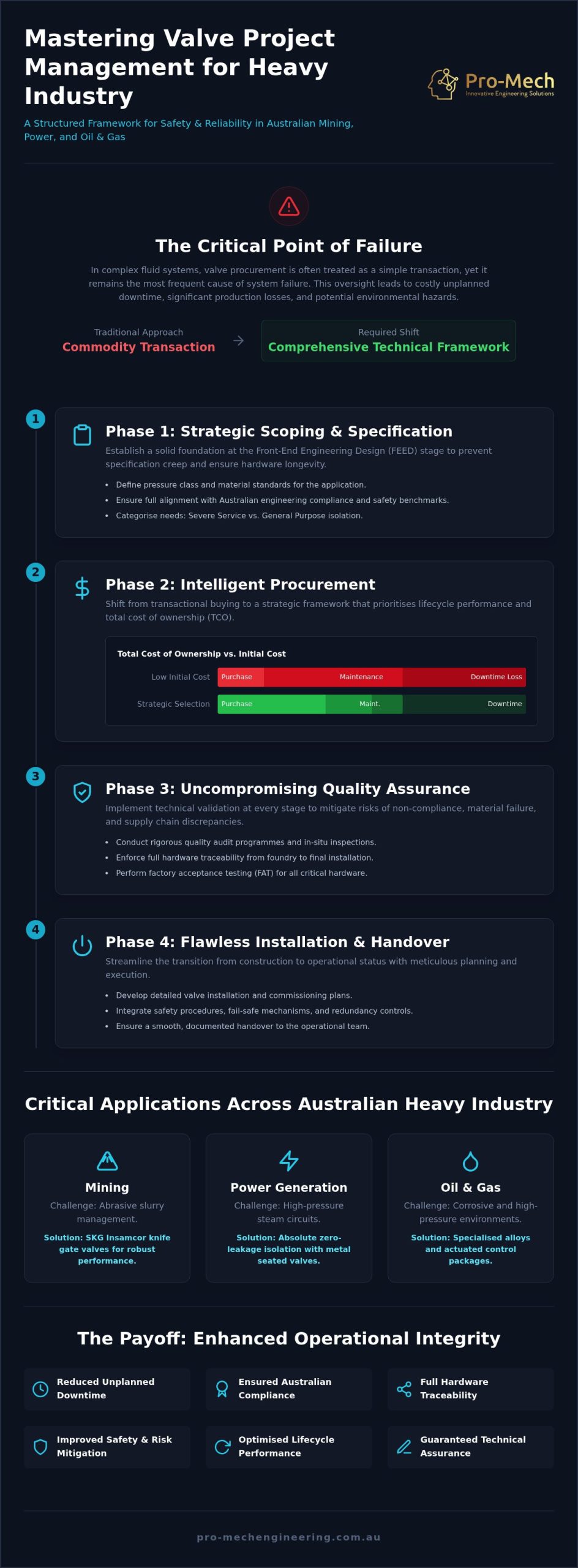
In heavy industry, valve procurement is often treated as a commodity transaction, yet it remains the most frequent point of failure in complex fluid systems. For project managers across Australia, the pressure to maintain strict timelines often clashes with the rigorous demands of technical compliance and material integrity. You likely recognise the frustration of supply chain delays and the risk of non-compliance with Australian engineering standards. Effective valve project management for heavy industry requires a shift from simple hardware acquisition to a comprehensive technical framework that prioritises safety and operational reliability.
This article provides a structured approach to mastering the complexities of industrial valve procurement, quality oversight, and commissioning. By implementing rigorous in-situ quality inspections and precise material selection for severe service, you can significantly reduce unplanned downtime and ensure full hardware traceability. We’ll examine the critical phases of the project lifecycle, from initial specification of metal seated valves to the final execution of commissioning plans, providing the technical assurance needed for high-stakes environments.
Key Takeaways
- Learn how strategic valve project management for heavy industry prioritises lifecycle performance over initial procurement costs to ensure long-term operational integrity.
- Understand the necessity of rigorous quality audit programmes and in-situ inspections to mitigate risks of non-compliance and material failure in severe service environments.
- Discover how to streamline the transition from construction to operational status through the development of detailed valve installation and commissioning plans.
- Identify the technical benefits of selecting high-tier hardware, such as ValvTechnologies metal seated valves or DelVal butterfly valves, for critical isolation tasks.
- Gain a structured framework for managing complex multi-sector requirements across the mining, power, and oil and gas industries throughout Australia.
The Complexity of Valve Project Management for Heavy Industry
Valve project management for heavy industry involves the synchronisation of engineering specifications with global supply chain logistics across the mining, power, and oil and gas sectors. Procurement cycles for high-specification hardware often span several months, necessitating early integration into the master project schedule. It’s vital to ensure that long-lead items arrive on-site before the commencement of mechanical installation to avoid costly delays. Each industry presents distinct operational challenges; for instance, mining applications often require SKG Insamcor knife gate valves for abrasive slurry management, while power generation demands absolute zero-leakage isolation in high-pressure steam circuits. Identifying the critical path in these procurement cycles is a fundamental requirement for maintaining project momentum.
The financial impact of valve failure in severe service environments extends far beyond the cost of replacement parts. A single component failure can trigger an immediate plant shutdown, resulting in significant loss of production revenue and potential environmental hazards. Balancing the acquisition of long-lead hardware with project construction schedules requires a disciplined approach to vendor management and technical oversight. Effective valve project management for heavy industry ensures that the correct materials, such as specialised alloys for corrosive environments, are specified and secured well in advance of the construction phase. It doesn’t just involve buying hardware; it involves the systematic management of technical risk over the entire project lifecycle.
Defining Project Scope and Technical Requirements
Establishing pressure class and material standards at the front-end engineering design (FEED) stage prevents specification creep and ensures hardware longevity. Procurement must align with Australian engineering compliance, ensuring all hardware meets local safety and performance benchmarks. Identifying severe service needs versus general purpose isolation allows for precise hardware selection, such as utilising DelVal valves for standard process lines while reserving metal-seated technology for high-stress applications. This early categorisation simplifies the quality audit programme and ensures that the most critical assets receive the highest level of technical scrutiny.
Risk Mitigation in Industrial Flow Control
Evaluating the risk profile of high-temperature and high-pressure sites is a core component of the management framework. This involves assessing the role of redundancy in valve actuators and actuated packages to maintain control during emergency shutdown scenarios. Integrating safety procedures into the broader project management framework ensures that technical validation occurs at every stage, from factory acceptance testing to final site integration. A robust framework prioritises the identification of potential failure modes within the flow control system, allowing for the implementation of redundant controls and fail-safe mechanisms before the commissioning phase begins.
Strategic Procurement and Hardware Selection Framework
Successful valve project management for heavy industry necessitates a transition from transactional buying to a strategic selection framework. Prioritising initial capital expenditure over lifecycle performance often leads to accelerated degradation in severe service environments. Engineering teams must evaluate the total cost of ownership, accounting for maintenance intervals and the potential for unplanned outages. Incorporating brand-specific engineering, such as DelVal butterfly valves, ensures that the hardware is matched to the specific flow characteristics and pressure profiles of the site. This approach reduces the likelihood of premature component failure and aligns the procurement process with the long-term operational goals of the facility.
Managing supply chain logistics across national Australian projects requires meticulous planning to synchronise delivery with construction milestones. Hardware must be staged to meet site-specific requirements while maintaining full traceability from the foundry to the final installation point. This level of oversight ensures that technical specifications are not compromised by logistics constraints or transport delays. By centralising the procurement of components like OCV control valves and actuated packages, project managers can maintain a consistent quality standard across multiple work packages. For those seeking technical assurance, reviewing a comprehensive hardware selection framework can mitigate long-term operational risks.
Selecting for Severe Service and Isolation
In high-stakes isolation, specifying ValvTechnologies metal seated valves is essential for achieving absolute zero leakage in high-pressure steam or volatile fluid lines. These components are engineered to withstand thermal cycling that would cause standard soft-seated valves to fail. In contrast, mining slurry applications require the robust design of SKG Insamcor knife gate valves, which are built to handle abrasive solids without compromising the seal. Material selection remains the primary defence against corrosion in chemical and water treatment environments, requiring alloys that are chemically compatible with the process medium to prevent systemic integrity loss.
Actuation and Instrumentation Integration
Integrating actuated valve packages into existing infrastructure requires a deep understanding of control logic and power availability. For remote or hazardous locations, the design must account for fail-safe requirements and environmental protection. OCV control valves play a critical role in precision pressure management, allowing for stable process control under varying flow conditions. Standardising instrumentation across the project simplifies future maintenance programmes and reduces the inventory of spare parts required on-site. This systematic approach to actuation ensures that the valve assembly operates reliably within the automated control architecture of the plant.
Rigorous Quality Assurance and Technical Validation
In the context of valve project management for heavy industry, quality assurance is the primary mechanism for preventing operational failure. A rigorous quality audit programme must be established to oversee the manufacturing and procurement of all critical hardware. This systematic approach ensures that every component, from high-pressure actuators to metal-seated isolation valves, meets the exact technical specifications defined during the front-end engineering stage. Central to this process is the collection and verification of Material Test Certificates (MTCs), which provide a definitive record of the metallurgical properties and chemical composition of the hardware. Rigorous valve project management for heavy industry depends on this documentation to provide the end-user with the technical assurance that the installed hardware is fit for purpose.
Managing the technical documentation for project handover is a continuous process that requires the consolidation of factory acceptance tests (FATs), design calculations, and compliance certificates into a comprehensive data pack. This documentation ensures full hardware traceability, allowing operators to verify the origin and performance history of every valve in the system. Without this level of oversight, the operational integrity of the plant remains at risk, as non-compliant materials can lead to catastrophic failures in severe service environments. Maintaining a disciplined record-keeping system is essential for meeting both regulatory requirements and internal safety standards.
In-Situ Quality Inspections and Audits
Conducting physical inspections at the point of manufacture or staging is essential for identifying defects before hardware arrives on-site. In-situ quality inspections allow engineering teams to verify material integrity and workmanship through non-destructive testing (NDT) and visual assessments. By standardising inspection reports, project stakeholders gain a transparent view of the procurement status and any potential technical deviations. This proactive oversight minimises the likelihood of receiving non-compliant hardware that could derail construction schedules. It’s a critical step in ensuring that the final installation aligns with the engineered design.
Valve Witness Testing and Performance Verification
Organising independent witness testing provides an additional layer of risk reduction for critical flow control assets. This process validates that the hardware performs under load and maintains seal integrity according to API 598 or relevant Australian standards. Performance verification often involves pressure testing and functional cycling of actuated packages to ensure they meet the specific operational parameters of the site. Leveraging independent technical validation ensures that the results are objective and that the hardware is ready for the rigours of severe service. This verification process is a fundamental requirement for the safe transition from construction to commissioning.
Installation, Commissioning, and Operational Handover
The final phase of valve project management for heavy industry represents the critical handover from construction teams to operational personnel. This transition requires a disciplined approach to ensure that the technical integrity established during procurement and quality auditing is maintained during site integration. Developing comprehensive valve installation and commissioning plans is a fundamental requirement for minimising the risk of “infant mortality” failures in new hardware. These plans provide a structured roadmap for site teams, ensuring that every actuated package and control valve is installed according to the original engineering design. It’s during this phase that the project’s success is truly validated, as the hardware is subjected to real-world operational stresses for the first time.
Optimising the commissioning phase is essential for reducing plant downtime and ensuring a seamless start-up. This process involves the systematic verification of every component’s functional readiness, from simple manual isolation valves to complex automated control loops. By synchronising the commissioning schedule with the broader project timeline, engineering managers can identify and rectify potential integration issues before they impact the critical path. Effective valve project management for heavy industry ensures that the transition to operational status is documented, verifiable, and safe, providing the end-user with a reliable asset that is ready for long-term service.
The Commissioning Workflow
A rigorous commissioning workflow begins with detailed pre-installation checks and site readiness assessments. This involves verifying that piping is correctly aligned and that internal surfaces are free from construction debris that could compromise the seals of ValvTechnologies metal seated valves or SKG Insamcor knife gate valves. Systematic flushing and pressure testing procedures follow, ensuring the entire fluid system maintains integrity under load. The final stage involves the calibration of actuators and OCV control valves, verifying that the instrumentation accurately reflects the physical state of the process. To ensure your facility maintains these standards, you can access specialised installation and commissioning plans designed for heavy industry.
Software-Driven Management and Traceability
Modern industrial projects increasingly rely on software-driven management to maintain long-term asset traceability. Implementing custom industrial application software allows for the digitisation of maintenance schedules and the centralisation of valve performance data. This ensures that the technical documentation and Material Test Certificates (MTCs) collected during the quality assurance phase are easily accessible for future engineering audits. By tracking every valve through its entire lifecycle, operators can identify patterns of wear and optimise spare parts inventory. Maintaining this data integrity is essential for the ongoing safety and reliability of high-stakes industrial environments, providing a digital twin of the physical infrastructure.
Optimising Heavy Industry Projects with Pro-Mech Engineering
Pro-Mech Engineering Solutions acts as a specialised technical procurement partner, bridging the gap between global manufacturing standards and the specific operational requirements of Australian sites. Entrusting valve project management for heavy industry to a firm with deep mechanical engineering expertise ensures that technical integrity remains the priority throughout the procurement cycle. This partnership model integrates the supply of high-tier hardware with rigorous professional services, such as in-situ quality inspections and witness testing. By maintaining a focus on technical validation, Pro-Mech mitigates the risks associated with multi-sector projects in the mining, power, and oil and gas industries. This disciplined approach ensures that every component, from an SKG Insamcor knife gate valve to a complex actuated package, is fit for its intended service.
The company’s commitment to safety and precision is reflected in its systematic execution of project workflows. Leveraging national Australian expertise allows for the seamless management of logistics and technical support across all states, providing a steady hand in complex industrial environments. This local presence is vital for maintaining the traceability of assets and ensuring that all hardware complies with current Australian engineering standards. By positioning engineering audits as a core risk-mitigation strategy, Pro-Mech provides the technical assurance required for long-term operational success in high-stakes facilities. It’s about providing a steady, knowledgeable hand in both equipment supply and project oversight.
A National Approach to Engineering Excellence
Supporting heavy industry across Australia requires a deep understanding of the diverse environmental and process challenges found on different sites. Pro-Mech provides access to global hardware brands like ValvTechnologies and DelVal through a local technical hand that understands the nuances of Australian infrastructure. Experience across mining and power generation demonstrates the effectiveness of this model, particularly in the management of abrasive slurry and high-pressure steam. These projects highlight the benefit of integrating specialised software development for asset tracking with traditional mechanical engineering oversight to ensure data integrity for future audits.
Next Steps for Strategic Valve Management
Engaging with a technical specialist early in the project lifecycle allows for maximum impact on both specification accuracy and supply chain efficiency. Customising the management framework to specific site needs ensures that the procurement strategy aligns with the long-term maintenance goals of the facility. This early involvement prevents the costly specification errors that often lead to unplanned downtime and compromised safety. To secure technical assurance for your facility, you should consult with Pro-Mech on your next industrial project to discuss the implementation of a tailored technical framework.
Securing Operational Integrity Through Technical Oversight
Mastering complex fluid systems requires a shift from simple procurement to a structured framework that prioritises engineering compliance at every stage. Successful valve project management for heavy industry integrates front-end technical specification with rigorous quality audits and systematic commissioning plans. This disciplined approach ensures that critical assets perform reliably under the extreme pressures and temperatures typical of severe service environments. By maintaining full hardware traceability and adhering to Australian engineering standards, project managers can significantly reduce the risk of unplanned downtime and premature component failure.
Pro-Mech Engineering Solutions provides national Australian coverage, acting as an authorised distributor for ValvTechnologies and SKG Insamcor. Our specialised engineering services, including in-situ quality inspections and technical audits, offer the precise oversight required for the mining, power, and oil and gas sectors. Partner with Pro-Mech for technical valve project management to bring authoritative expertise and meticulous planning to your next industrial project. Implementing these rigorous standards today ensures the continued safety and efficiency of your operations for the long term.
Frequently Asked Questions
What are the key stages of valve project management for heavy industry?
The key stages include front-end engineering design, technical specification, and strategic procurement followed by rigorous quality assurance. Valve project management for heavy industry also encompasses in-situ inspections, witness testing, and the development of detailed installation and commissioning plans. Each phase is designed to ensure hardware traceability and operational integrity from the foundry to final site integration. This systematic progression prevents specification errors and manages technical risk across the entire project lifecycle.
How does zero-leakage technology impact project lifecycle costs?
Zero-leakage technology, such as ValvTechnologies metal seated valves, significantly reduces lifecycle costs by eliminating fugitive emissions and process media loss. While the initial procurement cost is higher than soft-seated alternatives, the reduction in unplanned maintenance and seat replacements provides a superior return on investment. These valves maintain integrity during thermal cycling and high-pressure service, preventing the costly plant shutdowns associated with isolation failure in critical process lines.
What is the role of witness testing in industrial valve procurement?
Witness testing serves as a final technical validation before hardware is dispatched to the site. It involves an independent engineer observing pressure tests and functional cycling to ensure compliance with API standards or Australian engineering benchmarks. This process reduces the risk of receiving non-compliant hardware that could fail during commissioning. By identifying manufacturing defects early, project managers avoid the significant costs and schedule delays associated with on-site valve remediation.
Can custom software improve valve asset management in large plants?
Custom industrial software development enhances asset management by centralising technical documentation and Material Test Certificates. This digitisation allows for the automated tracking of maintenance intervals and valve performance data across large-scale facilities. It ensures data integrity for future engineering audits and simplifies the identification of underperforming components. By creating a digital record of every asset, operators can optimise their spare parts inventory and improve the overall reliability of the plant.
What are the benefits of bi-directional knife gate valves in mining?
Bi-directional SKG Insamcor knife gate valves provide the ability to isolate abrasive slurry flows from either direction, offering greater flexibility in piping design. This capability is essential in mining applications where back-pressure or reverse flow conditions are common. These valves feature robust sealing mechanisms that prevent solids build-up, ensuring reliable operation in severe service. Their design reduces the frequency of valve change-outs, directly contributing to increased production uptime in slurry management systems.
How do you ensure compliance with Australian engineering standards?
Ensuring compliance requires a disciplined approach to quality auditing and the verification of technical documentation. Every component must be checked against relevant Australian standards to confirm its suitability for high-stakes environments. This involves reviewing Material Test Certificates for metallurgical accuracy and conducting in-situ inspections at the point of manufacture. Effective valve project management for heavy industry prioritises these audits to mitigate the risk of installing hardware that fails to meet local safety benchmarks.
What is included in a professional valve commissioning plan?
A professional commissioning plan includes pre-installation site readiness assessments, systematic flushing to remove debris, and pressure testing to verify seal integrity. It also covers the final calibration of actuators and control instrumentation to ensure alignment with the plant’s automated control logic. This document acts as a technical roadmap, guiding site teams through the transition from construction to operational status while maintaining the safety and integrity of the fluid system.
How can actuated valve packages be integrated into existing systems?
Integrating actuated valve packages requires a detailed assessment of the existing control architecture and power availability. Engineers must ensure that the new actuators and OCV control valves are compatible with the plant’s communication protocols and fail-safe requirements. This process involves the design of custom mounting hardware and the standardisation of instrumentation to simplify future maintenance. Correct integration ensures that the automated system operates reliably without necessitating extensive modifications to the existing infrastructure.